
Blue Eyes, Blond Hair, Pale Skin and Milk: Which Came First?
Ancient DNA shows that the familiar northern-European combination was assembled in stages, not inherited as a single prehistoric package.

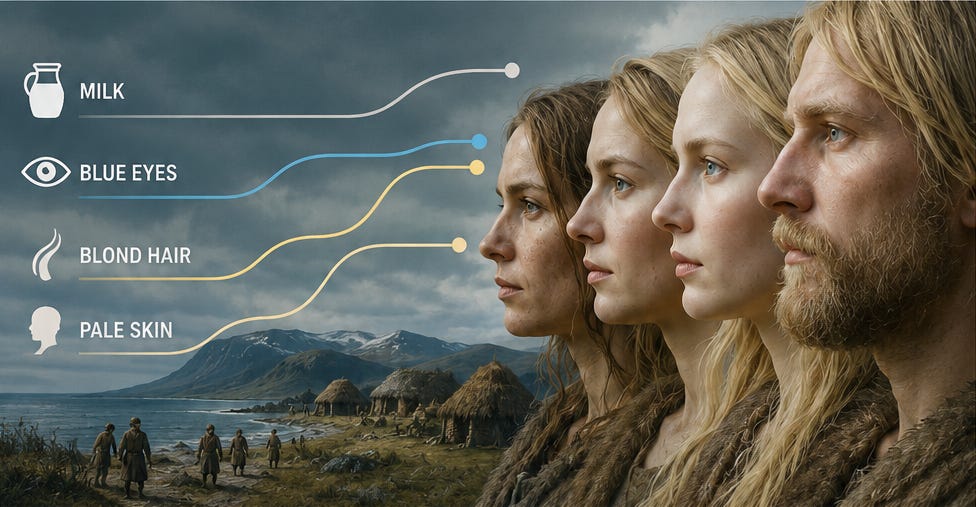
Picture the stereotypical northern European: pale skin, blue eyes, blond hair and no difficulty drinking fresh milk as an adult.
Because these traits are now common in many of the same populations, it is tempting to compress them into one evolutionary story. A dairy-adapted, light-pigmented people expanded across the north, carrying the whole package with them.
Ancient DNA breaks that package apart.
The ingredients of the modern combination were scattered among different prehistoric populations. They entered northern Europe by different routes, rose at different times and responded to different pressures. Some later moved together. Others did not.
The central result
In a matched sample of 916 ancient northern Europeans, lactase persistence and a lighter-skin polygenic score both rise most clearly between the Bronze- and Iron-Age cutpoints. After the Iron-Age cutpoint, lactase persistence keeps rising while the skin score flattens. The apparent late rebound in blue-eye and blond-hair measures is much less geographically robust and is partly driven by shared pigmentation loci.
The modern package was assembled. It was not born whole.
But how was that package assembled?
The answer requires following the four traits through the same ancient individuals. The trajectories reveal two partly separate histories: one linking lighter skin with lactase persistence, and another linking blue eyes with blond hair. Farmers, hunter-gatherers and steppe-descended populations contributed different pieces, while migration and selection repeatedly changed how those pieces were combined.
The rest of the analysis shows when each trait moved, which changes genuinely coincided, and why traits that appear inseparable in modern northern Europeans were separated for much of prehistory.