
Did Hard Times Build Civilization?

It is easy to assume that milder climates should favor human development. Longer growing seasons, easier winters, and more predictable food supplies reduce the basic cost of survival. Under that view, climatic deterioration should make complex societies harder to sustain, not easier.
But there is another intuition, familiar from the internet’s favorite civilizational cycle: hard times create stronger, more organized people; good times eventually soften them. The meme is crude, but the underlying question is not stupid. Do pressure and adversity sometimes force societies to become more complex?
Ancient history does not always look like a record of progress under comfort. Major transitions in subsistence, technology, settlement, and social organization often occurred under stress: changing seasons, unstable ecologies, shifting food systems, and population movements that forced human groups to adapt. The question, then, is not whether cold weather was pleasant. It is whether long-term climate change, measured over timescales meaningful for human populations, is associated with changes in archaeological stage.
To test this, I linked ancient DNA samples to reconstructed temperature histories and asked a simple question: when a location became warmer or colder than it had been 1,000 years earlier, did the samples from that location tend to belong to a later archaeological stage?
This is not a study of modern global warming. The data come from deep history, long before industrial emissions, fossil-fuel economies, or modern climate politics. The temperature changes examined here are natural, slow-moving fluctuations across thousands of years of human prehistory.
The point is not to draw a political lesson about the present, but to ask a historical question: did long-run ecological change leave a detectable trace in the way ancient societies were organized?
The answer, in the current data, appears to be yes.
What Exactly Are We Measuring?
I am not measuring IQ, wealth, literacy, or state capacity here. The outcome is much simpler: the archaeological stage assigned to each ancient genome, such as Mesolithic, Neolithic, Bronze Age, Iron Age, and related period categories.
That is obviously cruder than a full database of institutions or technologies. But it has one major advantage: it stays close to the metadata attached to the actual ancient DNA samples, rather than importing a separate historical classification system.
The climate variable is also straightforward. For each sample, I measured how much the local temperature had changed over the previous millennium:
delta1000 = current temperature − temperature 1,000 years earlier
A positive value means the location had warmed over the previous thousand years. A negative value means it had cooled.
The models then ask whether this temperature change predicts archaeological stage after accounting for the obvious confounders: current temperature, time, sample coverage, ancestry principal components, and educational-attainment (EA) polygenic scores.
The EA PGS control is especially useful because it addresses a possible objection directly. If climate change predicts archaeological stage, is that really a climate signal, or is it just picking up genetic differences correlated with educational attainment? Adding EA PGS lets us test whether the climate-stage association survives after that source of variation is included.
The Main Result: Linear Temperature Change
To get the cleanest possible result, I didn’t just rely on default database labels. I used a manually verified subset of the data, meaning rows where the archaeological period assignment was rigorously cross-checked and verified against the original published supplementary materials to filter out noise.
It’s also vital to clarify the mechanics of the model: this does not estimate a separate, isolated cooling slope. Rather, it evaluates continuous temperature change across the board.
To make the direction intuitive and readable, Table 1 reports the coefficient as the implied effect of 1°C of cooling. Because the underlying model was fit as current - lag1000, the reported cooling effect is simply the sign-flipped coefficient of that linear model.
Table 1. Linear Temperature Change, Displayed as the Implied Cooling Effect
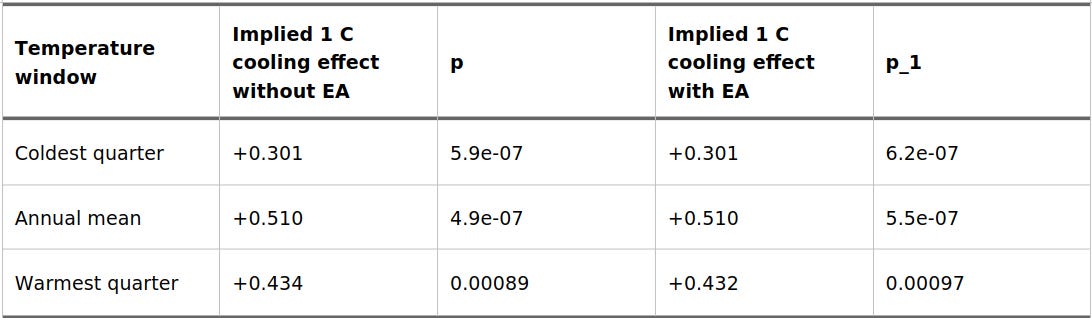
In this linear temperature-change model, the negative-delta direction implies that cooling over the previous 1,000 years predicts a higher ordered civilization stage.
Is this effect driven by genetics? How large is this shift in reality? And does this mean cold weather mechanically caused civilization?