
Did Confucian Institutions Select for Educational Attainment?

Over centuries, Confucian societies built unusually durable educational institutions. They took textual mastery, examination success, bureaucratic competence, and family status, and bound them tightly together.
In China, this culminated in the famous imperial examination system. In Korea, Japan, and Vietnam, related institutions spread through the wider Sinosphere in different forms and at different times (Weber, 1951; Ho, 1962; Woodside, 1971; Elman, 2000, 2013).
The broad historical claim is that a cultural system fundamentally changed the reward structure around human behavior. If educational success becomes a multi-generational route to office, status, income, and marriage prospects, could that institution create a weak but persistent evolutionary selection environment (Ho, 1962; Elman, 2000, 2013)?
The standard Confucian hypothesis is cultural/blank slatist: East Asian educational intensity persists because families and institutions transmit norms of study, discipline, examination ambition, and respect for learning across generations. A lineage that produces successful examinees teaches the next generation how to become successful examinees. Books, tutors, parental pressure, status competition, and family honor do the work. This is a vertical-transmission model, not a genetic one.
The evolutionary version asks whether that cultural system also changed selection pressures. If educational success improved officeholding, income, marriage prospects, and lineage prestige for many generations, then the institution may have rewarded not only learned behavior but also heritable traits correlated with educational success.
This idea has a deep intellectual background. Weber’s classic discussion of Confucian status culture placed the literati near the center of Chinese social organization (Weber, 1951). Ho treated the examination system as a ladder of elite competition and social mobility (Ho, 1962). Elman described the late imperial examination system as a mechanism of cultural and political reproduction (Elman, 2000, 2013), while Woodside emphasized how the Chinese bureaucratic model shaped Vietnam’s state tradition (Woodside, 1971).
But today, modern genetics allows us to test this historical theory in a completely new way. Educational-attainment GWAS now make it possible to construct polygenic scores, and ancient DNA allows those scores to be measured across historical time (Lee et al., 2018; Okbay et al., 2022).
For the first time, we can move beyond sociological debate and actually look for the genetic footprints of the Confucian hypothesis.
Here is a first look at the data. The figure below plots the relationship between ancient genomes and the "event time" of local Confucian establishment.
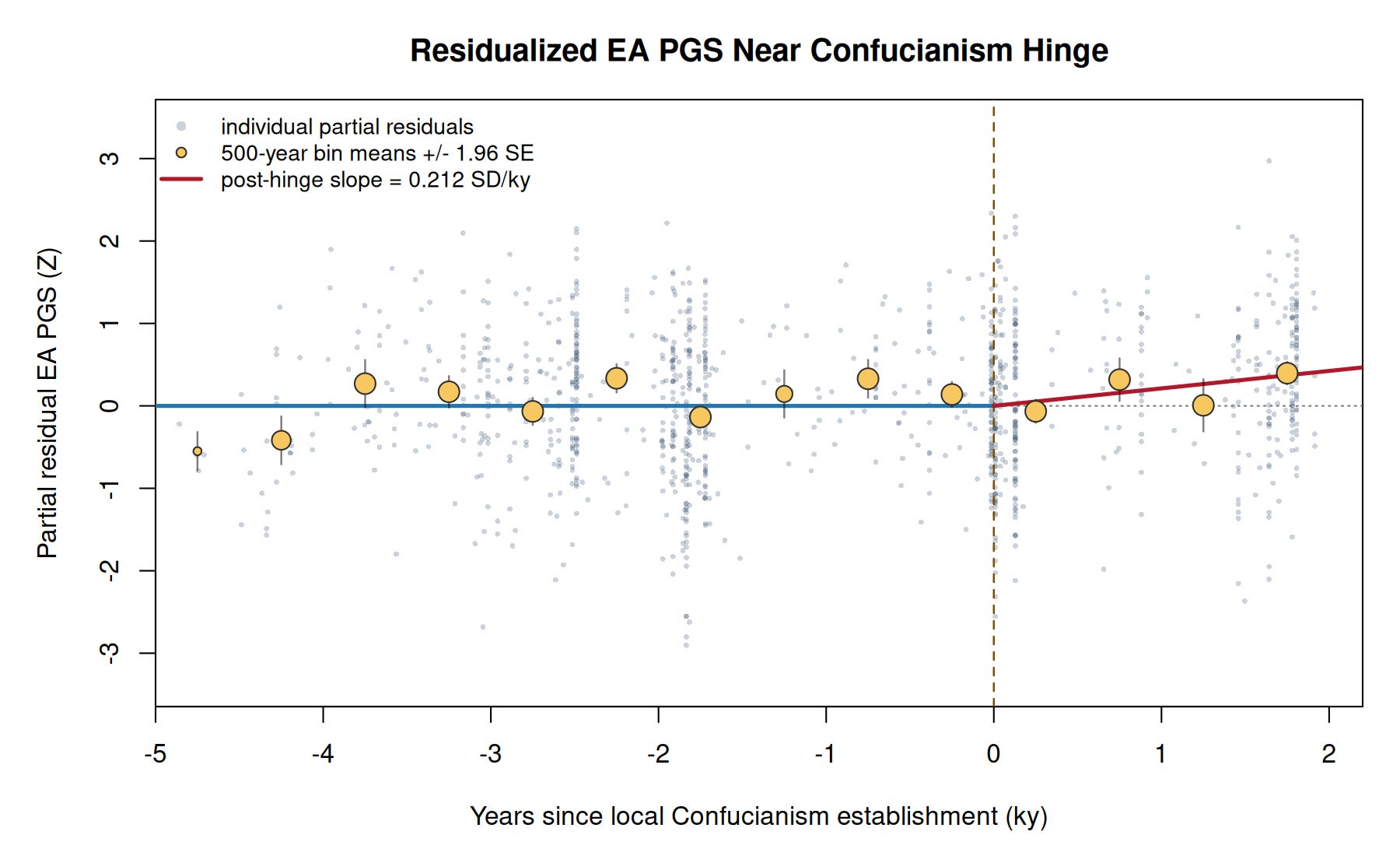
There is a clear, visible shift in the trajectory. But what exactly are the axes measuring here? Does this post-hinge slope survive when we strip away the noise and rigorously control for deep genetic ancestry?