

The hypothesis that COVID-19 vaccines impact fertility started as an early social-media claim. However, post-2021 fertility declines in many countries make it possible to ask an empirical question: Did countries with higher vaccine uptake later fall further below their own pre-pandemic fertility trajectories?
This is not a claim that can be settled by simply eyeballing birth-rate charts. Fertility was already falling in many countries before COVID-19. If we compare raw fertility in 2024 across nations, we mostly just rediscover that older, richer, highly vaccinated countries already had lower fertility before the vaccine campaigns ever began. That is not a useful causal comparison.
But the question is still worth testing carefully because the hypothesis has a real, documented public history.
Where the Hypothesis Came From
The vaccine-fertility concern did not originate as an academic demographic hypothesis. It was an early social-media claim. One influential version appeared in December 2020 and argued that antibodies generated against the SARS-CoV-2 spike protein might also attack syncytin-1, a protein involved in placental development. Fact-checkers and immunologists pushed back quickly, noting that the proposed mechanism was biologically implausible, but the claim spread anyway.
FactCheck.org described the rumor as starting with an article headlined “Head of Pfizer Research: Covid Vaccine is Female Sterilization.” PolitiFact covered a related December 2020 claim that a former Pfizer employee had said the vaccine would make women infertile. AFP documented online claims that COVID vaccines would cause infertility and even global population decline. Later versions involved male sterility, menstrual changes, miscarriage fears, and vaccine “shedding.” By 2021 and 2022, medical journals and mainstream outlets were discussing vaccine-infertility misinformation as a real driver of hesitancy among people of reproductive age.
Most of those mechanisms were weak, false, or speculative. But a weak mechanism does not by itself answer the empirical question. If countries with higher vaccine uptake later fell below their expected fertility trajectories, that would still be worth noticing. The right standard here is not “prove causality from country-level data.” Instead, we can ask: “do the ecological data show any pattern consistent with the claim, after using reasonable controls and avoiding obviously bad comparisons?”
There is also now a directly relevant published paper, although it is not the same design as the country-level analysis here. Manniche, Fürst, Schmeling, Gilthorpe, and Riis Hansen (2025) examined Czech Republic data on successful conceptions by COVID-19 vaccination status among women aged 18-39. Because that paper studies individual vaccination status within one country rather than cross-country ecological variation, it is much closer to the ideal exposure definition than the global country-level proxies used here. I do not treat it as settled evidence, but it belongs in the motivation: the fertility question is no longer only a social-media rumor; there are now published analyses directly asking whether conceptions differed by vaccination status.
The Raw Comparison (And Why It Fails)
If you take a deliberately crude approach, you can plot the share of the total population fully vaccinated by the end of 2021 against each country's total fertility rate (TFR) in 2024.
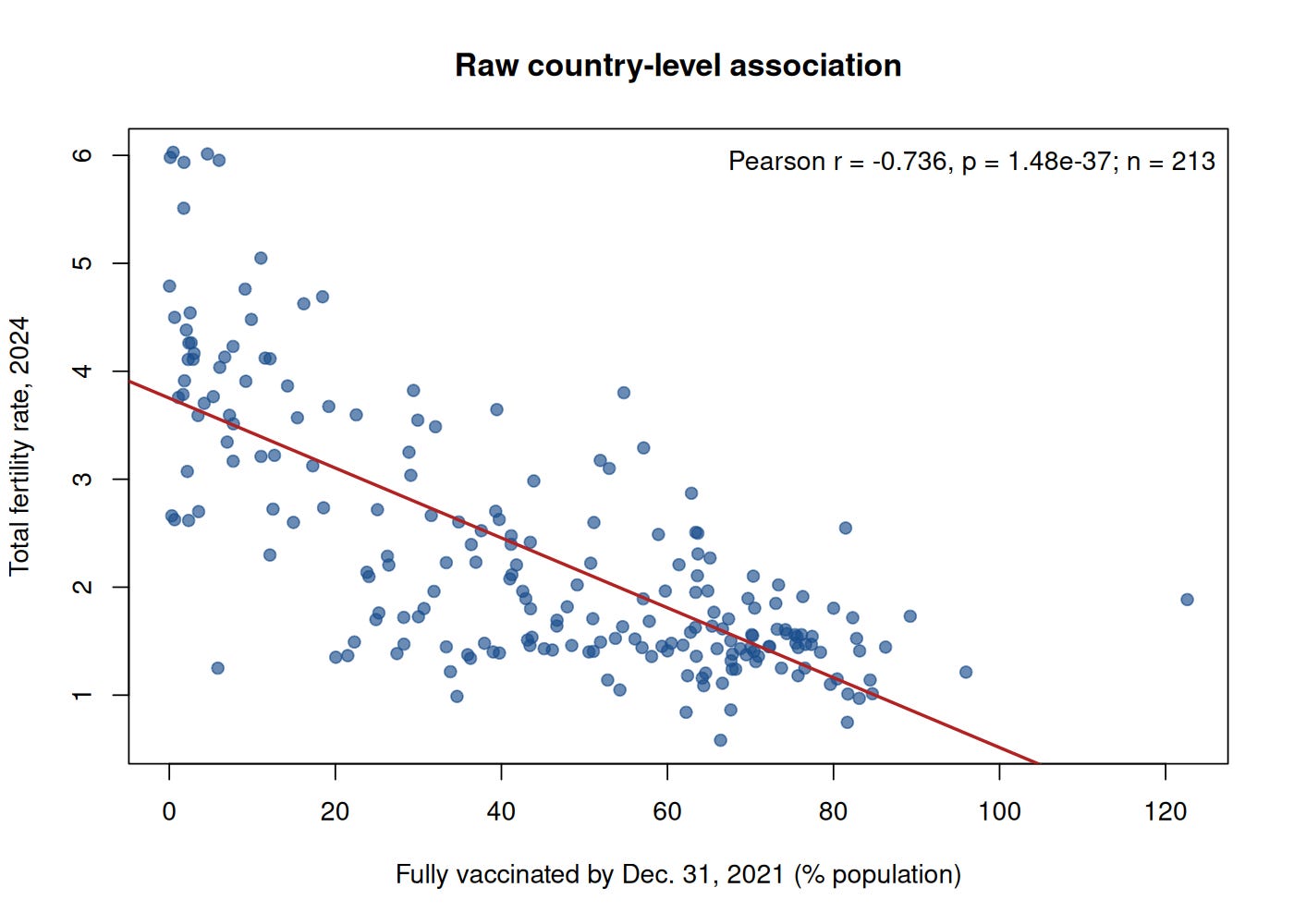
The raw association is very strong and negative: Countries with higher vaccination coverage in 2021 tend to have lower TFR in 2024.
But this is completely unsurprising, and it is not evidence of a vaccine effect. High-vaccination countries were disproportionately rich, older, urban, administratively capable, and already experiencing low fertility. Switzerland and Japan did not become low-fertility societies because of a 2021 vaccination campaign. A raw TFR comparison confounds vaccine uptake with the entire global demographic transition.
Designing a Better Test: The Residualized Model
To fix this, we need a model that doesn’t ask whether vaccinated countries have low fertility, but whether vaccinated countries fell further below their own pre-existing trends.
For each country, I fit a pre-pandemic fertility trend using data from 2015–2019:
log(TFR) ~ year
Then, I predicted what each country’s TFR should have been in 2024 if that pre-pandemic trend had simply continued. The primary dependent variable is the residual:
observed log(TFR_2024) - predicted log(TFR_2024)
In plain English: How far fertility in 2024 was above or below the country’s own expected trajectory. Negative residuals mean fertility came in below expectations.
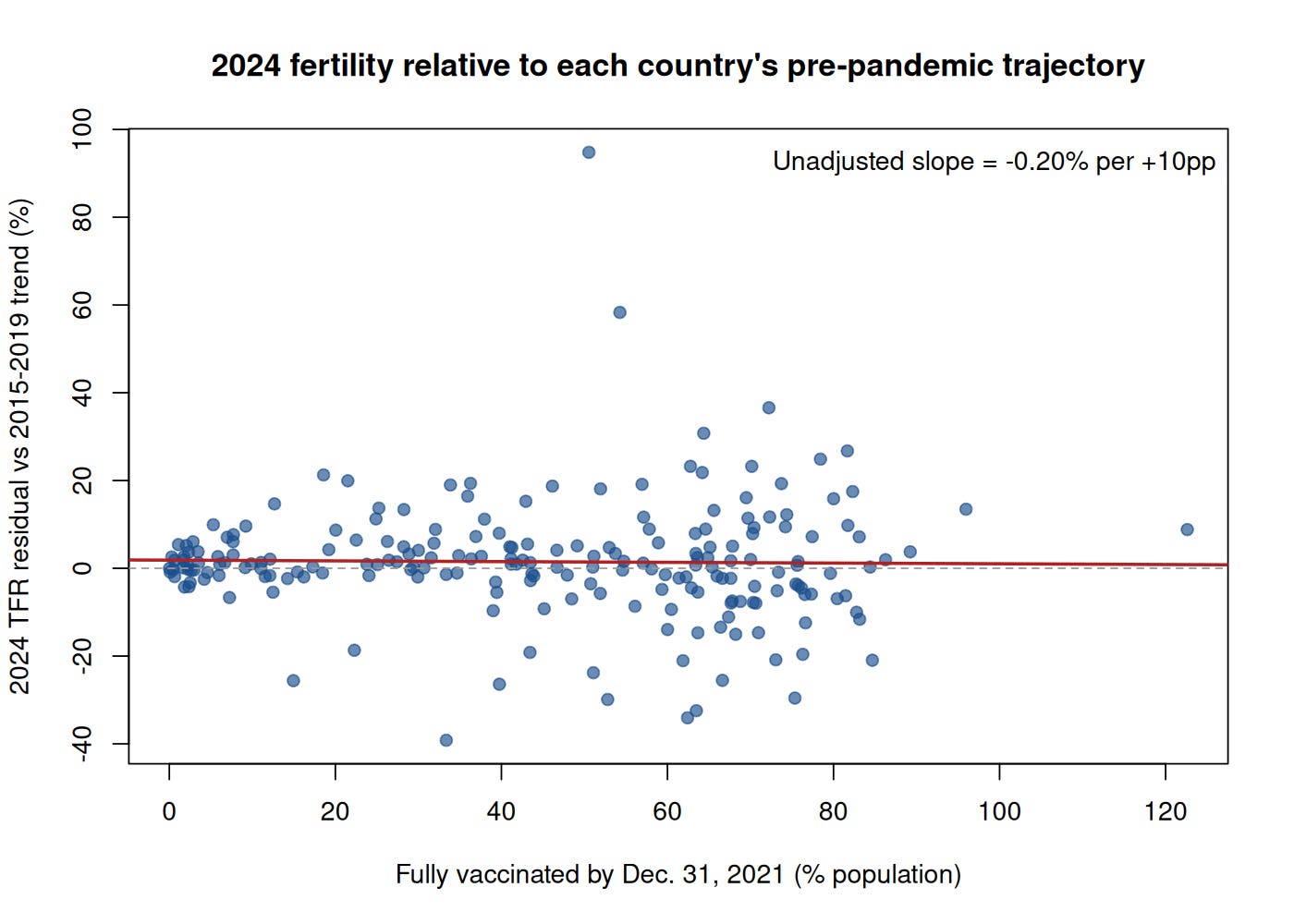
The final adjusted model controls for baseline TFR in 2019, the 2015–2019 fertility trend, median age in 2020, and log population density in 2020. These address the most obvious ecological confounding: demographic age structure, baseline fertility regime, pre-existing decline, and urbanization.
The Results
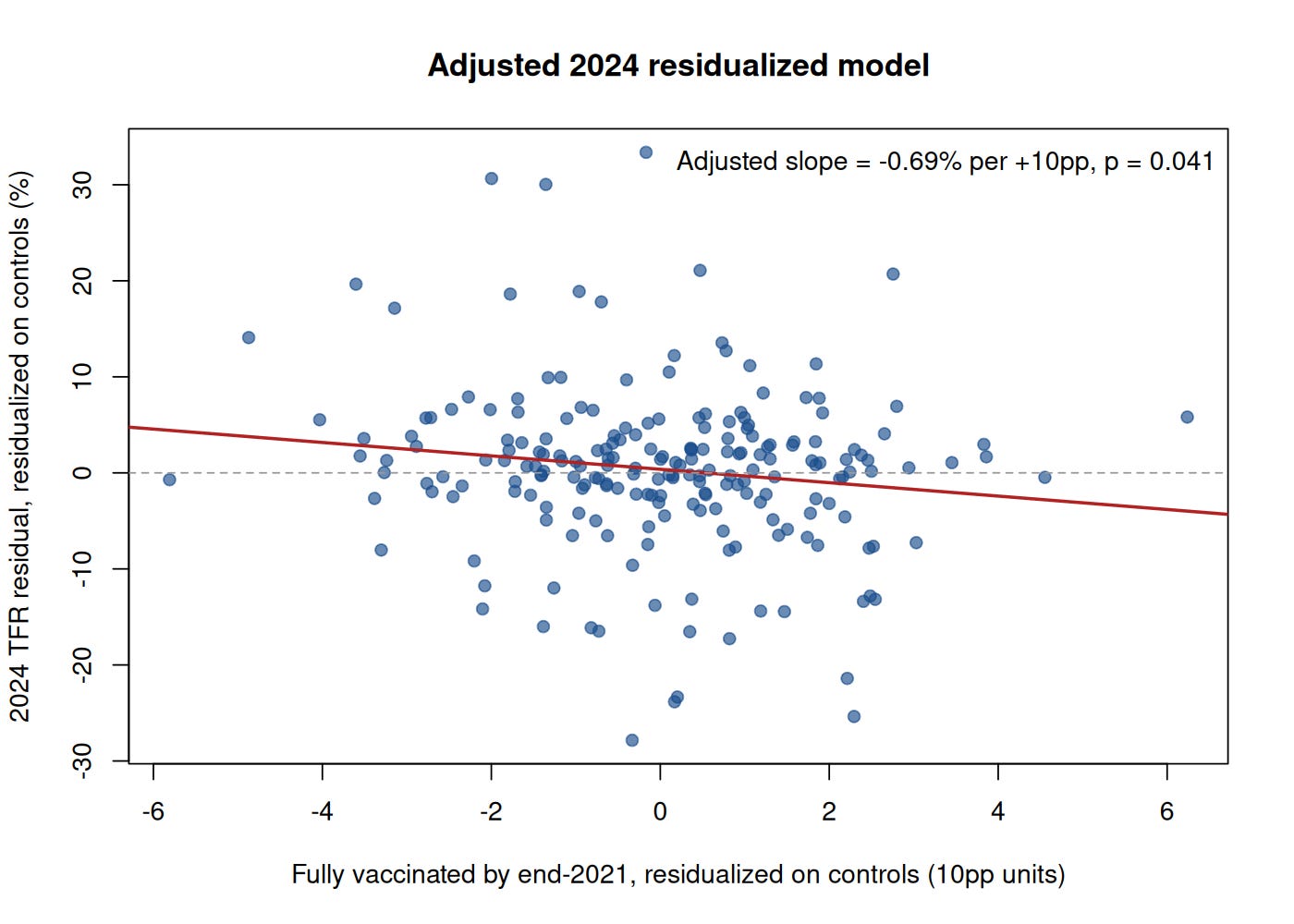
In the adjusted 2024-only residual model, being fully vaccinated by the end of 2021 is associated with a -0.686% lower-than-expected 2024 fertility per +10 percentage points of vaccination coverage (p = 0.0410).
That is not a large effect, and it is not definitive, but it is in the hypothesized direction and nominally significant.
Testing Different Metrics and Timings
The timing matters. Births in 2024 are cleanly aligned with mature vaccination exposure prior to conception. When we look at various vaccine exposure definitions, the results are mixed but trend in a specific direction:
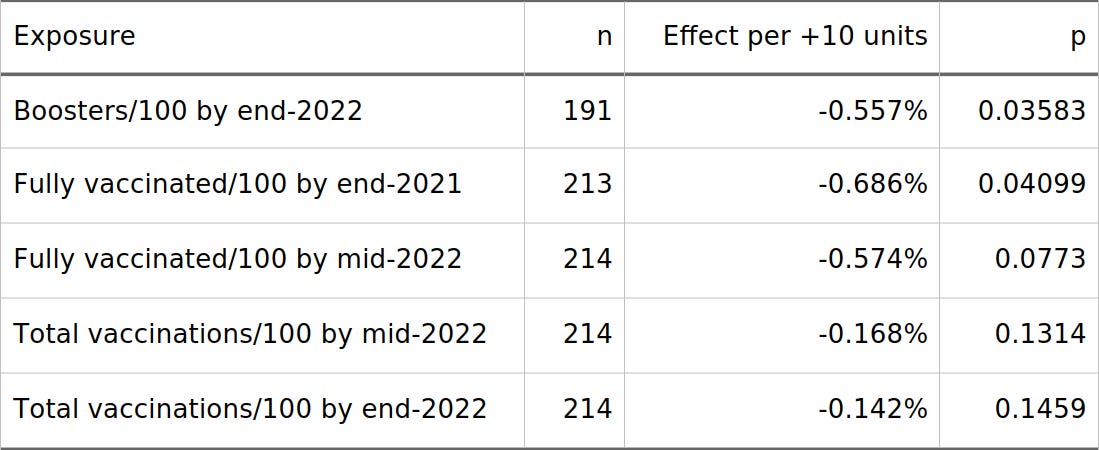
The strongest adjusted signals come from boosters per 100 by end-2022 and the fully vaccinated share by end-2021.
However, this table also highlights why we must remain cautious. If the effect were a simple cumulative-dose effect at the population level, total vaccinations per 100 might be expected to be among the stronger predictors. It is not. That suggests the signal, if real, is timing- or subgroup-specific rather than a clean aggregate dose-response pattern.
The global result is suggestive, but it still uses a blunt exposure measure. What happens if we look more directly at vaccination among people of reproductive age?
I will also investigate possible effecs of vaccine product class (mRNA, viral vector, and non-mRNA other).
