

After Troy
“Tell me, oh Muse, of that ingenious hero who travelled far and wide after he had sacked the famous town of Troy.”
—Homer, The Odyssey, Book I, translated by Samuel Butler [1]
The Odyssey begins after the victory. Troy has fallen; the fleet has scattered; kings return to homes that no longer behave as they did before the war. Christopher Nolan’s 2026 film makes the historical subtext explicit. His Odysseus says: “Our age of bronze is collapsing.” [2] The film looks beyond the victory at Troy toward the loss of palaces, trade and writing—and the Greek Dark Age that followed. Beneath the gods and monsters lies an old historical question: what happens to people when a wealthy, interconnected world breaks apart?
Around 1200 BCE, the Mycenaean palatial system of mainland Greece disintegrated. Palaces were destroyed or abandoned, and Linear B—the writing system used by palace scribes to keep administrative records of goods, land, workers and taxes—disappeared with them. Political and economic life was reorganized, and Greece entered a period in which writing effectively vanished for several centuries. Yet “collapse” is a label for uneven regional processes, not a single night of destruction. Archaeologists still debate the mix of warfare, migration, internal political failure, trade disruption, climate stress and other causes [3].
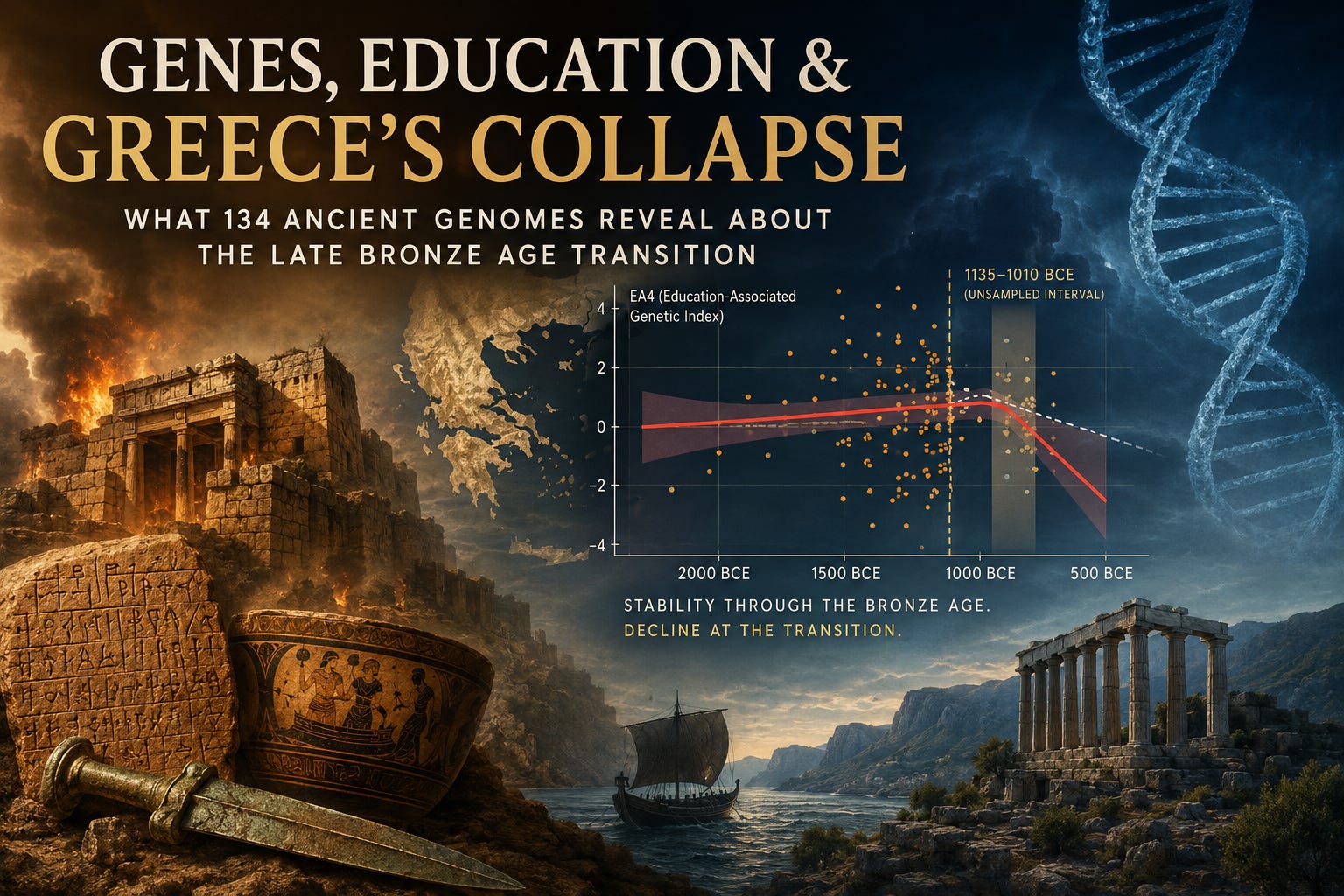
The idea I want to test is simple. Mycenaean palaces needed skilled people. Scribes had to learn Linear B, officials had to keep records and accounts, and administrators had to coordinate production, storage and trade. If the population became less genetically predisposed toward traits related to learning and problem-solving, the pool of people able to perform these jobs may have shrunk. That would not by itself explain the collapse, but it could have made an already fragile system less able to cope with the pressures it faced.
If this played a role, we should be able to see some trace of it in ancient DNA. In particular, a genetic index associated with educational attainment should begin to decline before the palatial system disappeared. I tested this using EA4, an index that combines thousands of genetic variants associated with educational attainment in modern populations, and tracked how it changed in ancient Greek genomes before and after the collapse.