
Did Harsh Seasons Make Complex Societies?

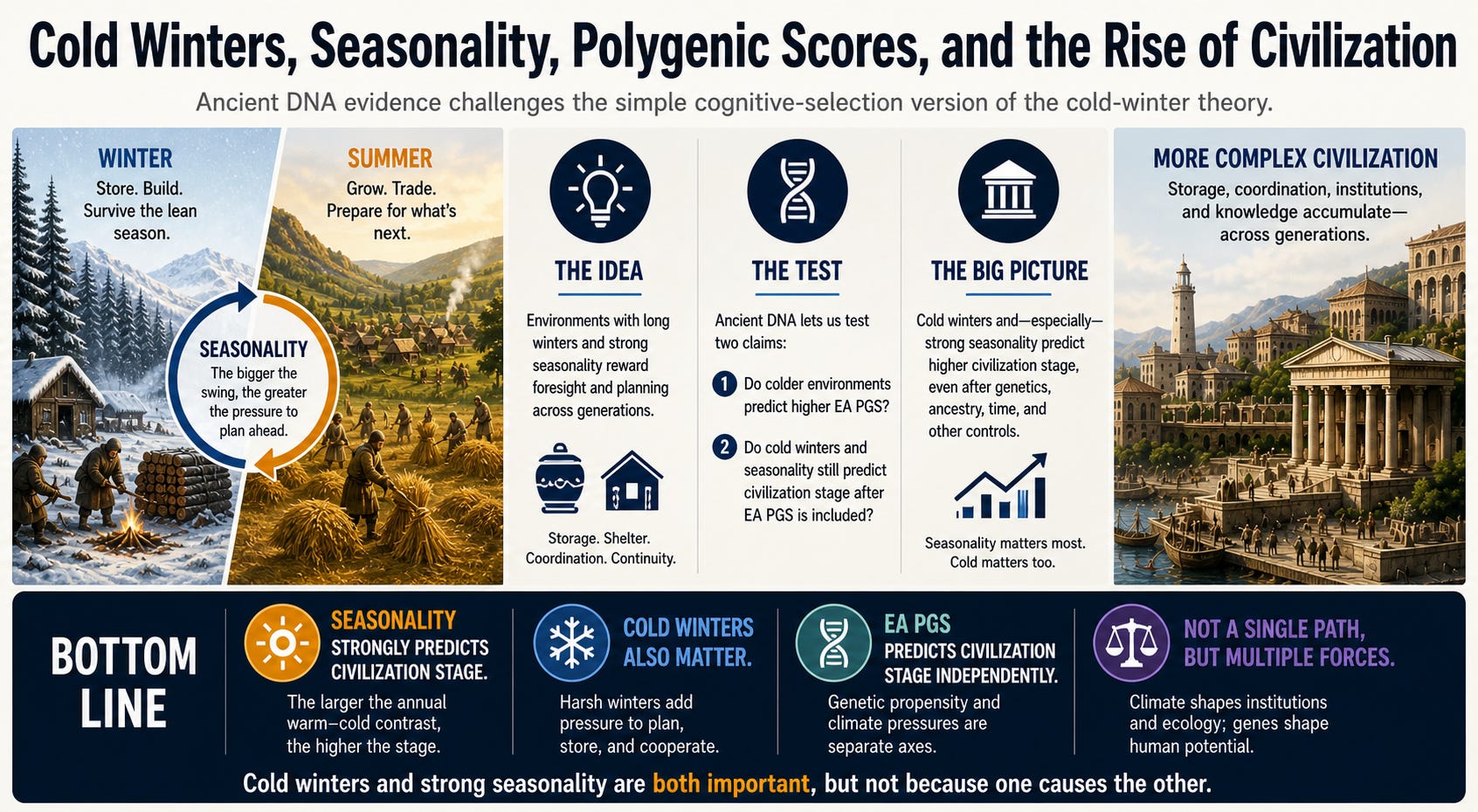
Look at the modern world and the cold-winter theory has an immediate appeal. Many of the societies that became rich, literate, bureaucratic, and technically complex were also societies that had to survive long winters. That does not prove anything by itself, but it gives the theory its intuitive force: winter rewards foresight.
A long winter is not just cold weather. It is a recurring deadline. Food has to be stored before it is needed. Shelter has to be built before the storm arrives. Fuel, clothing, animals, tools, and social obligations all have to be managed across seasons. If a climate repeatedly punishes short-termism, it is tempting to think that it might favor both individual traits and social institutions built around planning.
That is the strong version of the theory. It does not merely say that cold places developed different customs. It says that harsh seasonal environments may have helped push populations toward higher cognitive capacity and more complex civilization.
Ancient DNA lets us split that claim into two tests. First, do ancient people from colder environments actually have higher educational-attainment polygenic scores, used here as a rough proxy for cognitive human capital? Second, even after those genetic scores are included, do cold winters still predict civilization stage in the archaeological record?
Those two tests do not give the same answer. The genetic path is weak and ancestry-sensitive. The civilization-stage result is much stronger. That tension is the point of the analysis.
Methods Note
The analysis uses AADR v66 ancient individuals with nonzero dates and CHELSA TraCE21k climate assignments, restricted to 0-20,000 years before present. CHELSA monthly temperature and precipitation rasters were matched to each individual by latitude, longitude, and nearest available time slice.
Civilization stage is treated as an ordered outcome. The main controls are Years BP, genomic coverage, broad geographic region, AADR PCs or Europe-specific K8 ADMIXTURE components, EA PGS, and Height PGS. Absolute latitude is shown as a sensitivity adjustment rather than hidden as a default control, because latitude and temperature are conceptually and statistically close. Climate variables are standardized. Annual precipitation is treated as a climate predictor, not as a nuisance control; it is run alone and together with either coldest-quarter temperature or temperature seasonality.
The First Domino Does Not Fall Cleanly
If the cold-winter theory works mainly through cognitive selection, then the first domino should be visible before we even talk about civilization stage. Ancient samples from colder-winter environments should have higher EA PGS.
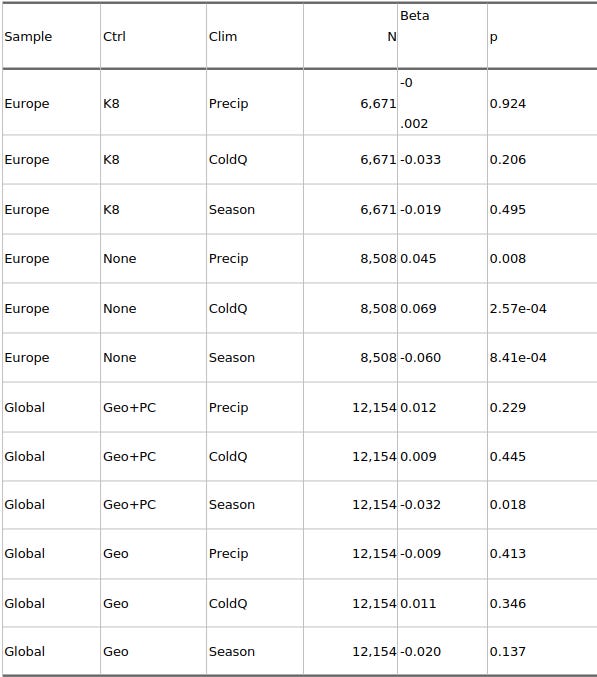
This is the cleanest place for the genetic version of the theory to win. It mostly does not. At the global level, coldest-quarter temperature is basically null. In Europe, the PC-controlled model even points in the opposite direction: warmer winters predict higher EA PGS. When ancestry is handled with K8 ADMIXTURE components, the coldest-winter association disappears.
Climate predictors of EA PGS
If cold winters pushed populations toward higher civilization stage mainly by raising the genetic propensity captured by EA PGS, then colder-winter environments should predict higher EA PGS before civilization stage is entered into the model. The results below do not show that pattern.
The signs are easy to read. Coldest-quarter temperature is coded so higher values mean warmer winters; therefore a negative coefficient supports the cold-winter version of the hypothesis. Seasonality is coded so higher values mean a larger warm-cold contrast; therefore a positive coefficient supports the same idea.
The simpler mediation model is not well supported. If cold winters raised civilization stage mainly by increasing EA-linked genetic propensity, then colder-winter environments should consistently predict higher EA PGS. They do not. Globally, with GeoRegion but without PCs, coldest-quarter temperature is null (beta = 0.0031, p = 0.856) and seasonality is weak (beta = -0.027, p = 0.090). In Europe without ancestry controls, coldest-quarter temperature is also null (beta = 0.029, p = 0.231), while seasonality points in the opposite direction from the cold-winter prediction (beta = -0.048, p = 0.0156).
The table reports the climate-PGS results before and after ancestry adjustment: global GeoRegion-only models are shown beside GeoRegion + PC models, and Europe no-ancestry models are shown beside K8 ADMIXTURE models. All models predict standardized EA PGS and exclude civilization score; they include Years BP and coverage. Annual precipitation is shown as its own climate predictor rather than being treated as a background control.
Table 1. Climate predictors of EA PGS
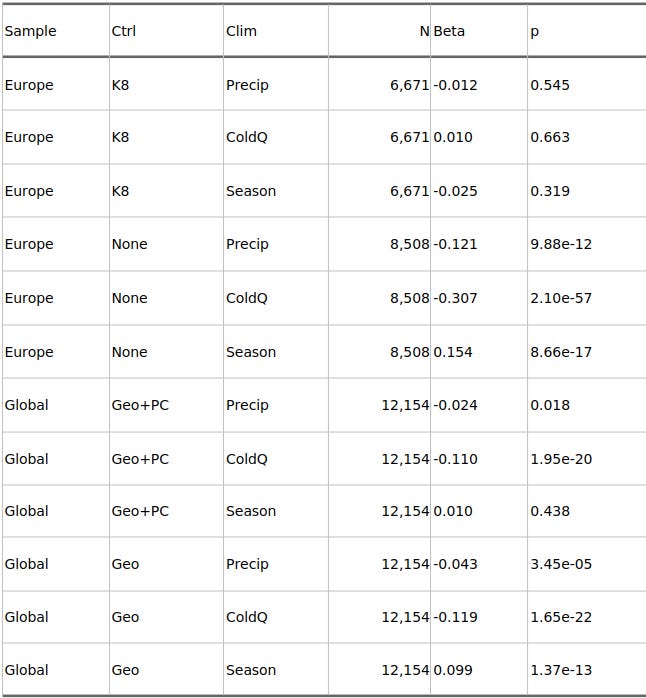
Height PGS is included because it gives the climate analysis a useful positive-control trait. Bergmann’s rule predicts that colder environments should favor larger bodies, so if the ancient-DNA climate merge is informative, cold-climate variables should be able to recover a height-related signal more clearly than they recover the proposed EA-PGS signal.
That is what happens. In the no-latitude global PC model shown below, coldest-quarter temperature is negative for Height PGS, meaning colder winters predict higher Height PGS. Annual mean temperature shows the same broad direction. The Europe-only result is less stable: with PCs, seasonality and annual mean temperature are associated with Height PGS, but the K8 ADMIXTURE model weakens these associations. This supports the idea that the climate data can recover a biologically expected PGS pattern, while the direct EA-PGS climate pattern remains weak.
The model structure is parallel to Table 1: standardized Height PGS is predicted from climate, Years BP, coverage, and the same geography/ancestry controls. Absolute latitude is omitted from the displayed rows, with latitude-adjusted versions retained in the TSV outputs. EA PGS is not included as a predictor.
Table 2. Climate predictors of Height PGS
Does the EA-Climate Relationship Change Over Time?
A single average coefficient can miss a moving relationship. Cold winters may have mattered more at some periods than others, especially if Europe itself was changing through migration, farming expansion, and steppe ancestry turnover.
I therefore tested a linear interaction between climate and Years BP. This is exploratory, but it is less arbitrary than imposing a hand-picked hinge. The European interaction is more suggestive than the main effect. In the K8 ADMIXTURE model, older European samples show a stronger association between colder winters and higher EA PGS. But this is not a stable all-period effect. It is a time-varying pattern, not a simple rule.
Figure 1. Time-varying cold-winter slope on EA PGS in Europe
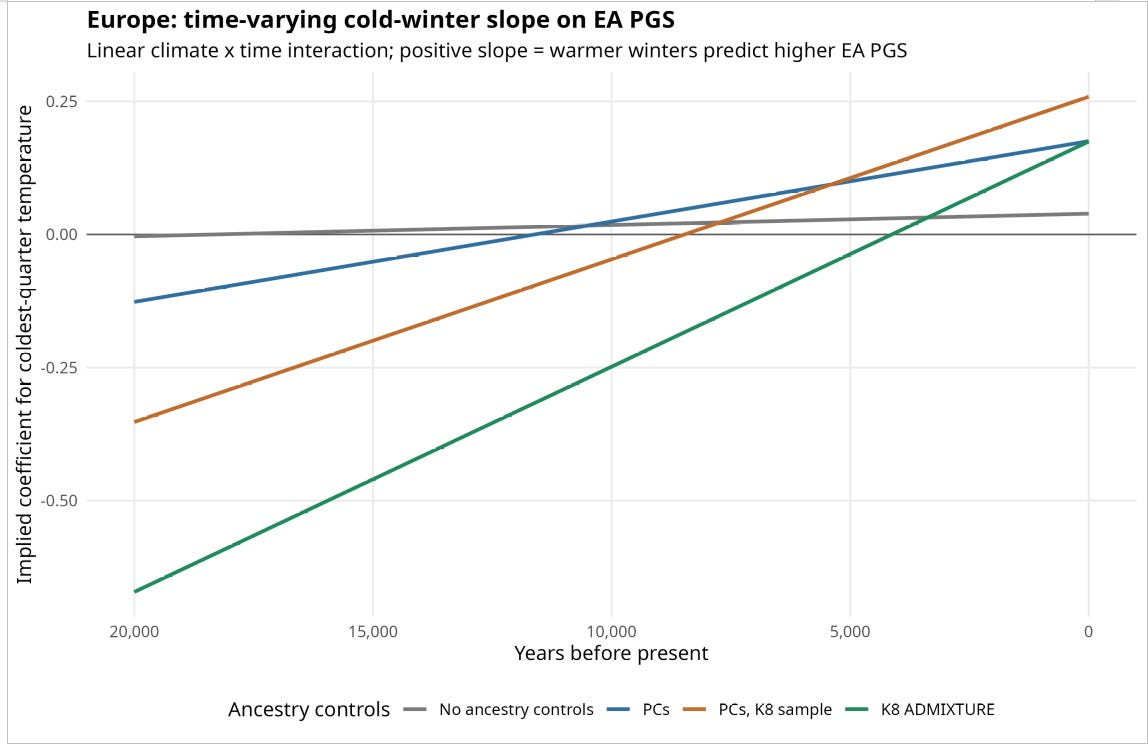
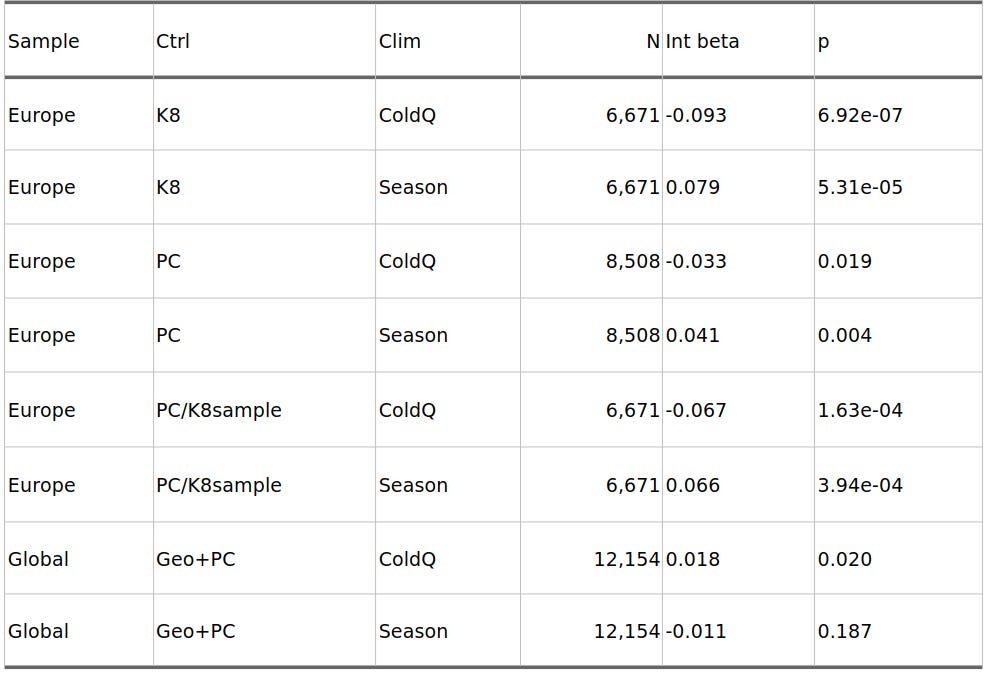
The interaction estimates put numbers on the pattern shown in the figure. The coefficient is the interaction between standardized Years BP and the climate variable, so it measures whether the climate slope becomes stronger or weaker in older samples.
For coldest-quarter temperature, a negative interaction means colder winters are more positively associated with EA PGS in older samples. For seasonality, a positive interaction means stronger warm-cold contrast is more positively associated with EA PGS in older samples. The table reports coldest-quarter temperature and seasonality under the same four control specifications used in Table 1.
Table 3. Climate x time interactions predicting EA PGS
Cold Winters Still Predict Civilization Stage
Now comes the twist. The direct EA-PGS result is weak, but the civilization-stage result is not.
In the global ordered-probit models, colder winters predict higher civilization stage, and stronger seasonality does the same. Annual precipitation is not just a background control: by itself it is weak or negative, but when paired with seasonality it becomes positive, especially after PCs are included. EA PGS has a positive effect in the same models. Height PGS is less stable and does not mirror the EA pattern. The result is not a neat mediation chain. It is a split result: climate predicts civilization stage more robustly than it predicts EA PGS.
Coldest-quarter temperature and seasonality are not put in the same table model because they are strongly collinear; instead, precipitation is paired separately with coldest-quarter temperature and with seasonality.
The genetic pathway looks weak. But the civilization-stage results are where the real test begins: does climate still matter after EA PGS, Height PGS, time, ancestry, and data quality are already in the model? The rest of the post walks through that answer for paid subscribers.
