
Did Rome Rise and Fall With Genetic Human Capital?

The history of Rome is usually told through its institutions: a village becomes a republic, a republic conquers the Mediterranean, and an empire builds roads, moves armies, and absorbs elites. When the Western Empire falls, the peninsula isn’t erased, it is simply reorganized.
While we traditionally trace this story through texts, coins, and pottery, ancient DNA (aDNA) introduces a different kind of evidence. It answers a fundamental question written records often obscure: Who was actually there?
Rome was more than a state. It was a demographic process. Conquest, slavery, trade, and migration constantly altered the genetic composition of the people living in Italy.
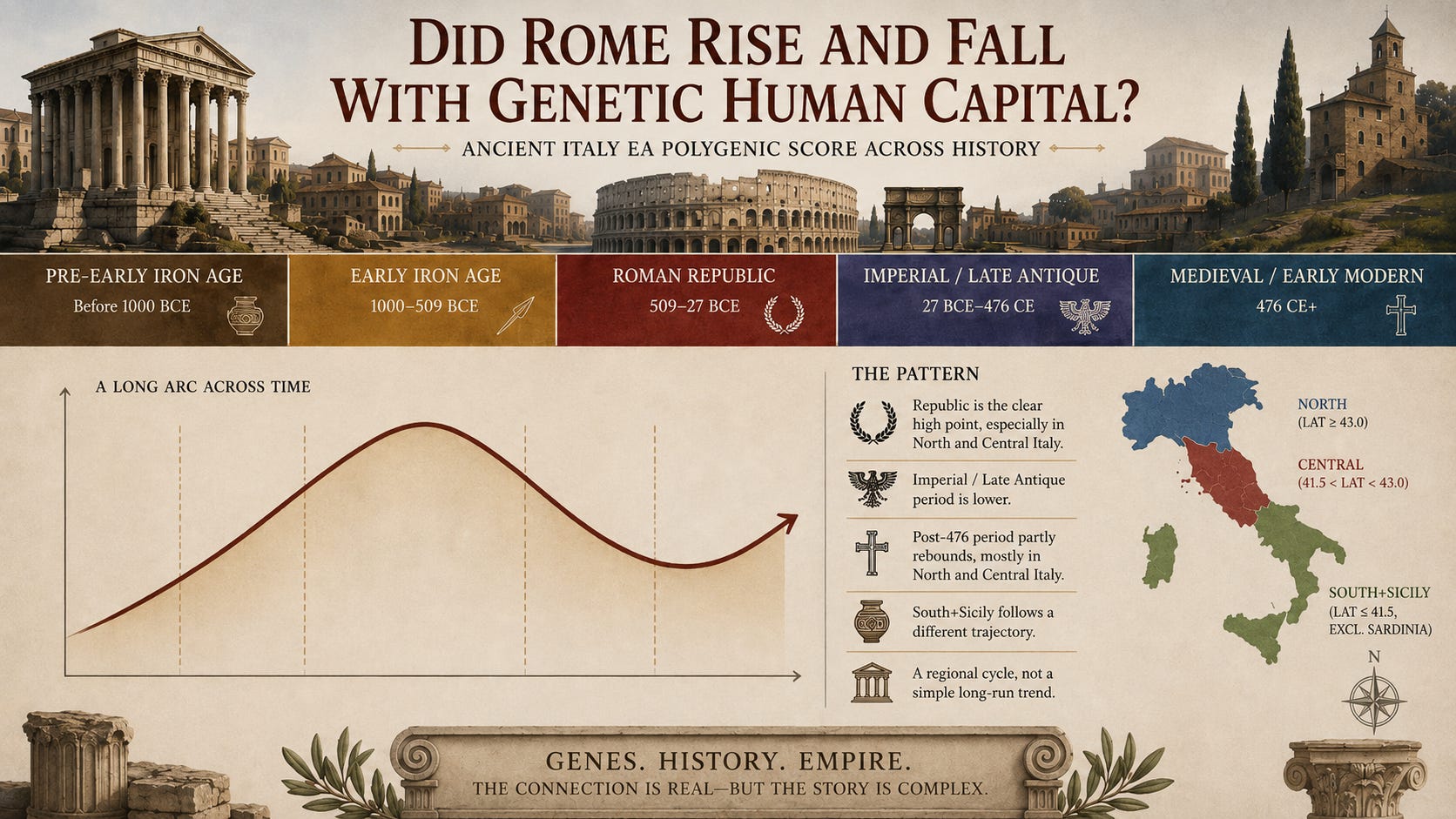
This post is a follow-up to a paper I published in 2023, where I analyzed Educational Attainment polygenic scores in ancient Rome. That paper was based on a single ancient DNA dataset from modern-day Lazio, the region of which Rome is the capital, so the question was necessarily narrow: what happened to EA PGS in and around the Roman capital across time?
Here I expand the analysis to Italy as a whole. Instead of relying on one dataset from one province, I combine ancient DNA samples from different studies, covering multiple regions of the peninsula and Sicily. This makes it possible to ask a broader question: was the genetic trajectory observed in ancient Rome just a local pattern, or part of a larger Italian cycle linked to the rise, transformation, and collapse of Roman civilization?
The Core Question: Linear Growth vs. Civilizational Cycles
Before getting to Rome, it is worth clarifying what is being measured. A polygenic score, or PGS, is a summary of many genetic variants that are each weakly associated with a trait in genome-wide association studies. No single variant matters very much. The score only becomes informative when thousands of small effects are added together.
Here I use the Educational Attainment polygenic score, or EA PGS, not as a literal measure of schooling in ancient people. Ancient Romans obviously did not take modern exams or attend modern universities. Rather, EA PGS is used as a broad index of genetic human capital: a noisy but useful proxy for the inherited component of cognitive potential, personality traits related to persistence and planning, and other behavioral tendencies that affect learning, achievement, and social complexity.
With that in mind, ancient Italian EA PGS can be used to test two competing hypotheses about how populations changed over time:
The Linear Trend (Long-Run Selection): Ancient Italy was merely a local example of a broader, steady upward trend in EA PGS seen across Western Eurasia over millennia. In this scenario, Rome requires no special explanation. It’s just a point on a long, continuous slope.
The Civilizational Cycle: The genetic timeline follows Rome’s historical arc: rising during the Republic, falling during the Imperial/Late Antique influx, and partially rebounding after the collapse of the Western Empire in 476 CE.
If the data reveals a cycle, it raises a fascinating possibility: that the rise and fall of civilizations is tied to fluctuations in the genetic human capital of their populations.
What the Data Shows
The results do not show a simple, flat national average. Instead, the genetic timeline changes by region, perfectly mirroring the broad historical sequence:
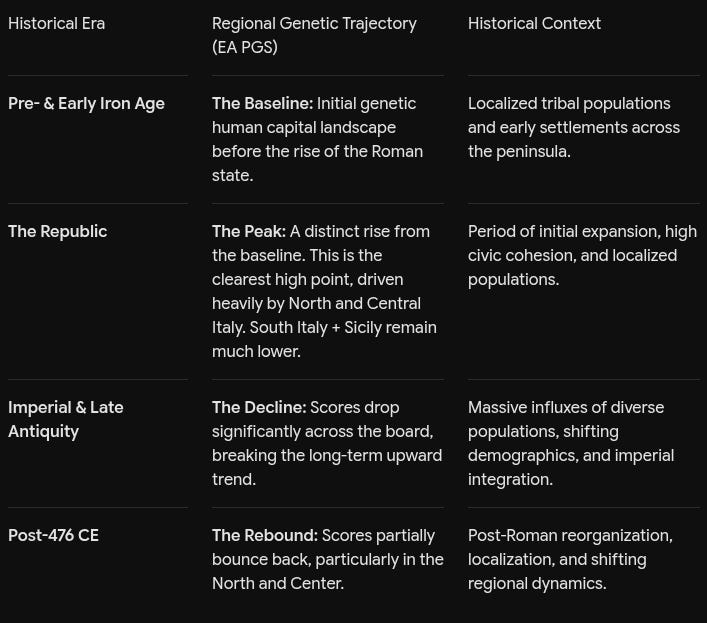
The fact that we see a regionally moderated cycle, starting from the pre-Iron Age baseline, peaking in the Republic, dipping in the Empire, and rebounding after, suggests that civilizational dynamics and genetic human capital are deeply intertwined.
The rest of the post shows how that pattern appears in the data, why the north-central Republican peak matters, and what happens when ancestry controls are added.