
Does Every European Descend From Charlemagne?

This started with a Twitter thread from Lyman Stone about one of those claims that sounds as though it ought to be settled with cocktail-napkin arithmetic.
You have two parents, four grandparents, eight great-grandparents, and so on. Go back 40 generations and your family tree appears to contain more than one trillion ancestral positions. Medieval Europe had nowhere near one trillion people. Therefore, the argument goes, every European must descend from Charlemagne—and perhaps from every European who lived before AD 1000 and left any descendants at all.
Stone’s objection was that real pedigrees do not double forever. Cousins marry cousins. The same medieval person can occupy hundreds or thousands of positions in one modern pedigree. This is called pedigree collapse. So, he argued, the simple doubling calculation does not show that Charlemagne—or anyone else—became an ancestor of literally every European. He went further and suggested that there are almost certainly people in France who do not descend from Charlemagne.
The easy doubling argument is indeed wrong.
But Stone’s conclusion does not follow from that.
Pedigree collapse is not a force that keeps lineages separate. It is what the merging of lineages looks like. The real question is not whether the same ancestors recur in a pedigree. They obviously do. The question is whether the European marriage network was connected enough for a surviving lineage to spread from one local group into the others.
That distinction matters. In a disconnected Europe, the universal-ancestry claim fails completely. In a weakly but persistently connected Europe, it becomes surprisingly difficult for a prolific medieval lineage not to become nearly universal.
And Charlemagne was not an arbitrary medieval person. His descendants are unusually well documented. They survived through multiple branches, dispersed across several regions, and entered the most interconnected marriage network in medieval Europe.
So I built a simulation to see where the line falls and then adjusted the interpretation using what we know about Charlemagne’s actual descendants.
One clarification before beginning: by “European,” I mean someone whose ancestry substantially runs through the historically connected populations of Europe. I do not mean every person who happens to reside on the continent today.
The family tree is not a tree
After a certain number of generations, a binary pedigree contains:
2 raised to the number of generations
ancestral positions.
At 40 generations, that gives:
2^40 = 1,099,511,627,776
That is more than one trillion positions.
But those are positions, not distinct people.
The same person can appear through your mother’s mother’s line, your father’s father’s line, and hundreds of other routes. Once distant cousins begin having children, the apparent tree folds back into itself. It stops looking like a branching tree and starts looking like a dense network.
The fact that 2^40 exceeds the historical population therefore proves only that there must be enormous duplication. It does not tell us which people occupy those positions. In particular, it does not prove that one named person—Charlemagne—appears anywhere in the pedigree.
A simple counterexample makes the logical problem clear.
Imagine two villages that never intermarry. A founder in Village A can eventually become an ancestor of everyone in Village A while remaining an ancestor of nobody in Village B. His descendants’ pedigrees can collapse as much as they like. No amount of duplicated ancestry creates a bridge that never existed.
The original arithmetic is therefore missing a crucial assumption:
The population must be sufficiently connected.
Without that assumption, “every European descends from Charlemagne” is not a mathematical theorem.
Why pedigree collapse is not a rebuttal
Stone is right that pedigree collapse invalidates the naïve proof. But pedigree collapse itself does not make universal ancestry unlikely.
Suppose a fraction of possible parents in a population descend from some founder. Call that fraction q.
A child fails to descend from the founder only if neither parent descends from the founder. The probability of that is:
(1 - q)^2
So the probability that the child does descend from the founder is:
1 - (1 - q)^2
When q is small, that is approximately 2q. A rare surviving lineage therefore tends to expand very quickly at first. It then slows as it begins to saturate the population.
Endogamy changes where that saturation happens. If almost everyone marries locally, a lineage can become universal inside one village, class, religious community, or region while remaining absent elsewhere. But once even a small number of marriages cross those boundaries, the lineage gets another opportunity to repeat the same process in the next group.
Endogamy therefore has two effects that are easy to confuse.
First, it accelerates the overlap of pedigrees within a group.
Second, it slows the spread of pedigrees between groups.
The first effect is pedigree collapse. The second is population structure.
Only the second provides a serious argument against universal ancestry.
In fact, pedigree collapse often means that a successful lineage has become so common that people inherit it through multiple routes. The same ancestor keeps reappearing because the ancestor’s descendants have become widespread.
What the existing mathematics says
This is not a new problem.
In a classic paper, Joseph Chang studied a finite population in which every person chooses two parents at random from the preceding generation.
In that model, the most recent person who is an ancestor of everyone appears roughly log base 2 of the population size generations in the past.
Farther back, at roughly:
1.77 times log base 2 of the population size
the population reaches what is called the identical ancestors point.
At that date, everyone alive falls into one of two categories:
They are an ancestor of everyone alive in the present.
They are an ancestor of nobody alive in the present.
That result already includes pedigree collapse. In fact, pedigree collapse is essential to it. The surviving lineages do not remain as separate branches. They merge until they are shared by the entire population.
Chang’s model assumes random mating, which Europe plainly did not have. Douglas Rohde, Steve Olson, and Chang later added geography and population structure. The timing changed, but occasional migration between groups still produced surprisingly recent universal ancestors.
The empirical evidence points in the same general direction. Using genetic data from 2,257 Europeans, Peter Ralph and Graham Coop estimated that even people from opposite ends of Europe share millions of genealogical ancestors from within the last thousand years.
Their result does not prove that Charlemagne specifically is an ancestor of every European. It does show that large-scale shared ancestry is not merely an artifact of pretending Europe was perfectly mixed.
There is also an important distinction between a genealogical ancestor and a genetic ancestor.
You can descend from someone without carrying any identifiable segment of that person’s DNA. After dozens of generations, most genealogical ancestors contribute no detectable autosomal DNA along a particular line of descent.
The Charlemagne claim is a claim about paths through a pedigree. It is not a claim that every European carries a measurable fragment of “Charlemagne DNA.”
Charlemagne was not an arbitrary medieval person
The generic mathematics tells us what can happen to a surviving lineage. But Charlemagne’s case is not generic.
His descendants are unusually well documented, especially near the beginning of the tree.
Einhard’s near-contemporary Life of Charlemagne names numerous children. With Hildegard alone, Charlemagne had the sons Charles, Pepin, and Louis, as well as the daughters Hruodrud, Bertha, and Gisela. Einhard also names children by Fastrada and several concubines.
More importantly for our purposes, the record shows that Charlemagne’s lineage survived through more than one child and more than one grandchild.
Pepin, whom Charlemagne made king of Italy, left a son named Bernard and several daughters. Charlemagne installed Bernard as his father’s successor. Louis the Pious survived Charlemagne and inherited the empire.
The first essential fact is therefore not speculative:
Charlemagne’s lineage did not survive through one precarious thread. It survived through multiple major branches.
Not all of his children founded enduring lines. Some died without known children. Some entered religious life. Some branches quickly disappear from the surviving record.
But the lines through Pepin of Italy and Louis the Pious are substantial and comparatively well documented.
The descendants spread across Europe’s elite network
The more important fact is that Charlemagne’s descendants did not remain concentrated in one royal household.
Within a few generations, they had spread into several different political and geographic networks.
One standard reconstruction runs:
Charlemagne
→ Pepin, king of Italy
→ Bernard, king of Italy
→ Pepin of Vermandois
→ Herbert I of Vermandois
→ Beatrice of Vermandois
→ Hugh the Great
→ Hugh Capet
Hugh Capet became king of France in 987, and his son Robert II continued the Capetian line.
This matters because the Capetians were not merely political successors to the Carolingians. Through Beatrice of Vermandois, they were also genealogical descendants of Charlemagne.
A separate route runs through Louis the Pious:
Charlemagne
→ Louis the Pious
→ Charles the Bald
→ Judith
→ Baldwin I of Flanders
→ Baldwin II
→ Arnulf I
→ Baldwin III
→ Arnulf II
→ Baldwin IV
→ Baldwin V
→ Matilda of Flanders
Matilda married William the Conqueror.
Charlemagne’s ancestry had therefore moved from the West Frankish royal family into the counts of Flanders and then into the Norman royal house in England.
The relevant medieval relationships are summarized in resources such as Columbia’s Epistolae genealogy of Charlemagne.
Matilda herself appears to have had more than one genealogical route back to Charlemagne. Her mother, Adela, descended from the Capetian branch. Her father descended through the counts of Flanders.
By the eleventh century, Charlemagne’s lineage was already crossing back over itself inside the aristocracy.
That is pedigree collapse.
But notice what it means in this case. It does not mean Charlemagne’s ancestry was failing to spread. It means his ancestry had become sufficiently widespread that two people marrying each other could both carry it through different routes.
Louis the Pious’s descendants also spread into East Francia, Bavaria, Lotharingia, Italy, Burgundy, Provence, Friuli, and other parts of the European aristocratic network.
Some male lines ended. That does not end genealogical descent. A daughter’s child is just as much a descendant as a son’s child.
The importance of these marriages is that they placed Charlemagne’s ancestry in several distinct regional networks.
By approximately AD 1000, we should not model Charlemagne’s descendants as ten people living in one French town. The documented picture is closer to multiple established clusters distributed across West Francia, Flanders, East Francia, northern Italy, Burgundy, Lotharingia, and Provence.
How reliable are the genealogies?
Medieval people themselves were already tracking the Carolingian family.
Monasteries and courts drew and copied Carolingian family trees by the late tenth and early eleventh centuries. The Bamberg Table, for example, divided the descendants of Louis the Pious into the branches of Lothair, Charles the Bald, and Louis the German.
Other Carolingian genealogies were repeatedly copied through the tenth, eleventh, and twelfth centuries. The Capetians, Ottonians, Salians, and other ruling families had strong political reasons to emphasize connections to the Carolingians.
The University of St Andrews’ After Empire project provides a useful discussion of these medieval genealogies and their political uses.
That makes the records both unusually valuable and potentially dangerous.
They are valuable because these family relationships mattered politically and were recorded much earlier than the ancestry of ordinary people.
They are dangerous because medieval genealogies were not neutral scientific documents. Their authors selected which branches to emphasize, omitted inconvenient relatives, and sometimes made errors. A family tree could also function as an argument about legitimate rule.
Modern medieval genealogists therefore do not simply accept one old chart. They compare chronicles, annals, charters, marriage records, property transmission, and later genealogical compilations.
The strongest lines from Charlemagne are supported by converging evidence. More obscure proposed connections remain uncertain.
Can the line be followed to living people?
For some people, yes.
Once a genealogist establishes descent from a well-documented medieval royal or noble family, the Charlemagne portion is often the easier part.
Genealogists use the term “gateway ancestor” for a later, securely documented person whose ancestry leads into medieval aristocratic families. Organizations such as American Ancestors publish guidance on royal ancestry and gateway ancestors.
The difficult part is usually not:
medieval king → Charlemagne
It is:
living person → early modern family → medieval noble family
That is where records become thin and where invented connections proliferate.
There are therefore two equal and opposite mistakes.
The first is:
“My online family tree reaches Charlemagne, so it must be true.”
It may not be. Online trees frequently copy unsupported relationships from one another.
The second is:
“Most people cannot document a line to Charlemagne, so they probably do not descend from him.”
That also does not follow.
A paper trail is much more likely to survive for kings and nobles than for peasants, artisans, soldiers, servants, and ordinary townspeople. The documentary tree is a record of the visible highways through the descendant network. It is not a complete map of the network.
Most of Charlemagne’s descendants would eventually have ceased to be royal. Many would have ceased to be noble. Their records would become progressively less complete even as their numbers increased.
So when we say that Charlemagne’s line has been tracked, we do not mean that historians possess a complete list of every descendant in every generation.
We mean something more limited but still important:
Multiple continuous descendant lines can be documented across many generations, regions, and dynasties, and those lines prove that Charlemagne’s ancestry became widely distributed inside the medieval European elite.
A simulation of a structured population
The established mathematics shows that universal ancestry can emerge. The documentary genealogy shows that Charlemagne had an unusually favorable starting position.
But the answer still depends on how connected the larger population was.
So I simulated a population divided into 100 equal communities arranged on a 10-by-10 grid.
Population geneticists often call such a community a “deme.” For present purposes, think of it as a stylized town, district, valley, religious community, or local marriage market.
Each community contained 100,000 people, for a total population of 10 million.
Every person in each new generation selected two parents from the preceding generation.
Most parental choices were local.
One percent came from an adjacent community.
I then varied the probability of choosing a parent from a randomly selected distant community.
The model tracked whether each person descended from one focal founder.
Suppose q is the probability that one sampled parent descends from the founder. A child is not a descendant only when neither parent is a descendant.
So:
probability the child descends from the founder = 1 - (1 - q)^2
The number of descendants in each community in the following generation was then sampled from a binomial distribution using that probability.
I ran 5,000 Monte Carlo trials for each structured scenario over 40 generations—roughly the right order of magnitude for the interval between Charlemagne and the present.
I tested two starting conditions.
The first began with one lineage-bearing individual.
The second began with ten established branches in the founder’s home community.
The ten-branch case is not a literal reconstruction of Charlemagne’s family. It is a sensitivity test for a prolific founder whose lineage has already survived its most fragile early generations.
I conditioned the main results on the lineage still existing at generation 40.
That is important. A random person’s lineage can disappear quickly. But in Charlemagne’s case, lineage survival is not uncertain. We know that it survived.
Finally, I used an unusually strict definition of success.
“Universal” means that every one of the 10 million people in all 100 communities descends from the founder.
One holdout is enough to make the result non-universal.
First, a sanity check
Before using the structured model, I tested the code against a well-mixed benchmark.
When a lineage is very rare, the number of times its members appear as parents in the next generation behaves approximately like a branching process with an average of two offspring connections per lineage member.
That process predicts an eventual lineage extinction probability of about 20.319 percent, or a survival probability of about 79.681 percent.
In 50,000 simulations of a randomly mixing population of 100 million, the lineage survived 79.596 percent of the time.
That is very close to the theoretical result.
Conditional on survival, the lineage had become universal by generation 40 in 99.9799 percent of runs.
The well-mixed model is not a realistic model of medieval Europe. Its purpose here is to verify that the simulation reproduces the expected mathematical behavior.
The result: connectivity dominates
Here are the central results.
“Long-range choices” means the number of distant parental selections per 10,000 parental selections.
The “home region” is the central block of 16 communities.
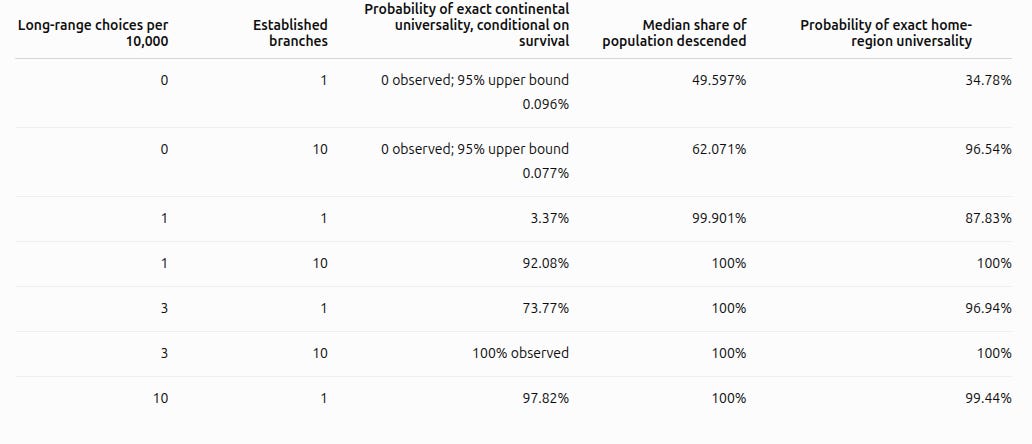
The confidence interval around the 92.08 percent result is approximately 91.30 to 92.80 percent.
The interval around the 73.77 percent result is approximately 72.39 to 75.11 percent.
Three points stand out.
Stone’s world is possible
When there were no long-range parental choices, the founder never became universal across the entire grid within 40 generations.
The lineage spread through neighboring communities, but geography preserved large populations of non-descendants.
This is enough to defeat the claim that universal ancestry follows as a matter of pure mathematics. A permanently isolated group is a permanent counterexample.
But notice what happened inside the founder’s home region.
With ten established branches, the founder became an ancestor of everyone in the 16-community home region in 96.54 percent of runs.
Pedigree collapse did not protect local non-descendants. It helped eliminate them.
The obstacle to continental universality was slow diffusion across the grid, not local pedigree collapse.
A tiny amount of long-range mixing changes the answer
Consider the scenario with one long-range parental choice per 10,000 choices.
In that population:
98.99 percent of parental choices remained within the same community.
1 percent came from an adjacent community.
0.01 percent were long-range.
That is an extremely endogamous population.
Yet it still amounts to roughly 20 distant parental assignments per 100,000-person community per generation, because every child has two parental selections.
With one initial branch, the founder reached a median of 99.901 percent of the population but became literally universal in only 3.37 percent of surviving runs.
With ten established branches, the probability of exact universality jumped to 92.08 percent.
The difference between “almost every European” and “every European” is therefore not semantic. It is a last-holdout problem.
A lineage can reach 9,990,100 people out of 10 million and still fail the literal claim.
Multiple branches matter enormously
A named historical figure is not necessarily equivalent to a random lineage selected from a random generation.
A ruler or other unusually prolific person may have several descendant branches that survive long enough to enter different parts of the marriage network.
The simulation captures this only crudely by comparing one established branch with ten.
But the effect is large.
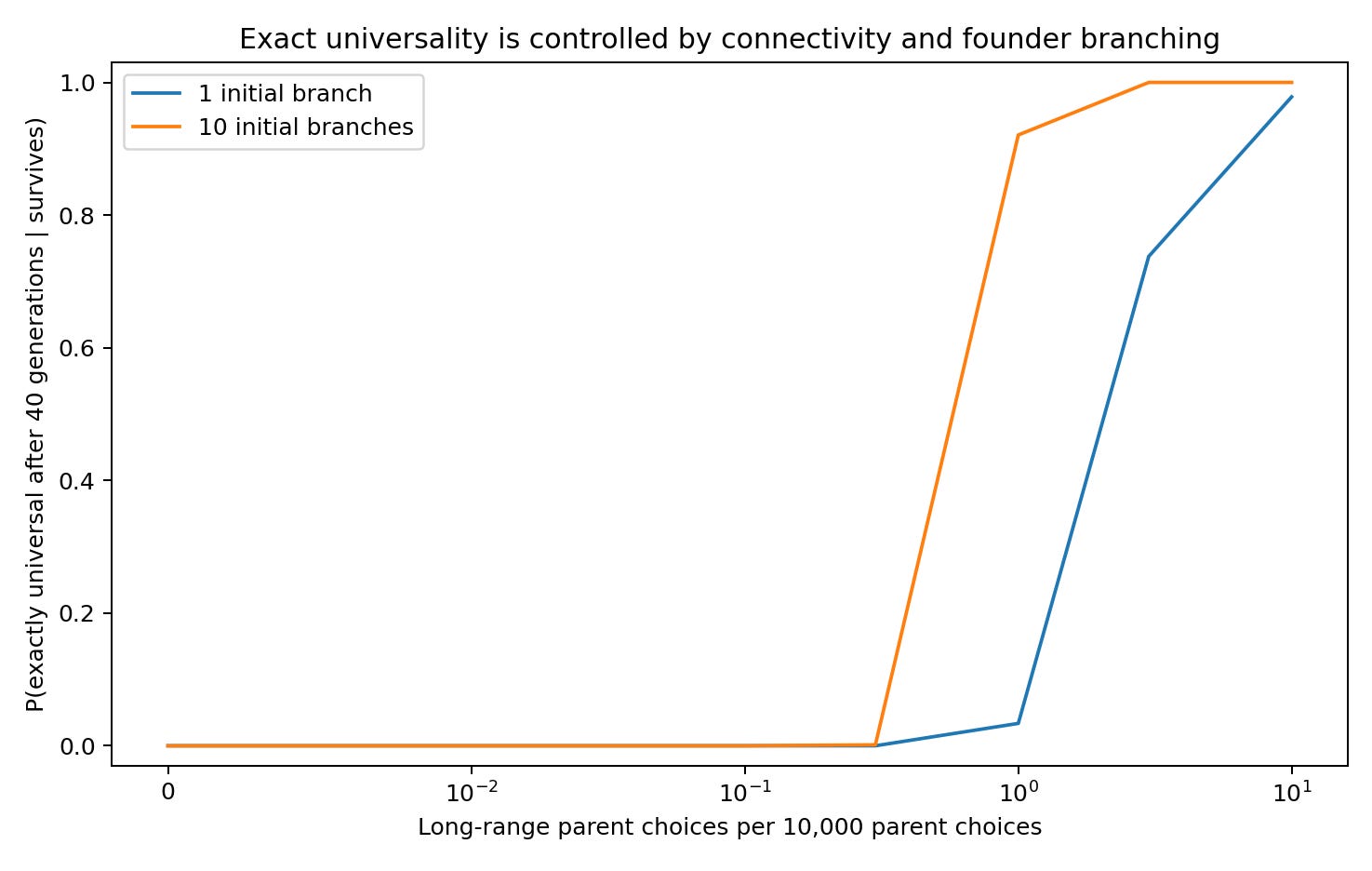
At one long-range parental choice per 10,000, exact universality rises from 3.37 percent with one branch to 92.08 percent with ten.
At three long-range choices per 10,000, the single-branch case reaches 73.77 percent, while all 5,000 ten-branch trials became universal.
This is why “Charlemagne” and “an arbitrary European alive in AD 800” are not interchangeable claims.
Charlemagne is historically known to have had multiple surviving branches. Those branches were also geographically and politically dispersed.
The one-founder simulation is therefore a useful mathematical baseline, but it is not the historically appropriate Charlemagne model.
Figure 1. The probability of exact universality after 40 generations, conditional on lineage survival. Sparse long-range connections and multiple established branches interact strongly.
“Almost every European” can become “every European” very abruptly
The transition over time is also sharp.
Holding the model fixed at ten established branches and one long-range parental choice per 10,000, I varied the number of generations.
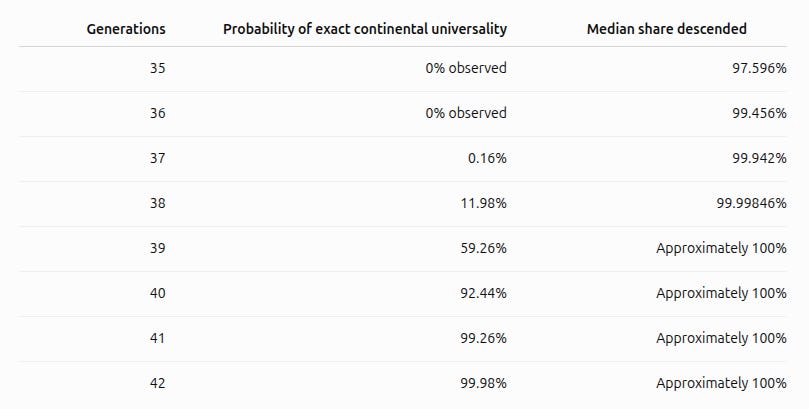
At generation 38, the median lineage already covered 99.99846 percent of the population.
That means only about 154 people in 10 million remained non-descendants in the median run.
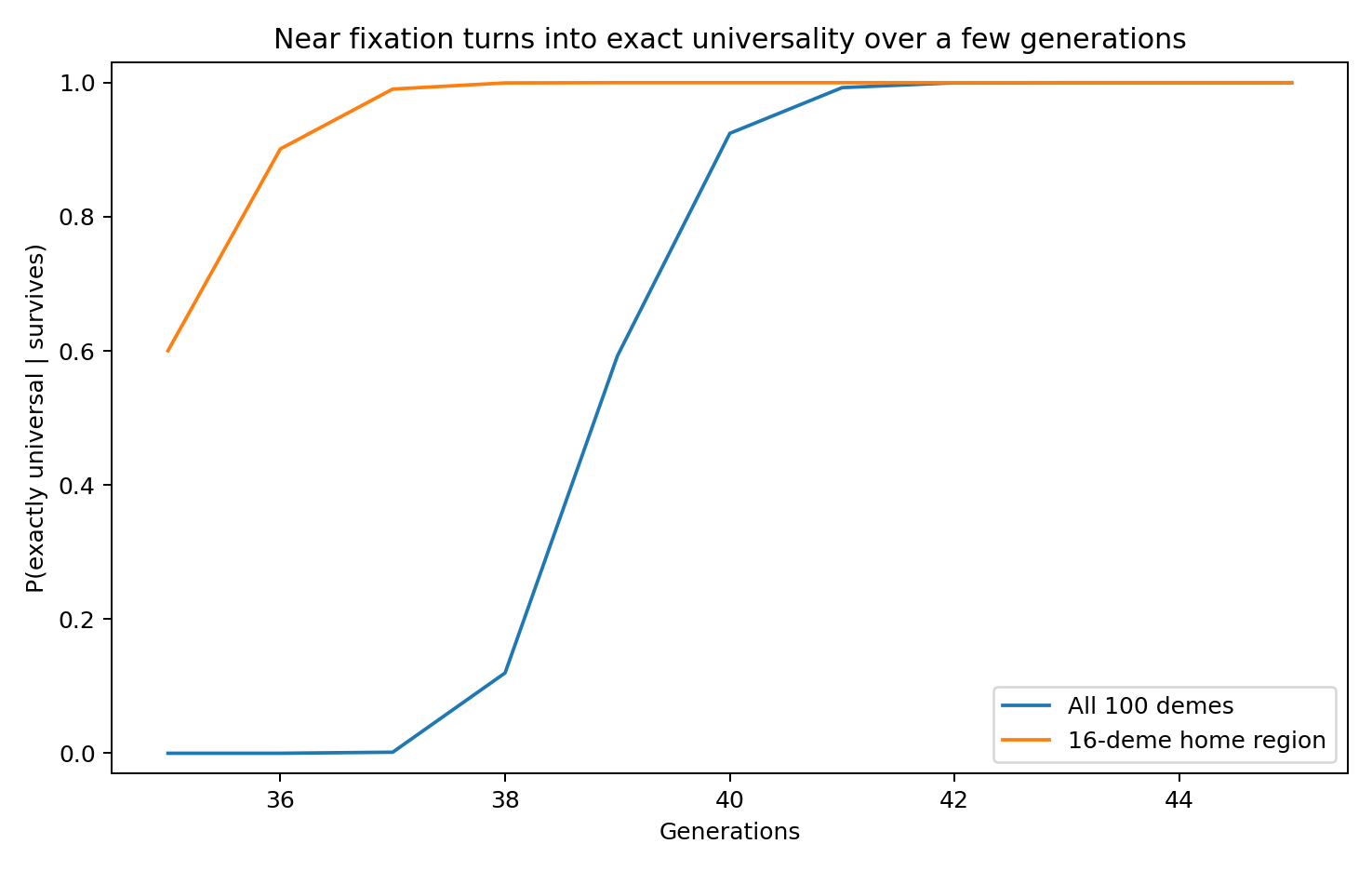
Yet exact universality occurred in only about 12 percent of runs.
One generation later, a majority of runs were universal.
Three generations later, nearly all were.
This threshold behavior explains why intuition is so unreliable. A population can appear essentially saturated while still containing a few isolated holdouts. Then those holdouts disappear over a very small number of additional generations.
Figure 2. Near-saturation turns into exact universality over only a few generations in the central structured scenario.
How Charlemagne’s actual genealogy changes the interpretation
The historical record changes four parts of the simulation.
First, survival is no longer uncertain
For a random person alive around AD 800, the main initial risk is that the lineage simply dies out.
For Charlemagne, we know that did not happen.
We can observe named children, grandchildren, and later descendants. We can trace multiple continuous lines into later medieval dynasties.
So the relevant calculation is not the unconditional probability that his lineage survived.
It is the probability of eventual spread given that the lineage survived and became established.
Second, he had multiple established branches
Charlemagne’s ancestry was not balanced on one grandson.
It passed through Pepin of Italy, Louis the Pious, and several sub-branches of Louis’s descendants.
Multiple branches matter because each is another opportunity to enter a different community. Once several branches are established, the complete extinction of the lineage becomes essentially irrelevant.
The ten-branch scenario is therefore more informative than the one-branch scenario.
Even that may be conservative, depending on which date we choose as the starting point.
Third, the branches were geographically dispersed
The simulation’s ten branches all begin in one community.
Charlemagne’s actual descendants did not.
They entered West Francia, Flanders, East Francia, northern Italy, Burgundy, Lotharingia, Provence, and other elite marriage networks.
This is crucial.
Ten descendants who remain in one isolated valley are not equivalent to ten descendants placed in several major regional networks.
The historically observed long-distance marriages effectively seed the lineage in multiple parts of Europe at once. That reduces the lineage’s dependence on slow, random geographic diffusion.
A more Charlemagne-specific simulation should therefore start with several descendant clusters already distributed across the map.
That would almost certainly raise the probability of continent-wide spread relative to the generic ten-branch scenario.
Fourth, the descendants belonged to a socially stratified elite
This is the main counterweight.
Royal and noble families did not marry randomly into the general population. They disproportionately married other royal and noble families.
Charlemagne’s ancestry could therefore saturate the aristocracy while taking longer to diffuse into ordinary populations.
The better model would contain at least two interacting layers:
A small, geographically mobile elite network with high interregional connectivity.
A much larger ordinary population with predominantly local marriage.
A low but persistent rate of movement between the two layers.
Charlemagne’s lineage would spread very quickly across the elite layer.
The remaining question would be how rapidly it moved downward into the wider population.
But the social barrier was not absolute.
Over many centuries, younger children, illegitimate children, impoverished noble branches, local officeholders, urban migration, military service, remarriage, and ordinary downward mobility would transmit elite ancestry into non-elite populations.
The rate is difficult to calibrate. Pretending otherwise would create false precision.
Still, the direction of the historical update is clear.
Charlemagne’s actual family structure makes universal or near-universal descent more likely than it is for an arbitrary surviving person of his era.
Probably substantially more likely.
What about France specifically?
Stone’s suggestion that there are almost certainly people in France who do not descend from Charlemagne is possible, but his argument does not establish it.
France was not peripheral to Charlemagne’s descendant network.
It contained the West Frankish Carolingians, Vermandois, Flanders, Burgundy, and the Capetian line. Charlemagne’s descendants were embedded in the political and marital networks that shaped medieval France.
For a modern person with deep French ancestry to be a non-descendant of Charlemagne, every branch of that person’s pedigree would have to avoid every Carolingian-descended line that entered the broader population over roughly forty generations.
That is not impossible.
An isolated community can preserve non-descent. So can a sufficiently strong religious, geographic, or social barrier.
But pedigree collapse does not make that outcome likely.
Pedigree collapse means the same ancestors recur repeatedly. Once Charlemagne enters a local pedigree, later endogamy tends to multiply the number of paths back to him.
Stone’s France claim therefore requires evidence about persistent isolation, not merely the observation that medieval people married distant cousins.
The stronger claim about every person before AD 1000
There is a tendency to move from the specific Charlemagne claim to a much stronger generalization:
Every European alive before AD 1000 who left any descendants must now be an ancestor of every European.
That statement does not receive the same historical support.
Charlemagne was unusually prolific, unusually well connected, and unusually successful at placing descendants in geographically mobile dynastic networks.
An ordinary person living in an isolated village might leave descendants who remained confined to one region for centuries.
Another person’s lineage might survive but pass through a religious or geographic community with little outside marriage.
The mathematical identical-ancestors result applies under assumptions about population connectivity and parental mixing. It is not an unconditional rule of history.
So there are really three different propositions:
Charlemagne probably became an ancestor of nearly every European with deep roots in the historically connected European population.
Charlemagne became an ancestor of literally every such European.
Every European alive before AD 1000 whose lineage survived became an ancestor of literally every modern European.
The evidence for the first is strong.
The second is plausible but unproved.
The third requires much stronger assumptions and is almost certainly too sweeping if it includes historically isolated populations.
My ruling
The original 2^40 argument is invalid.
It counts ancestral positions, not distinct people, and cannot prove that one particular medieval person appears in every modern pedigree.
Stone is right about that logical defect.
But Stone’s use of pedigree collapse points in the wrong direction.
Repeated ancestors do not generally preserve pockets of non-descendants. Within a connected population, pedigree collapse is the process by which surviving lineages become shared through many overlapping routes.
The relevant obstacle is persistent separation between groups.
And once we stop treating Charlemagne as a generic founder, the substantive case becomes stronger.
His lineage is known to have survived.
It survived through more than one major branch.
Those branches became geographically dispersed.
They entered the Capetian, Flemish, Norman, East Frankish, Italian, Burgundian, and other European dynastic networks.
By the eleventh century, prominent nobles already possessed multiple genealogical routes back to him.
That makes Charlemagne close to a best-case candidate for becoming a universal European ancestor.
The most defensible conclusion is therefore:
Nearly every person with deep ancestry in the historically connected populations of Western and Central Europe probably descends genealogically from Charlemagne. Literal descent by every European is plausible, but it has not been proved.
So I would split the decision this way.
Stone wins against the naïve proof.
The other side wins the substantive intuition.
And on the specific mechanism offered in the thread, connectivity—not pedigree collapse—decides the case.