

This project began with my 2025 paper with Daniel Van Pelt and Emil Kirkegaard, “Regional Migration Patterns and Educational Outcomes in Italy: A Surname-Based Analysis of Historical Population Movements”. That paper used Italian surname distributions to study migration and educational outcomes, and it introduced surname-weighted Mathematical Olympiad scores as a way to assign elite performance back to likely ancestral provinces.
Here I ask the more general question: can a very selected sample tell us something about ordinary population averages once the sample is reweighted by surname geography?
I test that question in two domains. The first is math. Mathematical Olympiad competitors are an elite sample, while INVALSI native math scores—a nationwide standardized assessment administered to Italian students—provide province-level average math performance. If surname-weighted Olympiad performance predicts INVALSI math, then the elite tail contains information about the population mean
The second domain is height. Elite athletes are a selected, height-biased sample; ISTAT conscript height is an external population benchmark. Height is useful because it lets me run the same surname-weighting logic in a different domain and compare it with the more obvious province-of-birth approach.
Throughout the post I use phenotype broadly: a measured province- or region-level outcome, not necessarily a purely genetic trait.
How the surname weights are computed
The surname method is simple in spirit. Some surnames are geographically uninformative because they are common almost everywhere. Others are concentrated in a few provinces. I use a TF-IDF-style weighting scheme to keep the second kind of signal and downweight the first kind.
In ordinary text analysis, TF-IDF gives high weight to a word when it is common in one document but uncommon across the corpus. Here the “documents” are provinces and the “words” are surnames. A surname receives more geographic weight in a province where it is locally overrepresented, and less weight when it is also common nationally. Rossi-style surnames therefore carry little geographic information; province-specific surnames carry much more.
Operationally, start with surname counts by province. For surname s and province p, compute a local frequency term: how common s is inside p. Multiply it by an inverse-commonness term: how distinctive s is across Italy. This gives a raw TF-IDF score for every surname-province pair:
raw_weight(s,p) = local_frequency(s in p) × inverse_national_commonness(s)
Then normalize across provinces for the surname:
P(p | s) = raw_weight(s,p) / sum_over_provinces raw_weight(s,p)
That normalized vector is the usable object. Strictly speaking, P(p | s) is a surname-geography weight rather than a certified genealogy. But it behaves like an ancestry posterior for the purpose of aggregation: it says how much of the observation should be assigned to each province given the surname.
A competitor or athlete is therefore not assigned to a single province. Their score or height is spread across provinces according to P(province | surname). A geographically generic surname produces a flat, weak vector. A geographically concentrated surname produces a sharper vector.
Province scores are then weighted averages. If individual i has outcome y_i and surname s_i, their contribution to province p is P(p | s_i). The estimated province score is:
province_score(p) = sum_i P(p | s_i) y_i / sum_i P(p | s_i)
So an Olympiad competitor with a Veneto-weighted surname contributes mostly to Veneto provinces; a competitor with a diffuse surname contributes weakly across many provinces. The same logic is used for athlete height, after the height adjustments described below.
The observations are elite individuals, but the target is an average province trait. TF-IDF turns the surname into a fractional ancestry-weight vector, and the province phenotype is computed by aggregating those fractional observations.
Test 1: the elite math tail predicts INVALSI
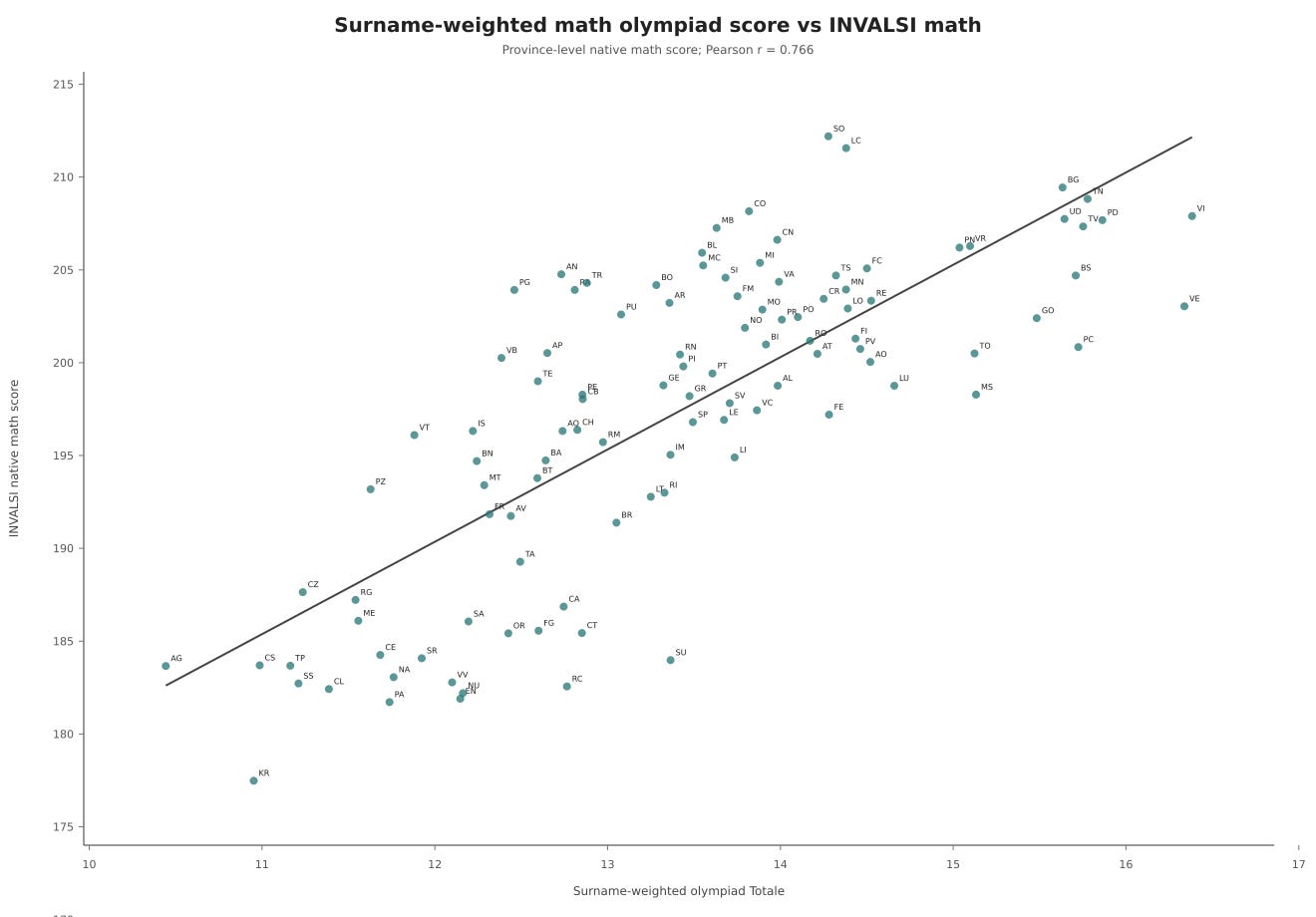
The cleanest test is math. I used the combined Mathematical Olympiad files, took Totale as the competitor score, applied the cognomix4 surname rules, and computed a surname-weighted average Olympiad score by province. I then compared that province score with INVALSI native math scores.
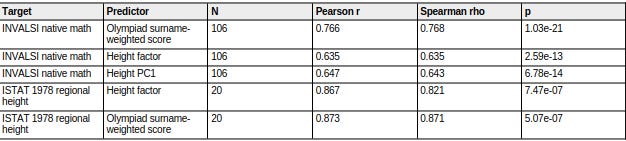
Across 106 matched provinces, the surname-weighted Olympiad score predicts INVALSI native math at Pearson r = 0.766. The height factor also correlates with INVALSI math, r = 0.635, and the height PC1 gives r = 0.647. But the Olympiad score is the stronger predictor; the Williams test comparing the dependent correlations gives p = 0.012.
That distinction matters. Many Italian province-level variables share a broad north-south gradient, so some cross-domain correlation is expected. The question is whether the math-specific elite measure adds signal beyond generic geography. Here it does.
Surname-weighted Mathematical Olympiad score vs INVALSI native math
Cross-domain prediction summary
Test 2: height as a validation phenotype
Height gives a second test of the same logic. I collected Italian athletes from women’s volleyball, men’s volleyball, women’s basketball, men’s basketball, and rowing, with winter sports added as a small supplemental check. I kept athletes with usable height and usable birthplace or surname information, collapsed duplicates, retained the last recorded height for athletes observed in multiple seasons, and excluded players younger than 16.
The target is not athlete height itself. The target is whether elite athlete height, after surname weighting, recovers an external population benchmark: ISTAT regional male conscript height.
I built a combined height factor from six sport-sex indicators: female basketball, female rowing, female volleyball, male basketball, male rowing, and male volleyball. The surname-weighted version has 106 provinces with all six indicators. Its first principal component explains 38.0 percent of the variance, while the one-factor model explains 27.4 percent. The factor loadings are 0.65 for female basketball, 0.24 for female rowing, 0.72 for female volleyball, 0.52 for male basketball, 0.26 for male rowing, and 0.56 for male volleyball.
Average height for provinces was not available, so I had to merge provinces into regions.
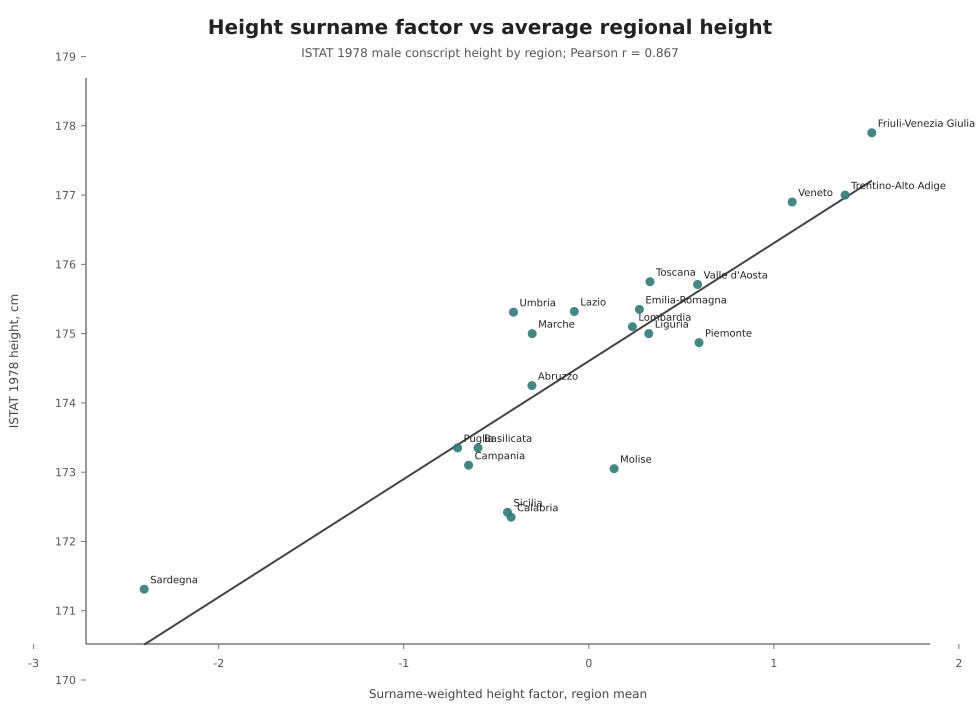
Using the 1978 birth cohort of male conscripts, the combined surname-weighted height factor correlates with regional ISTAT stature at Pearson r = 0.867. The PC1 version is slightly higher, r = 0.886.
Surname-weighted height factor vs ISTAT regional stature
Surname weighting versus birthplace
The height data allow a direct validation check that the Olympiad data mostly cannot: compare surname-weighted averages with ordinary province-of-birth athlete averages.
If surname weighting were merely decorative, birth province should do just as well. It does not. On the matched ISTAT height comparisons, the surname-weighted signal predicts regional height better than the corresponding birth-province signal. For the combined sex-sport height factor in the 1978 ISTAT series, the birth-province factor gives r = 0.698, while the surname-weighted factor on the same matched regions gives r = 0.857.
Across the matched historical height comparisons, the surname-weighted Pearson r is higher in every comparison.
A more practical birth-province ranking uses empirical-Bayes shrinkage after adjusting height for sport-sex and birth year. That ranking contains 7,444 athletes across 107 provinces, with 70 provinces having N >= 30. Its athlete-N-weighted regional shrunk means correlate with ISTAT 1978 height at r = 0.779 across all regions, and r = 0.819 when using only provinces with N >= 30.
Those are strong results. But in the all-region validation, the surname-weighted height factor remains higher. This is the key validation result: surname weighting is not just an ancestry-flavored transform. In the height domain, it predicts external average stature better than the corresponding birthplace-based elite averages or factors.
The effect of geography
The geographic structure is obvious once it is measured directly. Regressing the surname-weighted height factor on province latitude and longitude gives R^2 = 0.469. Latitude is the main term: its standardized beta is 0.83. Longitude is smaller but still positive, beta = 0.28.
Heating degree-days are a cold-exposure measure. For each day, they count how far the mean temperature falls below a reference comfort temperature; those daily shortfalls are then summed over the year. Colder provinces accumulate more heating degree-days because buildings need more heating.
Heating degree-days show the same broad north-south pattern: mean province heating degree-days correlate with the height factor at r = 0.597. But in a joint model with latitude and longitude, the HDD term no longer survives (p = 0.179), whereas latitude remains strongly predictive (p = 9.1e-06).
This also explains why the historical height comparison is less clean than the INVALSI math comparison. The height factor correlates with ISTAT 1978 regional height at r = 0.867, while the surname-weighted Olympiad regional score also correlates strongly, r = 0.873. That is not because Olympiad scores cause height. It is because many Italian province-level variables ride the same geographic gradient, which in turn is strongly correlated to ancestry.
The specificity result is therefore asymmetric. Olympiad scores clearly beat height for predicting INVALSI math. Height does not clearly beat Olympiad scores for predicting ISTAT regional height, likely because both measures carry a strong common geography or ancestry signal.
The novel idea: surnames as ancestry weights
A surname is usually treated as a label: Rossi, Esposito, Bianchi. One person, one name. The TF-IDF approach turns that label into an ancestry-weight vector. A name gets high weight in the provinces where it is unusually concentrated and low weight where it is merely common. Very common surnames are deliberately muted; geographically distinctive surnames carry more information.
In text analysis, TF-IDF asks which words distinguish a document from the corpus. Here it asks which surnames distinguish a province from Italy as a whole. A surname is informative when it is common locally but not common nationally.
That means each competitor or athlete can be given an implied ancestral geography. Not a single assigned province, and not a literal family tree, but a set of fractional weights over provinces: this much of the observation points to Veneto, this much to Sicily, this much to Campania, and so on. Once you have that vector, the individual’s phenotype can be redistributed across provinces according to the surname-implied ancestry weights.
This is the methodological novelty. Instead of asking whether someone was born in province X, the method asks how strongly their surname historically points to province X. Birthplace captures a recent event; surname geography captures a deeper and noisier historical signal. The TF-IDF step is what makes that signal usable: it separates surnames that are informative about origin from surnames that are just common.
An elite sample of a few thousand athletes or Olympiad competitors becomes a set of fractional ancestry-weighted observations spread over the Italian map. Aggregated back to provinces, those weighted observations recover real population-level differences.
In math, the surname-weighted Olympiad signal predicts INVALSI native math. In height, the surname-weighted athlete signal predicts ISTAT regional stature and beats the corresponding birthplace-based elite averages in the matched validation. The same trick works across two very different phenotypes.
Bottom line
Surnames can be used to compute useful ancestry weights for individuals, and that those weights become powerful when aggregated. TF-IDF turns a surname from a crude label into a probabilistic geographic instrument. It lets an otherwise biased elite sample be reweighted toward the ancestral provinces encoded in the names of the people in the sample.
Without family trees, DNA data, parental birthplace, or a random population sample, a small elite list can still carry enough geographic information to recover average province-level phenotypes.