
Germanic Origins Inside the Ancestry Doll

Germanic origins have been argued over for two thousand years. Ancient DNA changes the question: not where the story was told, but which ancestry layers actually survive.
Tacitus began with a simple claim. In Germania, he described the Germans as native to their land and not much mixed with outsiders. He even extended the idea into physical type, presenting them as a distinct population with shared appearance. That was Roman ethnography, not population genetics, but the image stuck: the Germans as an old northern people rooted in place.
Much later, archaeology and physical anthropology tried to give that intuition a prehistoric skeleton. Gustaf Kossinna’s settlement archaeology treated sharply bounded archaeological cultures as the traces of particular peoples. Early twentieth-century Nordic and Germanic origin theories often moved too quickly from pots, skulls, and maps to peoples, tribes, and races. Carleton Coon’s typological anthropology, for example, still spoke in terms of Nordic, Corded, Danubian, and Hallstatt types.
Ancient DNA did not simply confirm those older theories. It changed the object of the argument. The question is no longer whether a culture label can be equated with a people, or whether a skull type can identify a race. We can now ask directly how later northern Europeans relate to earlier genetic populations: Yamnaya, Corded Ware, Bell Beaker, farmer groups, and hunter-gatherer groups.
That sounds straightforward until the labels are opened. Bell Beaker is not a pure alternative to Corded Ware or Yamnaya. Corded Ware is not a pure alternative to Yamnaya. Each is itself a mixture of earlier ancestry. If Bell Beaker is used as a source, some farmer and WHG ancestry is already packed inside it. If Corded Ware is used as a source, some Yamnaya, farmer, and WHG ancestry is already packed inside it.
This post is about that nesting problem. I model Viking Scandinavians, medieval Germanic/Saxon samples, present-day northwest European proxies such as CEU and GBR, modern Finns, and southern Europeans. The point is not to identify a single ancestral source. It is to see how the model changes once the components themselves are decomposed.
Figure 1. The ancestry labels are nested
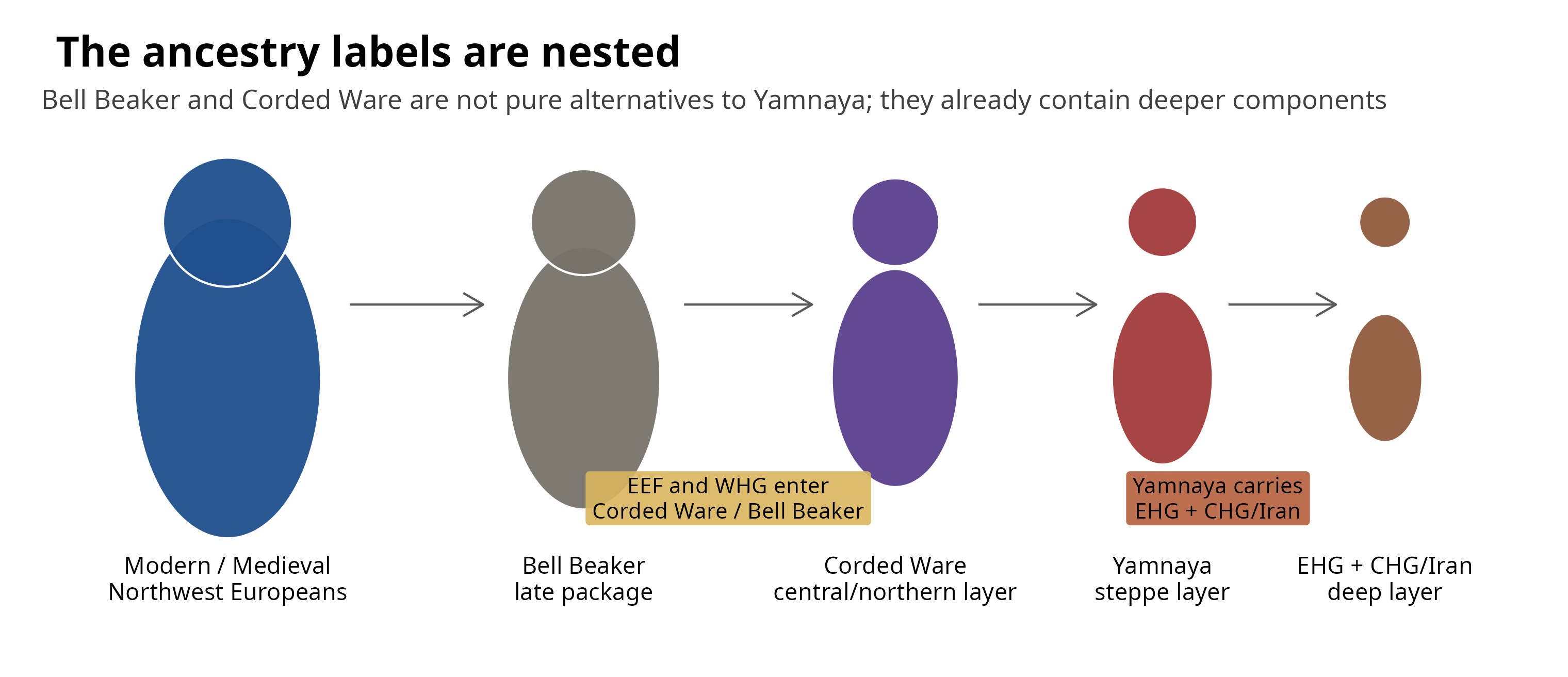
The surprising result is that Corded Ware, Yamnaya, and Bell Beaker are not rival answers. They are layers. Once those layers are opened, the same Germanic and northwest European samples tell a much cleaner story: closer to Corded Ware than to Yamnaya, closer still to Bell Beaker, and yet built from the same deeper ancestry stack.
