
How Aryan are Iranians?
Evidence from ancient and modern DNA

A common way of talking about Iranians, especially among nationalists, is to reduce them to “Aryans,” usually understood as descendants of Indo-Iranian peoples from the Eurasian steppe. The claim is exaggerated, but not baseless: part of Iranian ancestry really does trace back to the steppe.
In the standard archaeological and linguistic model, the story begins in the Proto-Indo-European world of the Pontic-Caspian steppe, often associated with Yamnaya-related populations. Later, from that broader steppe background, emerged eastern Bronze Age groups such as Sintashta and related populations, which are much more plausibly connected to Proto-Indo-Iranian. So the usual model is not that Yamnaya themselves were Proto-Indo-Iranian. Rather, Yamnaya-related peoples belong to an earlier Proto-Indo-European horizon, while Sintashta and related eastern steppe groups represent a later development, more directly tied to the branch that eventually gave rise to Indo-Aryan and Iranian languages.
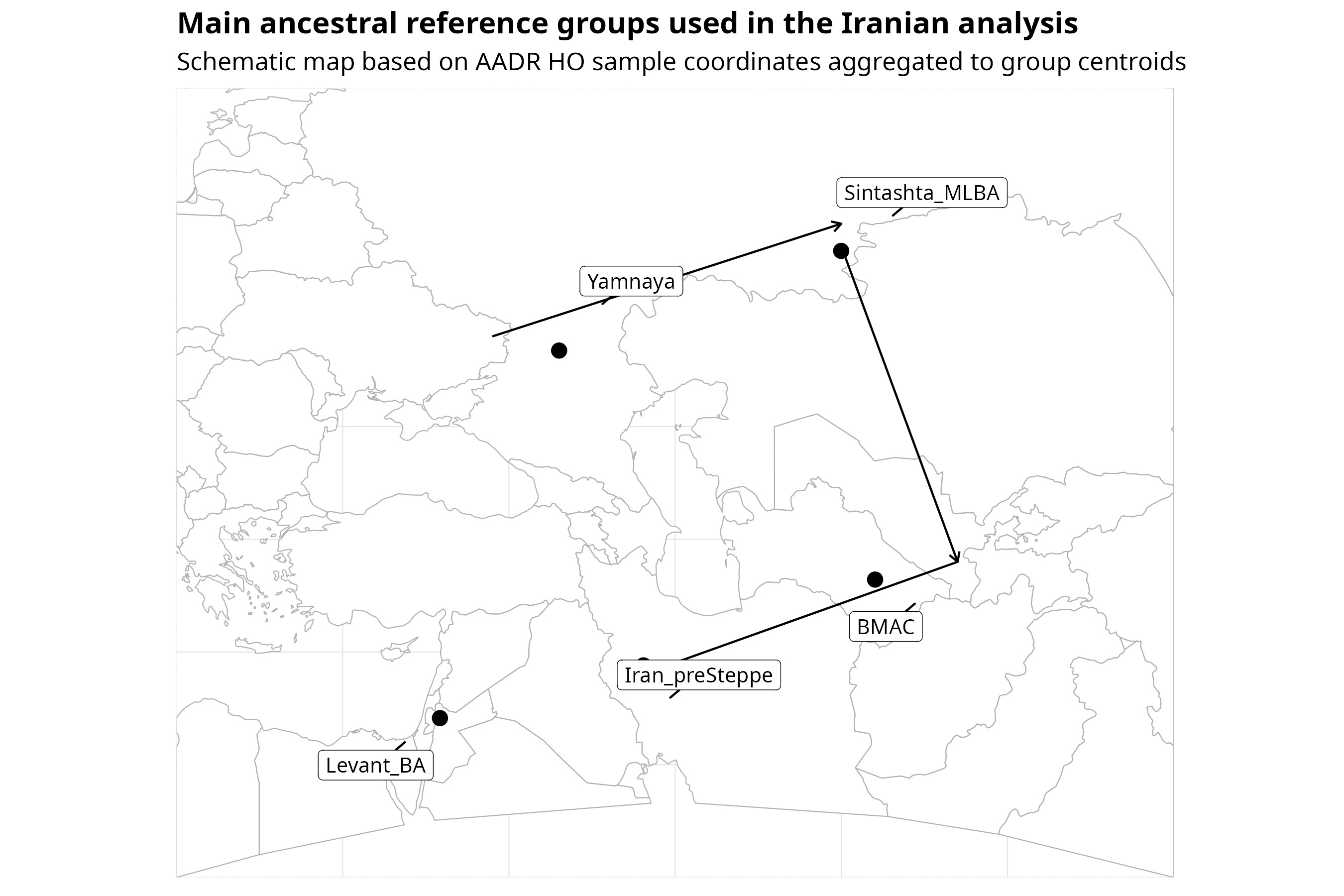
The map below summarizes the main populations used as geographic anchors in the analysis. It is not meant as a claim about exact homelands or migration routes in any narrow sense. Rather, it situates the broad ancestral zones discussed in the text: the western steppe world associated with Yamnaya, the eastern steppe zone associated with Sintashta and related Middle to Late Bronze Age groups, the Zagros-related pre-steppe populations of Iran, and the Central Asian BMAC horizon that later became crucial in shaping Iranian ancestry.
Figure 1. Map of the main ancestral source regions discussed in the Iranian analysis
If Iranian languages ultimately derive from a Proto-Indo-Iranian world connected to later steppe populations, then one should indeed expect some steppe-related ancestry in later Iranian-speaking populations.
The steppe connection is real. But how large was it, and what exactly did it enter? That is where the nationalist simplification starts to break down. Once we look at the ancient Iranian sequence, and then at formal models of modern Iranian groups, the picture becomes much more layered than the usual “Aryan” story suggests.
That, though, is not the main question. The more interesting question is how much of Iran’s ancestry came from that steppe-linked source, and how much was already there before it arrived.
