

There’s a meme that comes back every few months: the same face split in half, captioned “Northern Italian vs Southern Italian”: one side styled as lighter and more “Central/Northern European,” the other as darker and more “Mediterranean.” Or a blonde northerner contrasted with a brown southerner, like this one:
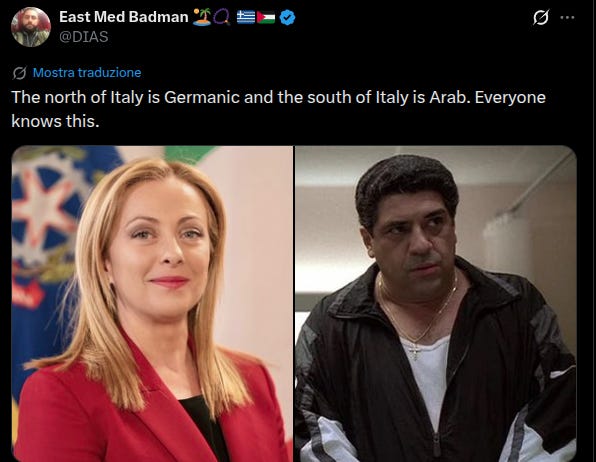
Setting aside the fact that Meloni’s parents are both from southern Italy, the meme is a caricature. Still, it gestures at a real question that is historically loaded and genetically testable:
Did Northern Italy actually absorb a meaningful amount of “Germanic” ancestry, especially during the Barbarian invasions of the early Middle Ages?
This post is my attempt to answer that question with a simple, transparent approach using Genoplot’s admixture models. These are not formal demographic reconstructions; they’re best thought of as a structured sanity check that can still be very informative when you interpret them carefully.
What does “Germanic” mean, exactly?
Before looking at numbers, we need to define the word Germanic, because people use it in at least three different ways:
“Germanic” = German (or Austrian/Swiss-German) today.
That’s a modern national meaning. It’s not what most people have in mind when they ask whether Northern Italy is “Germanic.”“Germanic” = the early medieval Germanic-speaking groups involved in the Migration Period (Goths, Lombards/Longobards, etc.).
Historically, this is the core claim: that admixture occurred during/after the Gothic and Lombard invasion and settlement, plus smaller later flows. The Lombards entered Italy in 568–569 CE and established a kingdom that reshaped much of northern and central Italy.“Germanic” as an old anthropological “Nordic” type.
That’s the least useful definition scientifically. “Nordic-looking” is not a genetic category, and phenotype can’t be reverse-engineered into clean historical ancestry labels.
In this post, I’ll use Germanic in sense (2): genetic contribution from early medieval, north/central-European-associated groups, as proxied by ancient DNA samples linked to that world.
