
Japan’s First Footprints: Tracing the Genetic Legacy of the Jomon

For thousands of years before the first rice paddies were carved into the landscape, the Jomon people thrived across the Japanese archipelago. These indigenous hunter-gatherer-fishers built a remarkably stable, deeply rooted island culture, leaving behind a rich archaeological record famous for some of the world’s earliest pottery (Cooke et al. 2021).
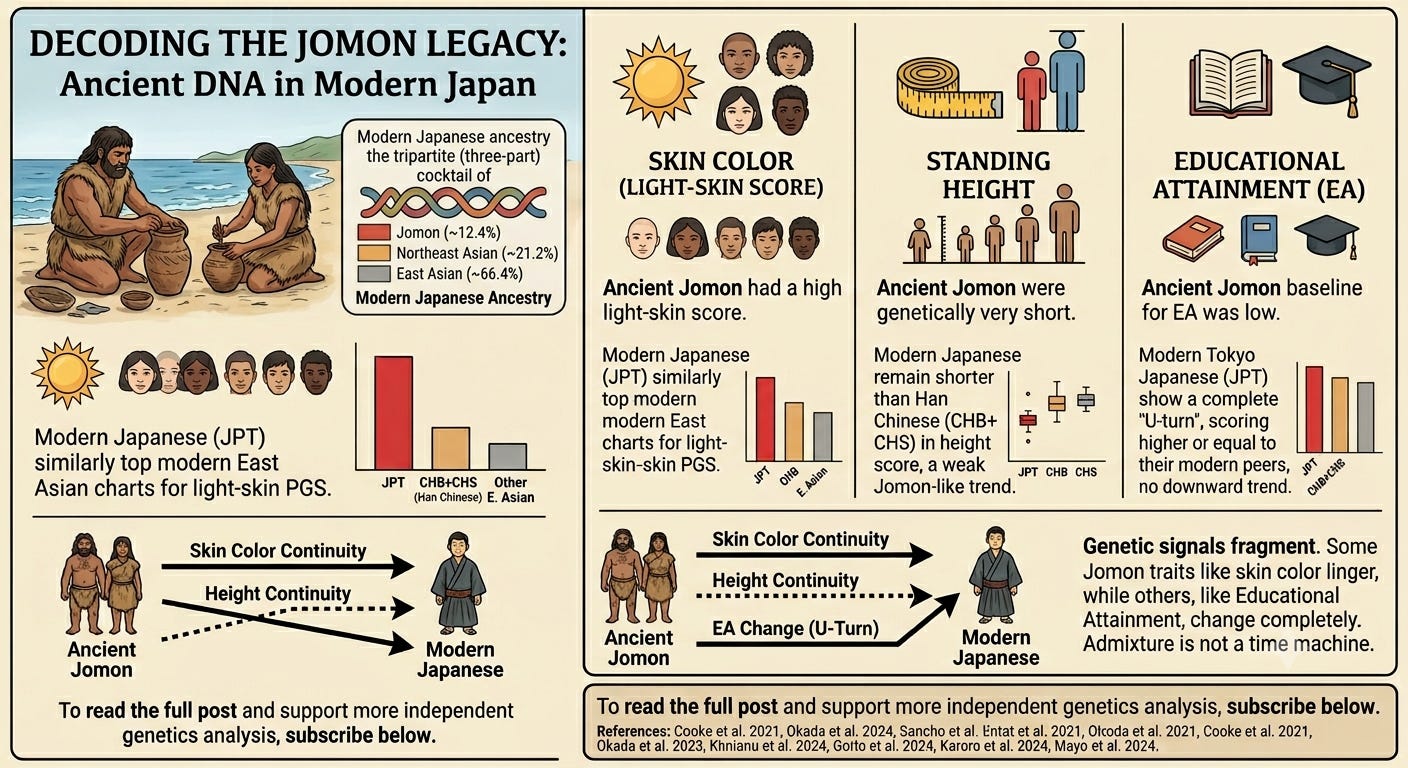
But from a genetic standpoint, the Jomon are an anomaly. They aren’t just “ancient Japanese” in a modern sense. Instead, modern mainland Japanese ancestry is a tripartite (three-part) cocktail (Okada et al. 2024).:
~12.4% Jomon (the original foragers)
~21.2% Northeast Asian (associated with the influx of Yayoi period farmers)
~66.4% East Asian (linked to Kofun period state formation)
Because of this distinct genetic layering, Japan serves as a fascinating evolutionary test case. If the ancient Jomon possessed a unique polygenic score (PGS) profile—the collective genetic variants that influence complex traits—does a shadow of that profile still linger in modern Japanese populations today?
To find out, I looked at three specific polygenic scores: educational attainment (EA), standing height, and a light-skin pigmentation score based on an East Asian GWAS (Kim et al., 2024).
The Ancient Baseline: How the Jomon Stood Out
To set the baseline, I pulled imputed ancient DNA from a broad East Asian dataset, grouping 17 ancient samples explicitly identified as Jomon. I then stacked them up against other ancient East Asian populations.
Because these ancient samples span a wide range of eras, a raw comparison could easily mask or mimic evolutionary shifts. To fix this, I adjusted the model for sample age. The numbers below reflect the standardized PGS effects driven strictly by Jomon group identity, independent of time.
Table 1. Time-adjusted Jomon PGS effects in the ancient dataset.

The Jomon are low for EA, extremely low for height, and high for the Kim light-skin score.
Figure 1. Time-adjusted ancient Jomon PGS compared with other metadata population groups.
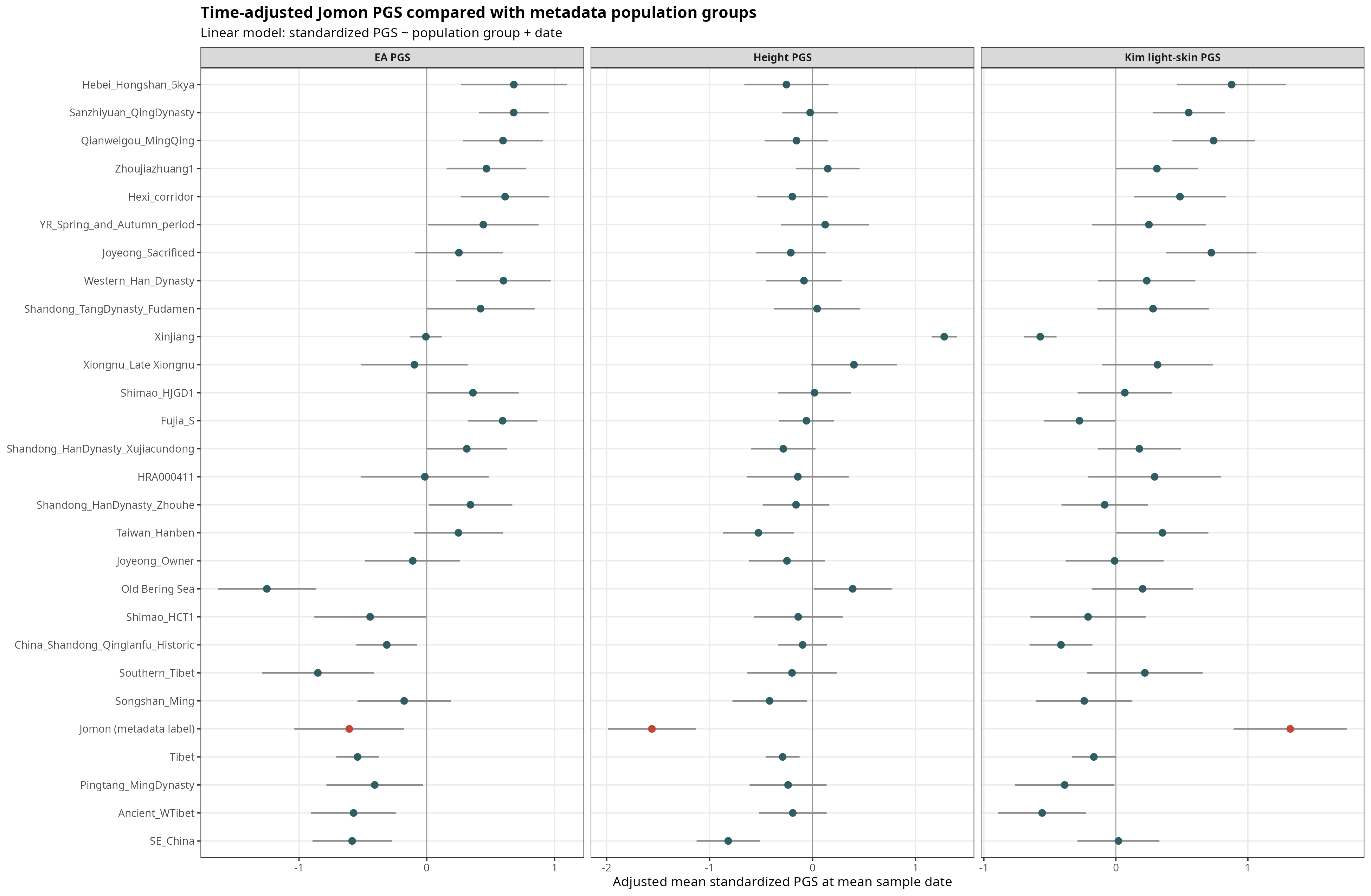
The ancient Jomon pattern is clear: low EA, very low height, and high light-skin PGS. But the more interesting question is whether any of this survives in modern Japanese, who are mostly descended from later mainland-derived Yayoi and Kofun ancestry. That is where the result gets more complicated.