
Modern Middle Eastern inbreeding patterns may have very deep roots

One of the most common claims in ancient DNA research is that the Neolithic transition reduced inbreeding.
Before agriculture, human populations were extremely small and scattered. In such populations individuals inevitably share many ancestors, increasing genetic relatedness. When farming spread across Eurasia, populations grew dramatically. Larger populations reduce the probability that parents are closely related.
Yet this leaves an obvious question.Some of the highest rates of cousin marriage in the world today are found in the Middle East. The standard explanation is Islam. But what if Islam did not create these practices? What if it instead codified marriage patterns that were already ancient?
Ancient DNA allows this claim to be tested directly.
Runs of homozygosity (ROH) are long stretches of DNA inherited identically from both parents and they provide a genomic measure of inbreeding in individuals who lived thousands of years ago.
ROH vary in length, and different lengths reflect different demographic processes.
Very long segments typically arise when parents are closely related. Shorter segments accumulate gradually in small populations even when marriages are not between close relatives.
To distinguish these processes, I analyzed three ROH classes in more than 3,500 ancient Eurasian individuals from the Allen Ancient DNA Resource:
4–8 cM: background relatedness accumulated over many generations
8–20 cM: intermediate inbreeding reflecting relatively small populations
20 cM: very recent parental relatedness
I then estimated regression models with a hinge around 12,000 years before present, allowing the relationship between time and ROH to change at the beginning of the Holocene.
The results show that the Neolithic transition reduced some forms of inbreeding but not others.
Very long ROH—the genomic signature of close parental relatedness—are not predicted by time. Instead, they are strongly associated with the Iran Neolithic / Levantine-related ancestry component (labelled “East Med Levant Anatolia”), which peaks in Iranian Neolithic populations and reflects ancestry from early farming groups across the eastern Fertile Crescent. Ancient DNA studies show that these populations formed part of a broader West Asian Neolithic genetic continuum linking the Iranian plateau, Anatolia, and the Levant.
This pattern raises the possibility that some modern Middle Eastern marriage practices may have very deep historical roots.
Three Patterns in Ancient Inbreeding
To quantify these patterns, I estimated regression models predicting the total length of ROH in each size class. The models include time (in centuries), a hinge at 12,000 years before present, sequencing coverage, and ancestry components from the major prehistoric populations of western Eurasia.
First, short ROH (4–8 cM) increase strongly as we move back in time, reflecting the very small population sizes of Paleolithic hunter-gatherers.
Second, intermediate ROH (8–20 cM) show a clear structural break around the beginning of the Holocene, consistent with the demographic expansion associated with the spread of agriculture.
Third, very long ROH (>20 cM)—the signature of close parental relatedness—are not predicted by time at all. Instead, they are strongly associated with Levantine / East Mediterranean ancestry.
The table below summarizes the hinge models for the three ROH classes.
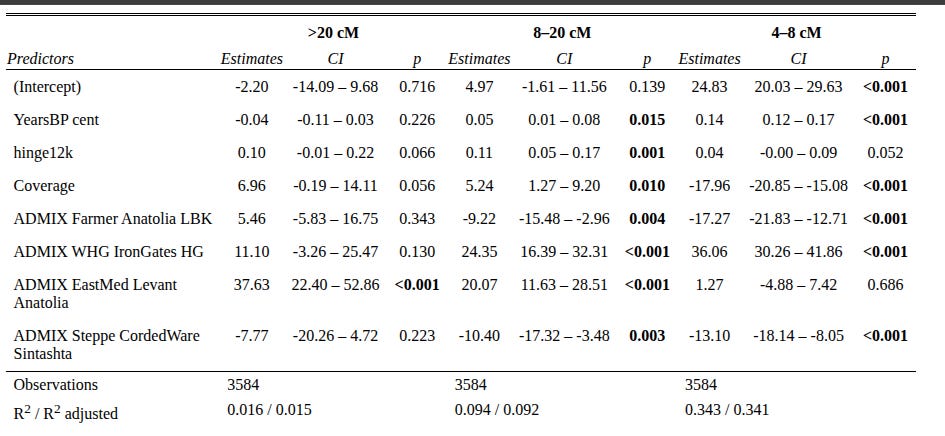
The coefficients point to a clear conclusion: the Neolithic transition reduced the background relatedness produced by extremely small populations, but it did not eliminate the social patterns that generate very close genetic relationships.
In other words, the transition to agriculture changed the demographic scale of human populations, but it did not necessarily transform the local marriage structures that determine whether close relatives reproduce.
The next sections examine each ROH class separately. Short ROH capture the long-term demographic expansion of human populations. Intermediate ROH reveal a clear structural break around the beginning of the Holocene. And the longest ROH—the clearest genomic signal of close parental relatedness—show a very different pattern altogether.
These differences help explain why some ancient populations continued to show extremely high levels of close-kin relatedness thousands of years after the Neolithic transition.