

A new study in Science has just strengthened the case that interbreeding between Neanderthals and modern humans was strongly sex biased. By examining patterns of introgression on the X chromosome and autosomes, Platt et al. (2026) conclude that gene flow was predominantly from male Neanderthals into female anatomically modern humans (AMHs).
That finding reopens an older debate: what exactly were Neanderthals in biological terms? Separate species? A subspecies? A deeply divergent human lineage that nevertheless exchanged genes with ours?
The discussion often moves quickly to scenarios of “mate preference,” as if interbreeding were simply a matter of individuals choosing across group boundaries. But this assumes a level of familiarity and similarity that is easy to project backward and much harder to justify.
We forget how different Neanderthals and early modern humans must have seemed to one another. The lineages had been separated for roughly half a million years. Neanderthals also differed in craniofacial morphology, overall robusticity, and body proportions, and likely in aspects of development and life history. The genetic differentiation between the lineages was substantial. And the distance wasn’t only biological: even if both groups used complex vocal communication, there is no reason to assume mutual intelligibility—or even anything like easy interpersonal conversation. More conservatively, we should expect major communication barriers. At the extreme, it is still debated whether Neanderthals had “language” in the modern human sense at all, as opposed to some more limited communication system.
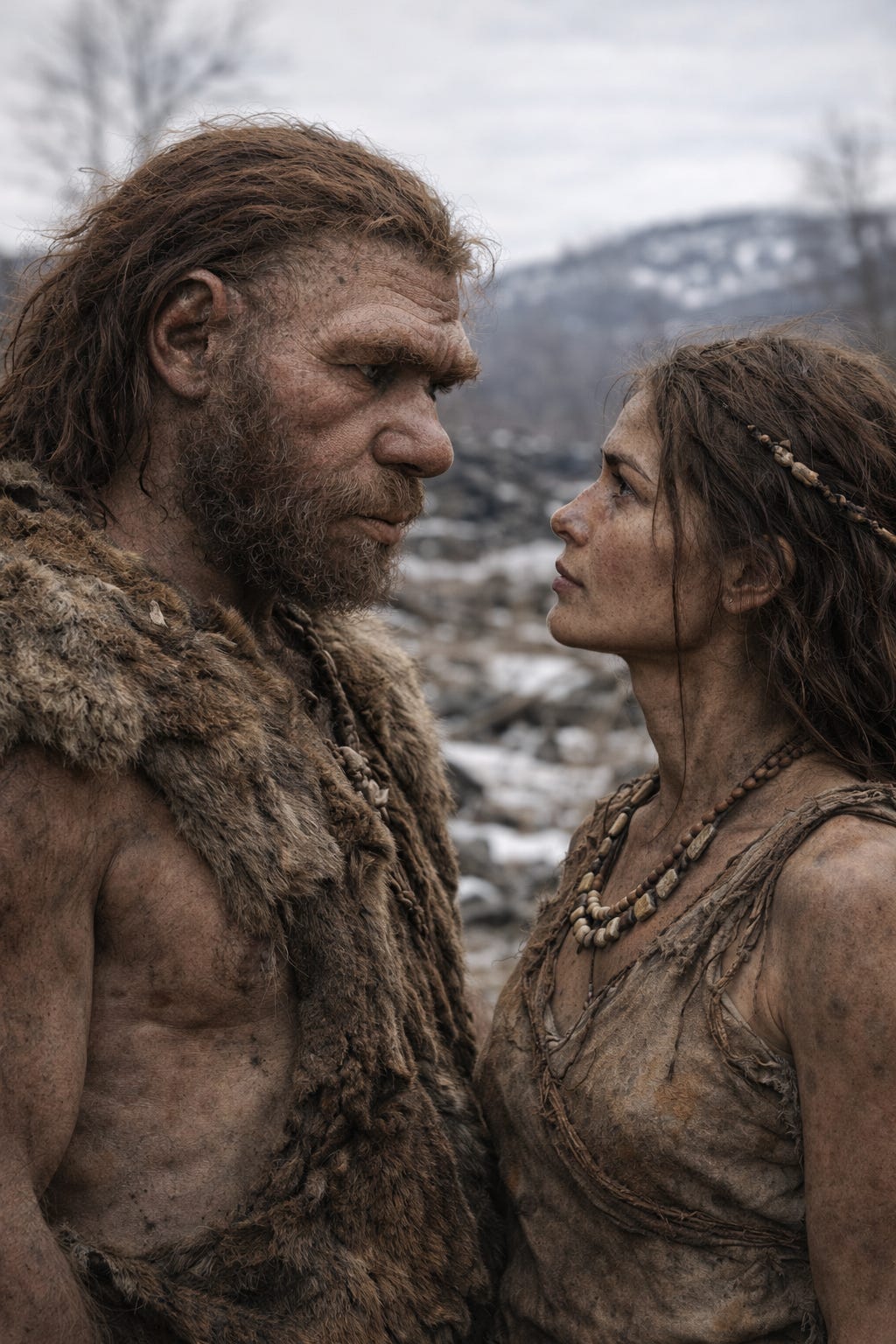
Even among present-day humans, where genetic distances are far smaller, relatively subtle phenotypic, cultural, and linguistic differences can produce strong mating barriers. Here the differences were likely larger on every relevant axis.
How plausible is a “free choice” scenario in which modern human females preferentially chose Neanderthal males, or vice versa? Could coercive encounters such as capture of females during intergroup conflict, have contributed? Or were the patterns driven by more conservative demographic processes, such as patrilocality, skewed migration, or repeated small pulses of contact?
Before you tell a story about mate choice, coercion, or demography, you need the scale of divergence. So I measured it.