
Psychology’s Blind Spot: Laziness
The marshmallow task measures patience. It does not measure willingness to exert effort

Modern psychology has no trouble talking about anxiety, impulsiveness, trauma, grit, self-control, conscientiousness, executive function, and delay discounting. But it still seems oddly reluctant to talk about laziness.
That is strange, because laziness is one of the most familiar facts of ordinary life. Everyone knows the phenomenon. A person keeps postponing a task that matters, not because he does not understand the reward, not because the reward is too small, and not even because the reward is too far in the future, but because he simply recoils from the effort itself. He does not want to begin. He does not want to persist. He does not want to bear the friction.
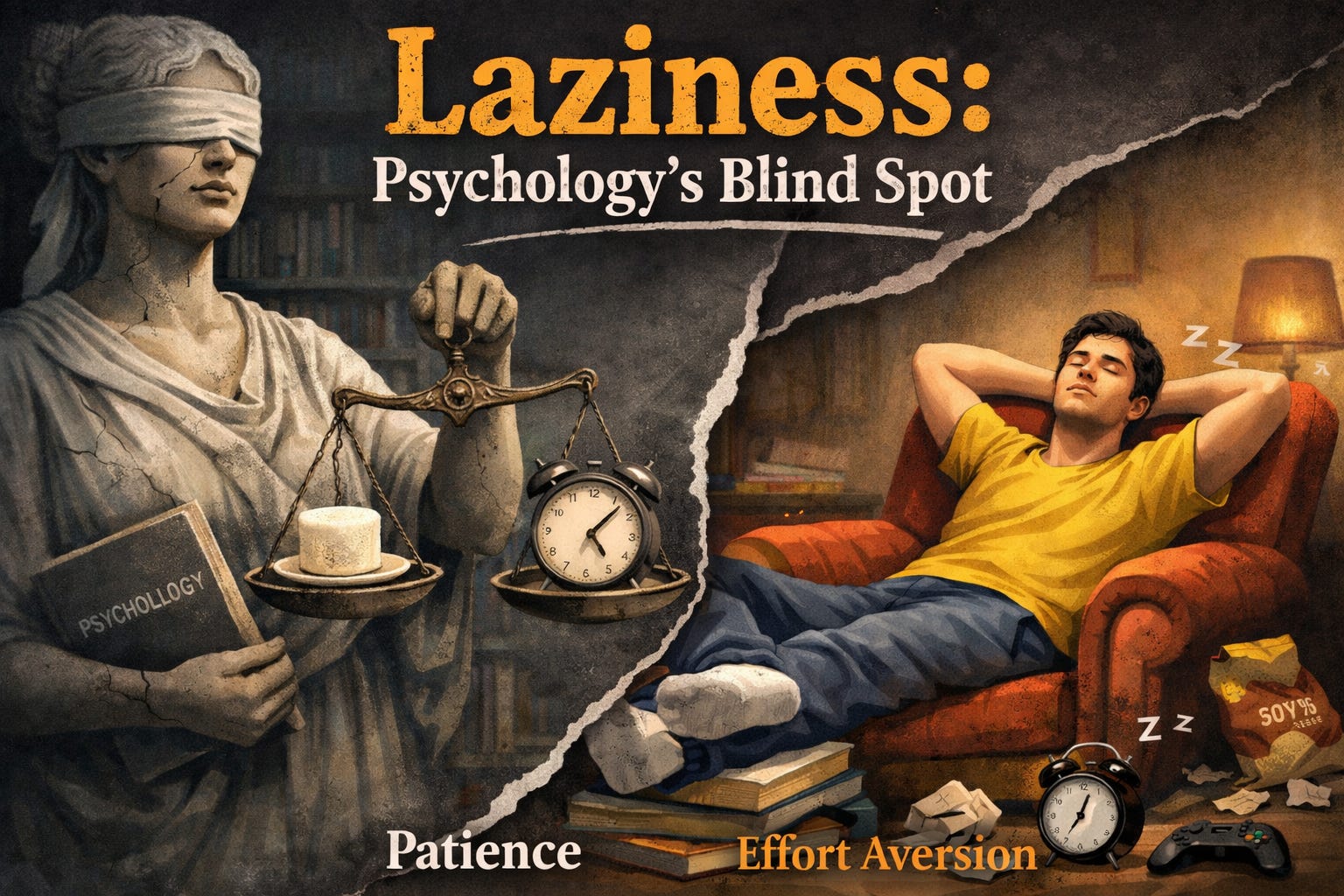
Yet once you try to formalize that intuition, the concept becomes morally radioactive. Laziness is not a neutral modern label. It carries the residue of sloth, vice, and blame. It is one of the seven deadly sins. And that may be one reason the scientific literature has mostly approached the territory indirectly, through safer and cleaner constructs like conscientiousness, self-control, and delay discounting, rather than asking head-on whether some people are simply more averse to exertion than others.
That caution is understandable. No serious psychology should smuggle theology in through the back door. But the opposite error is also possible. Once a trait becomes morally charged, researchers become unusually hesitant to treat it as a real dimension of human variation at all. They prefer to rename it, dissolve it into environment, or absorb it into broader constructs that sound less accusatory. In that sense, laziness may represent a kind of scientific blind spot: not because the phenomenon is unreal, but because the word is too morally dangerous to touch directly.
The result is that psychology has become much better at measuring impatience than at measuring unwillingness to exert effort.
The classic example is the marshmallow task. A child is offered one treat now or two if he waits. For decades, that experiment served as the popular emblem of delayed gratification and future-oriented discipline. But later work greatly complicated the legend. The predictive power of the task turned out to be much smaller than the original mythology implied once background variables were taken more seriously, and more recent work has continued to treat the task more cautiously than its pop-psych afterlife would suggest. The marshmallow task still captures something real, but what it captures is mainly willingness to wait. It does not cleanly capture willingness to work.
That distinction is important, because willingness to wait and willingness to work are not the same thing.
A person may fully accept that a future reward is valuable, may be perfectly capable of waiting for it in principle, and yet still avoid the actions required to obtain it. Not because he discounts the future steeply, but because the path itself feels aversive. The task is tedious, draining, monotonous, frustrating, attentionally costly, or simply more unpleasant than its alternatives. The problem is not time preference. The problem is effort cost.
This is where I think the concept of laziness should be sharpened.
Laziness is not just low conscientiousness. Conscientiousness is too broad. It bundles together reliability, orderliness, dutifulness, self-discipline, and persistence. Those things overlap with laziness, but they are not identical to it. Nor is laziness just procrastination, because procrastination can arise from anxiety, self-doubt, fear of failure, or perfectionism. Nor is laziness simply impatience, because impatience is about devaluing rewards that arrive later.
Laziness, in the stricter sense, is better understood as effort aversion net of impatience.
That raises the next question. What exactly is effort?
The wrong answer is to treat it as something mystical or merely introspective. The overly narrow answer, on the other hand, is to reduce it to calories alone. The calorie-based view has an enormous advantage: it grounds effort in a real, measurable physical quantity. That should not be dismissed prematurely. In physical tasks, effort clearly does involve energy expenditure, and the idea that humans evolved to economize scarce energy has obvious plausibility. At the same time, the literature on cognitive effort strongly suggests that the subjective cost of effort is not exhausted by immediate metabolic burn. Researchers often define cognitive effort in terms of the way rewards lose subjective value when they require more mental work, and some influential theories interpret the feeling of effort as partly an opportunity-cost signal, not just raw fuel consumption.
So effort should be defined more carefully as the subjective cost of mobilizing and sustaining resources toward a goal. Sometimes that cost is physical exertion in the narrow energetic sense. But it can also include sustained attention, inhibition of distractions, monotony, frustration, cognitive strain, and the sacrifice of more pleasant alternatives. Pain avoidance belongs in this territory, but it does not exhaust it. Effort is broader than pain, because even painless tasks can feel effortful when they demand concentration, persistence, or self-control. And effort is broader than calories, because two people can face the same objective demand while experiencing very different subjective costs.
Once you define effort that way, the scientific blind spot becomes easier to see. We already have decent tools for measuring time preference. We have much less satisfactory tools for measuring the sheer unwillingness to incur effort costs after time preference has been taken into account.
That is the missing variable.
A person may avoid a task for at least four different reasons. He may not value the outcome. He may value it but discount it because it is delayed. He may doubt his own ability and therefore expect failure. Or he may understand the reward perfectly well, believe he can achieve it, and still recoil from the effort required. Only the last case is really close to what ordinary language has long meant by laziness.
If that is right, then laziness should not be measured by one familiar proxy like conscientiousness or one iconic task like the marshmallow test. It should be measured by a battery designed to separate effort aversion from its nearest confounds.
The first part of that battery would be a straightforward delay-discounting task. This is the easy part. Offer choices between smaller-sooner and larger-later rewards and estimate how steeply the person discounts delayed outcomes. That gives you a measure of impatience.
The second part would be an effort-discounting task. Here the delay is held constant or explicitly modeled, while the required effort varies. Rewards lose value as they become more effortful to obtain. This can be done with physical effort, cognitive effort, or both. In the cognitive literature, paradigms like COG-ED were built precisely to quantify the subjective value of cognitive effort, and a growing literature now treats cognitive and physical effort-based decision making as related but not identical domains.
The third part would control for pain sensitivity and general aversiveness. Otherwise critics could always argue that what you are measuring is not laziness but a broader tendency to avoid unpleasant experiences of any kind. The fourth part would control for expected success and ability. Someone who does not start because he believes he will fail is not lazy in the same sense as someone who could succeed but hates the exertion. The fifth part, which matters most for ordinary life, would be a real-world initiation and persistence measure: how quickly people begin low-glamour tasks, how often they abandon them, how often they choose lower-effort routes when the payoff is otherwise similar, and how consistently they follow through across days or weeks.
Only after all that would you have something that deserves to be called a measure of laziness.
In formal terms, the construct would look something like this: laziness is the residual tendency to avoid action after controlling for delay discounting, expected success, ability, and generalized aversiveness. In plainer English, it is the reluctance to bear the felt cost of exertion even when the future payoff is clear and worth having.
What makes this especially striking is how little standardized work has been done under the actual name. Only recently has the literature even started to produce dedicated laziness scales, including a 2025 Laziness Assessment Scale whose authors explicitly present it as addressing the absence of a standardized measure. That alone tells you that this is still conceptually underdeveloped territory.
The larger point is not moralistic but analytical. Human beings differ not only in patience, intelligence, and conscientiousness, but plausibly also in their tolerance for exertion itself. Some people are willing to pay effort costs over and over again in pursuit of remote goals. Others are far more likely to stall, drift, postpone, or choose the path of least resistance even when they understand perfectly well what they are sacrificing. A science that measures the first pattern but treats the second as conceptually embarrassing is leaving out something important.
So perhaps the right way to think about laziness is not as a sin, and not as a loose insult, but as a trait-like disposition toward effort avoidance once impatience has been subtracted away.
The marshmallow task measures who hates waiting. A real laziness science would measure who hates exertion.
And until psychology does that more cleanly, it will keep confusing two very different human problems: the inability to resist the present, and the unwillingness to bear the cost of effort.
You could perhaps invert laziness as you define it here and call it diligence / drive / industriousness? I like industriousness best. That would partly avoid the moral loading of laziness.
The 5-step measurement process you outline - that's pretty ambitious. I assume the measurement/reliability for all of those would be imperfect. How accurate would that construct be after the 5 steps?
And one aspect of the fifth step... someone might be industrious to chase girls, another one to chase status, or do science etc etc. You'd need a battery of real world tests or just limit it to a narrow domain. This conceptual stuff is interesting but complicated, perhaps that's why some intuitive measures have not been formalized. Similarly for creativity in your recent post.