

One of the most common mistakes in online discussions of genetics is not that people associate R1b with Steppe ancestry. That association is real. Ancient DNA has shown that the spread of R1b-M269 in western Europe was closely tied to Bronze Age expansions of Steppe-derived populations. In that sense, R1b really does function as a proxy for Steppe-related male-line history.
The mistake is to push that idea too far and treat R1b as if it were an ancestry percentage. A Y-chromosome haplogroup can track a real historical process without measuring genome-wide ancestry in any simple one-to-one way.
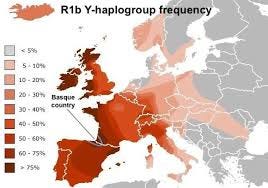
The Basques are a good test case. They have very high frequencies of R1b, comparable to those seen in several populations farther north in Europe, as shown in the map below.
Figure 1. R1b Y- haplogroup frequency
Yet their genome-wide ancestry profile is not northern European. In plots of ancestry components, Basques typically show much less Steppe-related ancestry and much more ancestry ultimately deriving from Europe’s earlier Neolithic populations. The contrast is clear in the figure below, reproduced from Evolution: On the origin of Basques.
Figure 2. Deep ancestries in modern European populations.
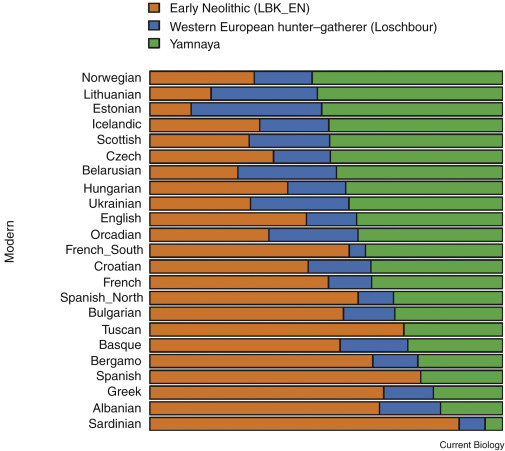
If R1b were a straightforward ancestry meter, populations with similarly high frequencies of R1b should also look broadly similar in genome-wide ancestry. But they do not. Basques and more northerly Europeans can overlap in paternal lineage frequency while differing substantially in their autosomal ancestry profiles.
The key point is that the same haplogroup can be carried by populations with different autosomal backgrounds. What needs explaining, then, is not why Basques have R1b at all, but why a population with such high R1b can remain much less Steppe-shifted than northern Europeans with similar haplogroup frequencies. This is what I call the “Basque paradox”.
The answer, I will argue, is that the same total frequency of R1b does not imply the same demographic history. Ancient DNA shows that R1b carriers in Iberia were not simply genetic equivalents of R1b carriers farther north. Once that is recognized, the Basque paradox becomes much easier to understand.
Ancient DNA resolves the puzzle
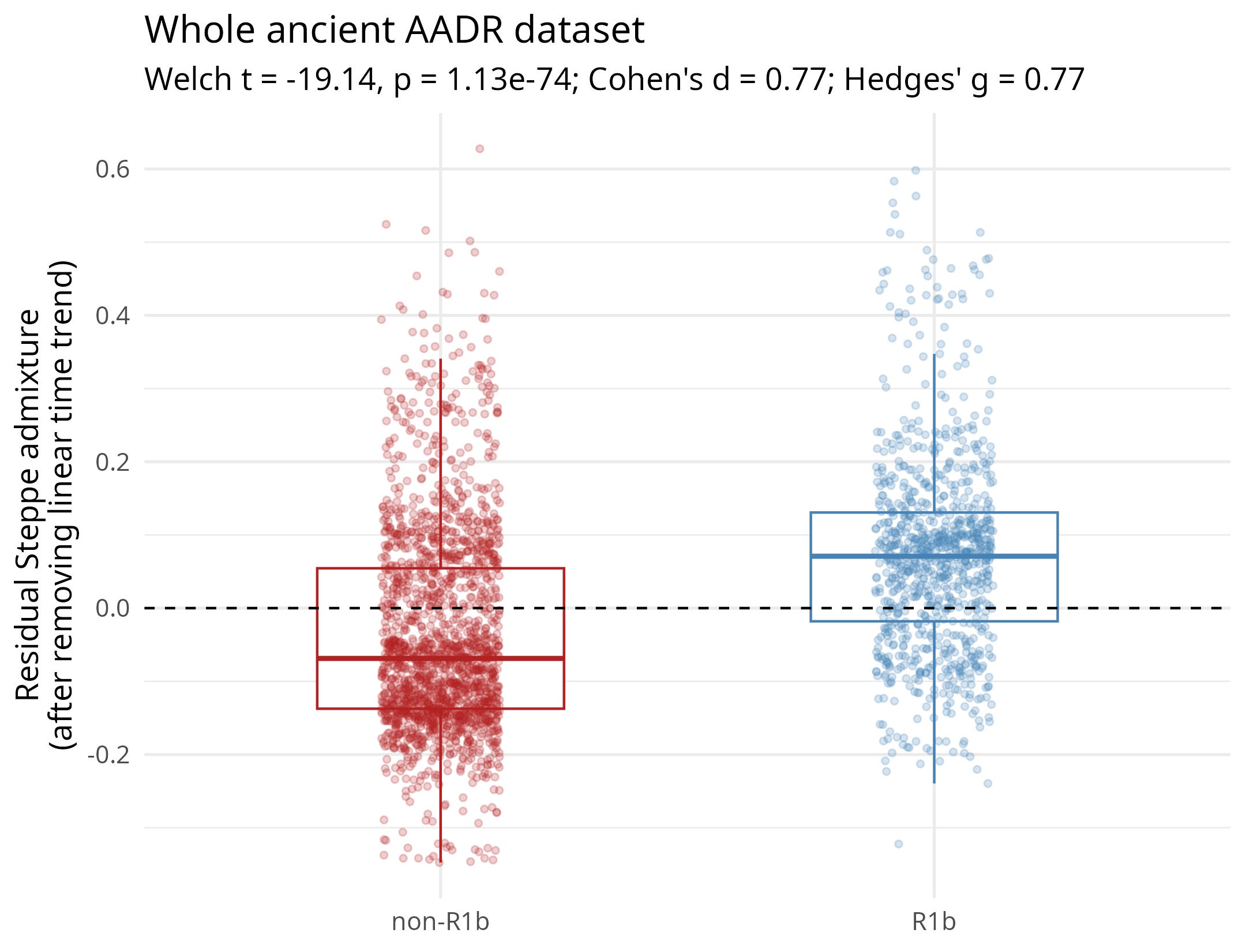
First, using the whole ancient AADR dataset restricted to males younger than 7500 BP, I tested whether R1b carriers are more Steppe-shifted than non-R1b individuals after accounting for time. After removing the linear time trend, the difference remains very large: Welch t = -19.14, p = 1.13e-74, Cohen’s d = 0.77, Hedges’ g = 0.77. In plain language, R1b does track Steppe-related ancestry. It just does not track it perfectly or in a one-to-one way.
Figure 3 shows that general association. It plots residual Steppe admixture after removing the time trend, separately for R1b and non-R1b individuals in the whole ancient dataset. The two distributions overlap, but they are clearly shifted. R1b is associated with more Steppe ancestry.
Figure 3. Residual Steppe admixture in the whole ancient AADR dataset after removing the linear time trend, shown separately for R1b and non-R1b males.
We are getting closer to the solution of the Basque paradox. The crucial question is whether the ancient R1b carriers of Iberia were themselves less Steppe-rich than the ancient R1b carriers of northern and central Europe.
