

Rome built a flattering story about civilization and the peoples beyond its frontier. Ancient DNA lets us test one narrow part of it, and the answer changes once time enters the picture.
The word “barbarian” can sound almost quaint today. In Rome it marked a line through humanity. On one side stood cities, roads, written law, and the imperial order. Beyond the Rhine and Danube, Romans imagined a rougher world of forests, war bands, strange speech, and people who had not learned how civilized life was supposed to work.
Tacitus gives us a much sharper example in chapter 45 of Germania. At the eastern edge of his northern world lived the Aestii, a people of the eastern Baltic whom he described within his survey of Germania. They alone, he wrote, gathered amber (glesum) from the shallows and beaches of the Baltic coast.
Tacitus then supplies the Roman explanation: “Being barbarians, they have not learned or even enquired as to its nature and origin.” The Aestii collected the lumps, sold them unworked, and—according to Tacitus—were astonished that anyone would pay for them.
To a Roman reader, this need not have registered as an insult. It expressed an assumed hierarchy of knowledge: the Aestii supplied the raw material, while Rome identified, valued, and refined it. The passage is revealing precisely because Tacitus presents that hierarchy as self-evident.
Two thousand years later, the stereotype is difficult to kill. Rome still appears as the natural centre of European civilization; ancient Germanic peoples appear as muscular men waiting beyond the frontier until history finally lets them in.
Ancient DNA creates a new temptation: to turn that old cultural ranking into a biological one. Did northern populations carry fewer genetic variants associated with education-related outcomes in the periods being compared? And how did the difference change as migration, admixture, and demographic turnover reshaped both regions?
Why use an education score when nobody in ancient Germany was sitting school exams? Educational attainment is one of the best-powered behavioural traits in modern genetics. Its polygenic score (PGS) overlaps strongly with intelligence—the reported genetic correlation is about 0.70—and more modestly with traits such as conscientiousness, motivation, persistence, self-control, and patience.
That makes EA (Educational Attainment) polygenic score (PGS) a useful, if imperfect, lens. It is not a civilization meter. It cannot read manners, literacy, political institutions, or individual worth out of a skeleton.
I compared ancient northern Europe with northern and central Italy, adjusting the scores for date and genome coverage. The first comparison establishes one fact: in the pooled early centuries, Italy is clearly higher in EA PGS.
But that average hides one of the most revealing turns in the data. The comparison looks different in the Republic, under the Empire, and during the centuries of migration.
The question, then, is this: how did northern Europe and Italy compare in genetic propensity foir education before Rome, under Rome, and after the western empire?
Who are the “northern Europeans” in this comparison?
Mostly ancient Scandinavians, with Denmark supplying nearly four people in five.
Of the 427 northern Europeans, 337 come from present-day Denmark, 65 from Norway, and 17 from Sweden. The remaining eight come from Lithuania and Finland. The largest concentrations are on Zealand and Jutland, followed by central Norway and Trøndelag, with smaller groups from Funen, Skåne, Bornholm, and Nordland. There are no samples from modern Germany. In the comparisons below, then, “northern Europeans” means a predominantly Scandinavian—and heavily Danish—sample.
Which archaeological culture did they belong to? There is no single answer. Their dates stretch from 3706 BCE to 925 CE: 59 are labelled Neolithic or Bronze Age, 328 Iron Age, and 40 Viking-period. The more detailed descriptions range from Pre-Roman and Early Roman to Late Roman, Early Germanic, Late Germanic, graves, bog skeletons, and war deposits. The comparison therefore brings together northern Europeans from different centuries and archaeological settings.
How large was the pre-Imperial Italian advantage?
For this first comparison, I combine three periods: the capped Pre-Early Iron Age (3706–1000 BCE), the Early Iron Age (1000–509 BCE), and the Roman Republic (509–27 BCE). I call this combined span the pooled early period. It ends with the Republic and does not include Imperial Rome.
Across those three periods together, north-central Italy has a clear EA-PGS advantage.
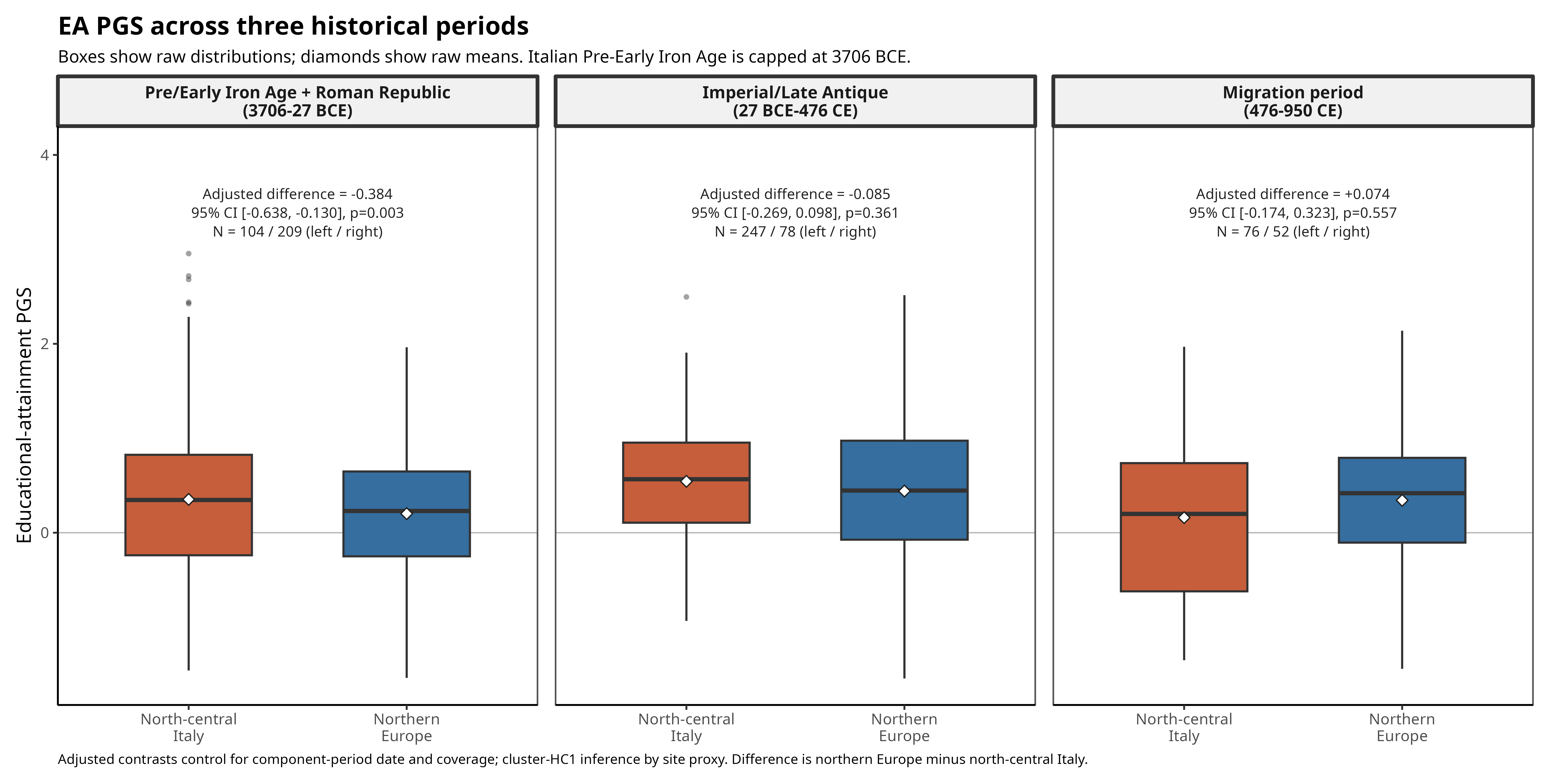
The combined sample contains 104 northern Europeans and 209 people from north-central Italy. After adjusting for date and genome coverage, the northern-European mean is 0.384 standardized-score units lower (95% CI [−0.638, −0.130], p=.0032).
That is not a faint or ambiguous difference. At the beginning of this story, north-central Italy leads.
Pooling improves the sample size, but it compresses several very different centuries into one number. Splitting them apart reveals the next result.
Was north-central Italy equally high throughout those early centuries?
No. The pooled average hides a pronounced Republican peak.
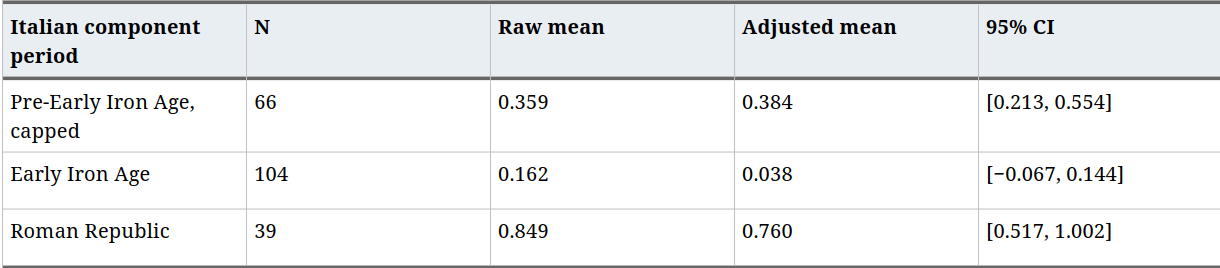
Republican Italy reaches an adjusted mean of 0.760: 0.376 above capped Pre-Early Iron Age Italy (p=.0022) and 0.721 above the Early Iron Age (p<.001). Yet the combined early Italian benchmark is only 0.394. Pooling has averaged a high Republic together with two earlier periods, one of them represented by a particularly large Early Iron Age sample.
Figure 1. Italian EA PGS across the three components of the pooled early bin.
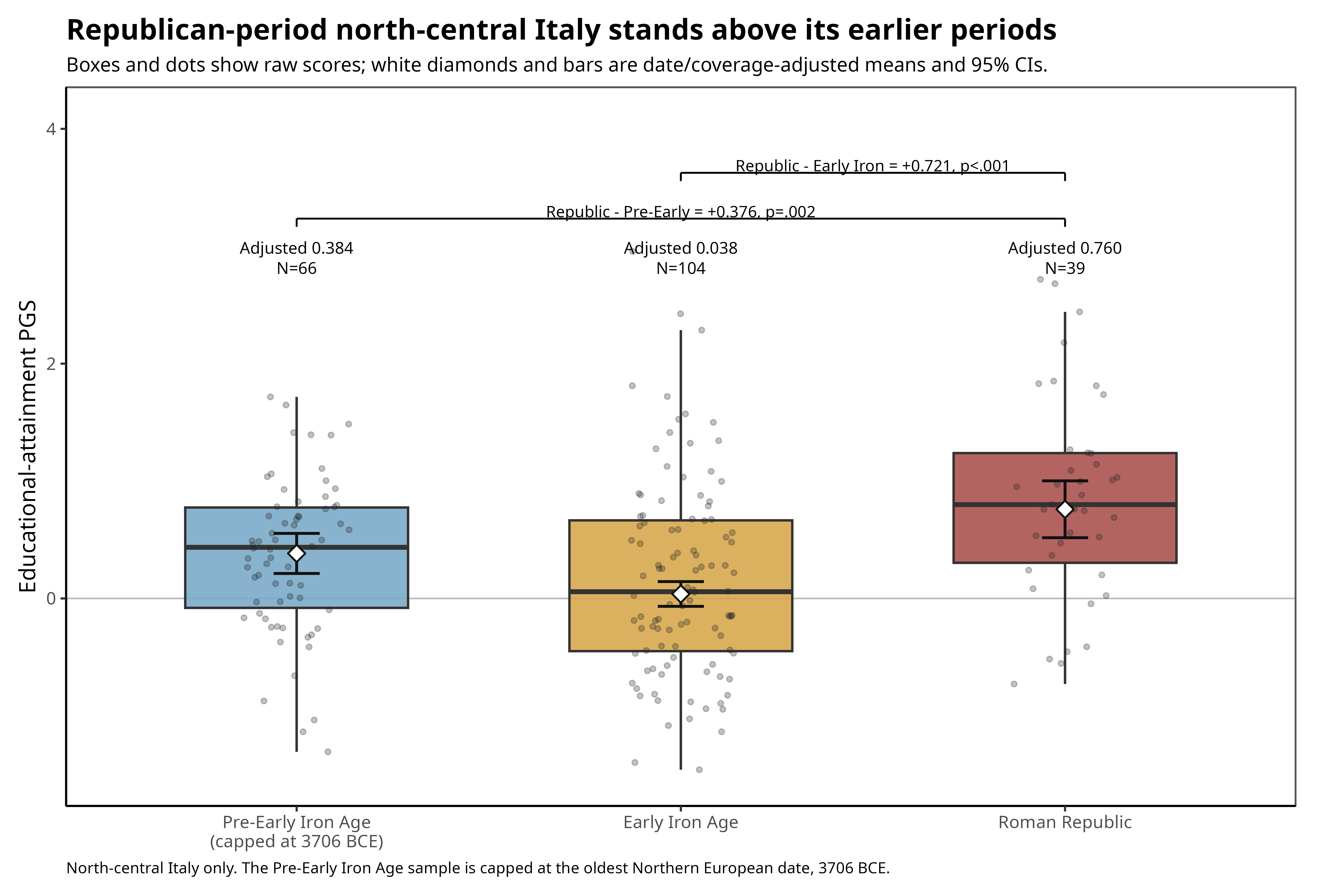
That restores the Republican peak. But a peak matters because of what comes next.
What happened when the Republic gave way to Empire?
At first glance, the broad period bins make the early Italian lead look as if it vanished.
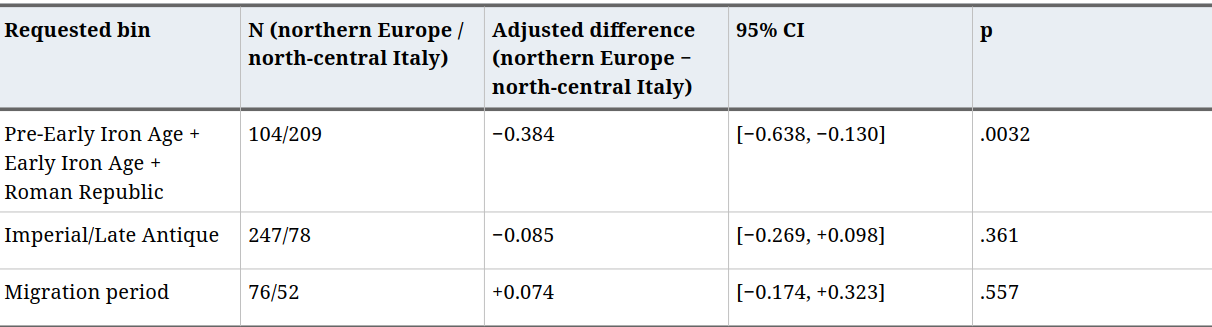
Across Imperial and Late Antiquity as a whole, the estimate still leans slightly toward north-central Italy, but the uncertainty includes no difference. In the Migration period, the point estimate changes direction and leans slightly toward northern Europe but it is just as inconclusive.
Figure 2. Raw EA-PGS distributions across the three historical periods.
The catch is chronological. “Imperial/Late Antique” runs from 27 BCE to 476 CE. The original model treated the difference between northern Europe and north-central Italy as constant across that entire span and effectively summarized it around 178 CE, the bin’s mean sample date. It therefore cannot tell us what the difference was around 98 CE, when Tacitus composed Germania.
What did the comparison look like when Tacitus wrote?
Center the analysis on 98 CE, and the Italian advantage is still visible.
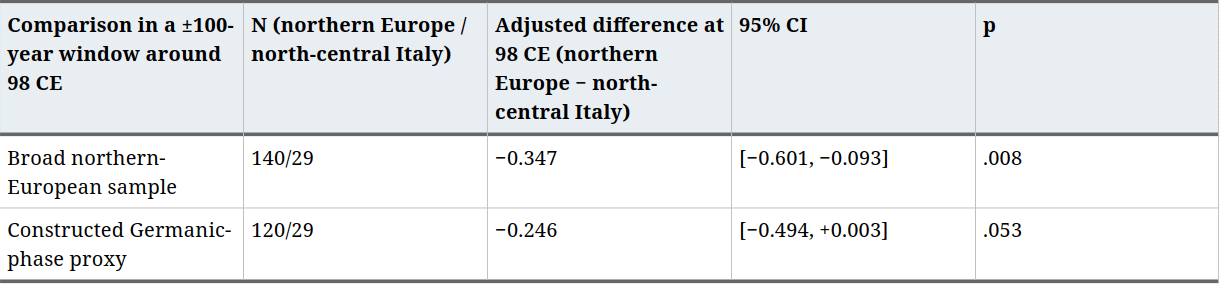
The window runs from 2 BCE to 198 CE. The model adjusts for genome coverage and estimates separate local time trends for northern Europe and north-central Italy. In the broad geographical sample, northern Europe is clearly lower at the date Tacitus wrote. The Germanic-phase proxy points in the same direction, although its confidence interval just crosses zero.
The result is not an artifact of including dates that only one side possesses. Restricting both groups to common observed date support still gives −0.372 for the broad northern-European comparison (p=.010); the Germanic proxy remains negative but less certain at −0.245 (p=.087). Nearby centered windows produce the same directional pattern.
So the early Italian advantage had not necessarily vanished by 98 CE. The broad Imperial average becomes inconclusive because it combines centuries during which the relationship itself was changing.
But a broad later-bin average being indistinguishable from contemporary north-central Italy is not quite the same as reaching north-central Italy’s earlier level. That requires a second comparison.
Did northern Europeans eventually catch up?
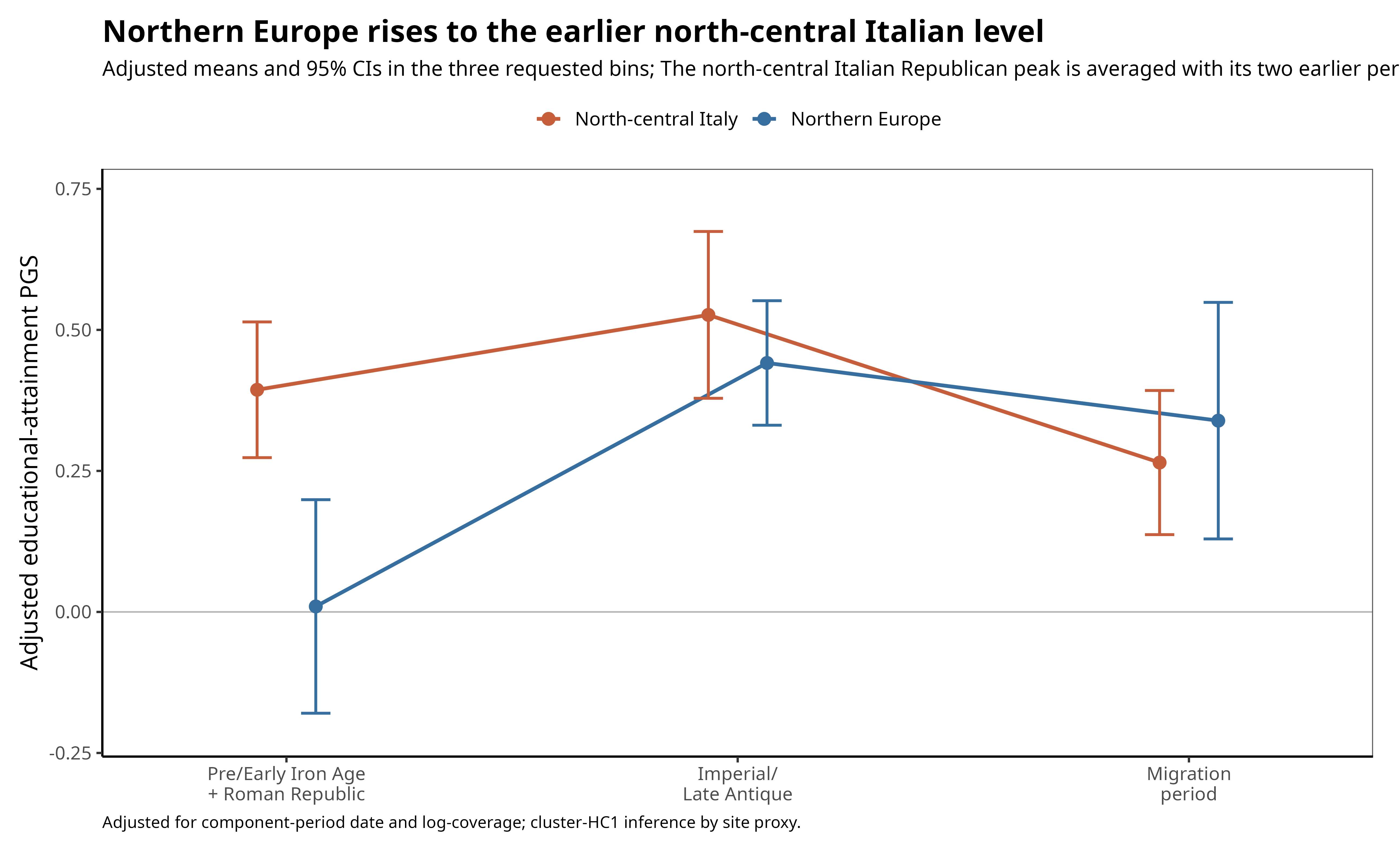
Across the broad later-period averages, yes—within the precision of these data.
The adjusted pooled-early Italian mean is 0.394.

The Imperial/Late Antique northern-European average sits a shade above the pooled-early north-central Italian benchmark; the Migration-period northern-European average sits a shade below it. Neither difference is statistically distinguishable from zero. The defensible claim is that the broad later-period northern-European averages reached a comparable level, not that they overtook north-central Italy. This does not locate the comparison specifically at 98 CE.
Figure 3. Adjusted EA-PGS means and 95% confidence intervals for north-central Italy and northern Europe across the three bins.
Did northern Europe rise, or did north-central Italy fall?
The first act is mainly a northern-European rise. North-central Italy’s clearer decline comes later.
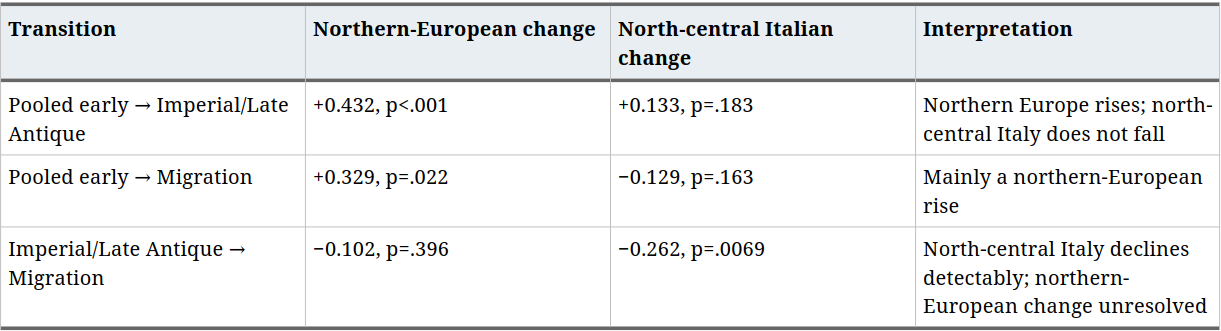
From the pooled early era to Imperial/Late Antiquity, the northern-European estimate rises strongly while north-central Italy does not show a detectable fall. Between the Imperial and Migration periods, the clearer movement is instead a north-central Italian decline.
That is the best description of the pattern, not a proven causal mechanism. When archaeological sites rather than individuals receive equal weight, the decomposition shifts somewhat. Ancient DNA can show the trajectory more confidently than it can explain exactly what drove it.
Can we tell which ancient population drove the change?
Not cleanly. Ancient ancestry does not come in four neatly labelled drawers.
First, a geographical result should not be turned into a tribal biography. The primary sample is northern European, not uniformly “Germanic.” These skeletons span different places, dates, ancestry profiles, and archaeological contexts. Language and ethnicity do not appear in a genome as tidy labels.
I therefore use the broad northern-European sample for the main comparison. The narrower Palaeo-, Proto-, and later-Germanic phase category is a constructed sensitivity check, not an observed ethnicity.
In the preprint “Steppe Ancestry in Western Eurasia and the Spread of the Germanic Languages”, McColl and colleagues (2025) trace an Eastern Scandinavian ancestry with links toward the north-eastern Baltic region entering Sweden around 4,000 years before present and becoming widespread in Scandinavia by about 3,500 years before present. Its timing makes it a plausible vector for Palaeo-Germanic. But that is not evidence for a simple march of already formed Proto-Germans from the Baltics to Scandinavia and then south into Germany. Proto-Germanic formed later in southern Scandinavia and northern Germany, and culture or language could travel differently from ancestry.
In a separate preprint, “Tracing the Spread of Celtic Languages Using Ancient Genomics”, McColl and colleagues (2025) present a similarly layered story. Bell-Beaker-related ancestry supplied a broad demographic and Indo-European substrate. Later Knovíz and Urnfield expansions, followed by continuity into Hallstatt and La Tène contexts, are more closely tied to the spread of historically recognizable Celtic languages. So Bell Beaker ancestry can be part of Celtic population history without making every Bell Beaker a Celt. Corded Ware ancestry can contribute to later Germanic populations without making Corded Ware identical to Germanic. Neither is a simple, exclusive line of descent.
Would Tacitus have recognized this timeline?
Surprisingly, yes—at least chronologically.
Tacitus wrote around 98 CE. By then, Proto-Germanic had already developed in southern Scandinavia and northern Germany during the preceding Pre-Roman Iron Age, and Germanic dialects were established and diversifying. Later ancestry expansions farther into Germany, Poland, and the Netherlands therefore do not imply that Germanic speakers were absent from Germany in Tacitus’s lifetime.
The broad Imperial/Late Antique average cannot answer what the comparison looked like in 98 CE. Once the analysis is centered on the year Germania was composed, the broad northern-European sample is 0.347 units below north-central Italy (p=.008). The Germanic-phase proxy is 0.246 units lower and narrowly misses the conventional threshold (p=.053). The narrow genetic analogue of Rome’s hierarchy is therefore clear in the broader geographical comparison and directionally compatible in the more specific proxy around the time Tacitus wrote.
What the genetics does not support is his rhetoric of an unmixed indigenous people. The deeper record is full of movement and mixture: Steppe-related migrations, Baltic-linked ancestry entering Scandinavia, further mixture within Scandinavia, and later expansions and cultural adoption.
Conclusion
There is nothing paradoxical about a polygenic difference changing quickly. Polygenic means can move on historical timescales through migration, admixture, selection, drift, and population replacement. The local results indicate different time trends in north-central Italy and northern Europe, although they cannot determine how much each mechanism contributed.
The chronology therefore changes by period. North-central Italy is higher across the pooled pre-Imperial centuries and remains higher in the broad comparison centered on 98 CE. Across Imperial and Late Antiquity as a whole, however, the estimated difference is only −0.085 and its confidence interval includes zero. The Migration-period estimate is +0.074 and is equally inconclusive.
By the later centuries, the Germanic north had closed the EA-PGS gap with Rome. On this measure, at least, the barbarians had caught up with the Romans.
References
• Antonio, M. L., Gao, Z., Moots, H. M., et al. (2019). “Ancient Rome: A genetic crossroads of Europe and the Mediterranean.” Science 366: 708–714. https://doi.org/10.1126/science.aay6826
• Dawson, C. (2026). “Associations of genetic variants for educational success with risk and time preferences vary by childhood environment.” Communications Psychology 4: 50. https://doi.org/10.1038/s44271-026-00421-y
• Demange, P. A., Malanchini, M., Mallard, T. T., et al. (2021). “Investigating the genetic architecture of noncognitive skills using GWAS-by-subtraction.” Nature Genetics 53: 35–44. https://doi.org/10.1038/s41588-020-00754-2
• Hill, W. D., Marioni, R. E., Maghzian, O., et al. (2019). “A combined analysis of genetically correlated traits identifies 187 loci and a role for neurogenesis and myelination in intelligence.” Molecular Psychiatry 24: 169–181. https://doi.org/10.1038/s41380-017-0001-5
• Lee, J. J., Wedow, R., Okbay, A., et al. (2018). “Gene discovery and polygenic prediction from a genome-wide association study of educational attainment in 1.1 million individuals.” Nature Genetics 50: 1112–1121. https://doi.org/10.1038/s41588-018-0147-3
• Mallick, S., Micco, A., Mah, M., et al. (2024). “The Allen Ancient DNA Resource (AADR): a curated compendium of ancient human genomes.” Scientific Data 11: 182. https://doi.org/10.1038/s41597-024-03031-7
• McColl, H., Kroonen, G., Moreno-Mayar, J. V., et al. (2025 version). “Steppe Ancestry in Western Eurasia and the Spread of the Germanic Languages.” bioRxiv preprint 2024.03.13.584607. https://doi.org/10.1101/2024.03.13.584607
• McColl, H., Kroonen, G., Pinotti, T., et al. (2025). “Tracing the Spread of Celtic Languages Using Ancient Genomics.” bioRxiv preprint 2025.02.28.640770. https://doi.org/10.1101/2025.02.28.640770
• Okbay, A., Wu, Y., Wang, N., et al. (2022). “Polygenic prediction of educational attainment within and between families from genome-wide association analyses in 3 million individuals.” Nature Genetics 54: 437–449. https://doi.org/10.1038/s41588-022-01016-z
• Smith-Woolley, E., Selzam, S., & Plomin, R. (2019). “Polygenic score for educational attainment captures DNA variants shared between personality traits and educational achievement.” Journal of Personality and Social Psychology 117: 1145–1163. https://doi.org/10.1037/pspp0000241
• Tacitus. Germania, ch. 45 (“The Aestii and Sitones”), composed around 98 CE; translation by A. S. Kline. https://www.poetryintranslation.com/PITBR/Latin/TacitusGermania.php
How does the rise in Germanic score fit with this data? https://substack.com/home/post/p-179183885 Seems that their scores were pretty low and rose a lot in the late middle ages. Did Italian scores rise similarly around the same time?
I invariably enjoy reading your posts! But I'm not very well-read in background information. So, I wonder about unavoidable sample bias. For example, who are the 29 Romans ... city elites? Versus the 140/120 northern Europeans ... Teutoburg forest warriors? Certainly it's very unlikely to get great socio-economic correspondence from ancient DNA sources. Thanks for doing these topics!