

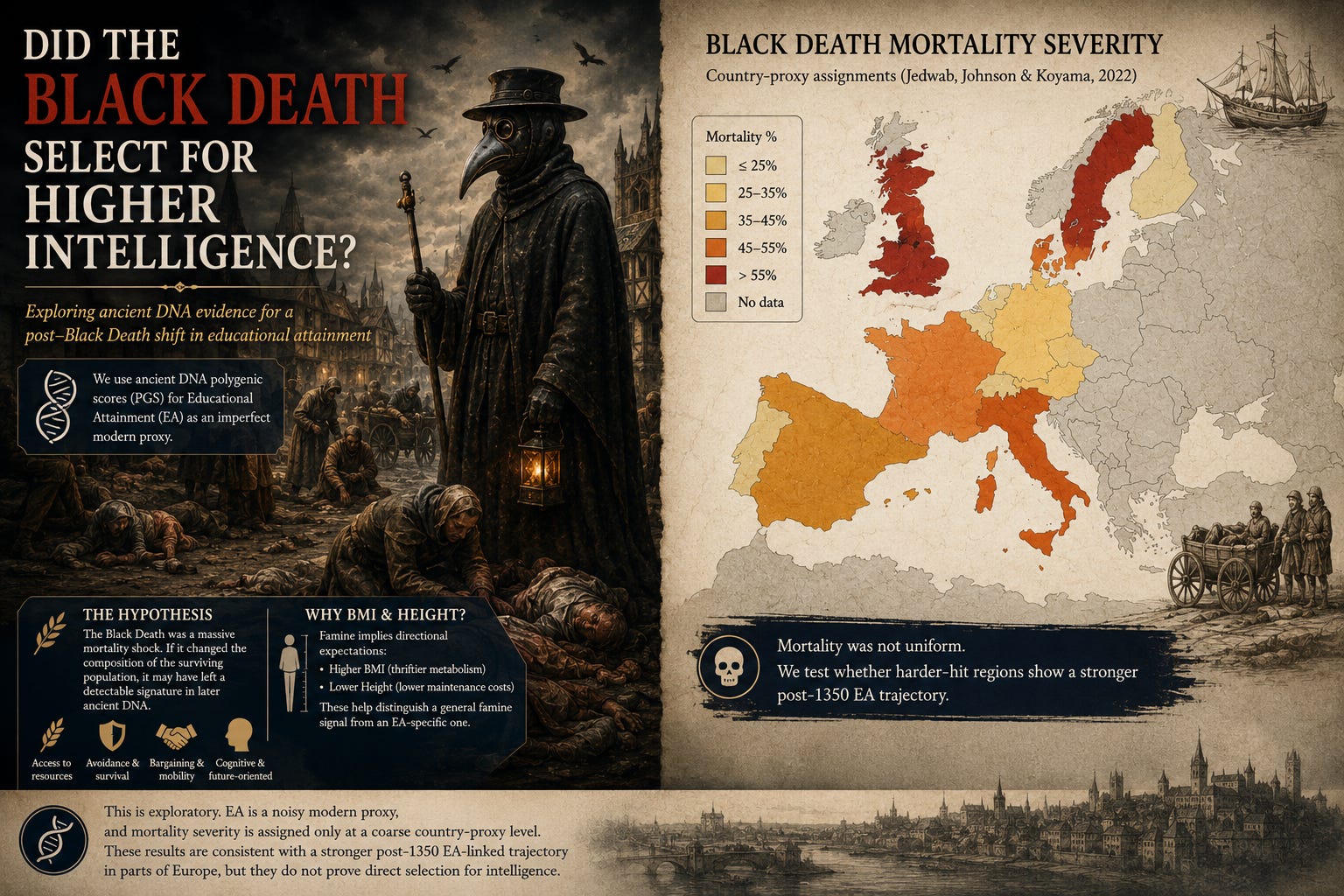
The Black Death killed a massive share of Europe’s population in the mid-14th century. Whenever an event wipes out such an indiscriminate percentage of humanity, evolutionary biologists and historians ask a fundamental question: Did this mortality shock change the genetic composition of the surviving population? If it did, it might have left a detectable signature in later ancient-DNA (aDNA) polygenic scores.
The specific hypothesis tested here is not that the plague directly selected for modern educational attainment (EA). Rather, the pandemic may have selected on a partly heritable bundle of cognitive, personality, and status-linked traits for which an educational attainment polygenic score (EA PGS) serves as an imperfect modern proxy.
The idea that the plague acted as a major selection event for cognitive and personality traits has been proposed before (Dutton & Woodley of Menie, 2018), given the substantial heritability reported in twin studies for intelligence and personality (Plomin & Deary, 2015; Nettle, 2007). In practical terms, the hypothesized mechanism is that higher-status, more future-oriented, more conscientious, and cognitively stronger lineages may have been better equipped to secure food, move away from danger, bargain, delay exposure, or simply survive the chaotic shock-and-recovery period that followed the plague.
That mechanism is also historically plausible in a narrower social sense. The plague struck populations already weakened by famine, meaning lineages with better access to resources may have held a vital survival advantage. Differential mortality estimates are consistent with strong class gradients in at least some settings: while overall mortality is often placed around 40%, much higher rates have been reported for serfs and laborers in some regions (Dodds, 2008).
None of that proves genetic selection for intelligence, but it does provide a concrete model for why an EA-linked signal might shift after 1350. Body Mass Index (BMI) and Height are included as secondary controls because famine should imply directional expectations for them. If repeated food scarcity selected for a thriftier metabolism, one might expect a higher post-crisis BMI-linked signal, especially in harder-hit areas. If famine and chronic scarcity favored lower maintenance costs, one might expect a lower post-crisis Height-linked signal, or a more negative post-1350 trajectory, again especially where mortality and associated disruption were most severe. Those control traits therefore help distinguish a general famine-selection story from an EA-specific one.
I look at the question two ways. First, I test whether post-1350 Europeans differ from pre-1350 Europeans after adjusting for Dataset, broad region, coverage, PCs, and imputation uncertainty. Second, I fit a hinge model with a knot at 1350 CE and then ask whether higher Black Death mortality is associated with a steeper post-1350 slope.
The Sample: Tracking 12,000 Years of European History
To capture this moment in time, the analysis uses a few different sample slices depending on the model:
The Broad Window Sample: 754 individuals in total. For the covariate-adjusted means, this includes 508 individuals living before the plague (1000–1349 CE) and 248 individuals living after (1350–1599 CE) across 19 distinct populations.
The Hinge Model Sample: To see the long-run evolutionary trajectory, I use a broader Europe-only sample of 5,183 individuals spanning the last 12,000 years.
The Severity Subsets: To test whether harder-hit regions saw bigger changes, I use a subset of individuals (643 for the broad window, 2,342 for the hinge model) mapped to Christakos locality-level plague mortality data.
Before vs After
The raw means are useful as a visual check, but the adjusted means are the relevant comparison because the samples are not evenly distributed across datasets, regions, coverage levels, principal components, or imputation uncertainty. The adjustment does not make the data representative, but it reduces the most obvious technical and sampling differences between the pre- and post-1350 groups.
In the broad 1000-1599 CE window, the post-1350 samples sit higher on EA after adjustment. This is the simple version of the Black Death hypothesis: if the mortality shock changed who survived or reproduced, the later medieval sample should differ from the earlier medieval sample. The important caveat is that the broad-window design deliberately sacrifices temporal detail. It treats 1000 CE and 1349 CE as one pre period, and 1350 CE and 1599 CE as one post period, so it is a blunt test of a level shift rather than a model of historical dynamics.
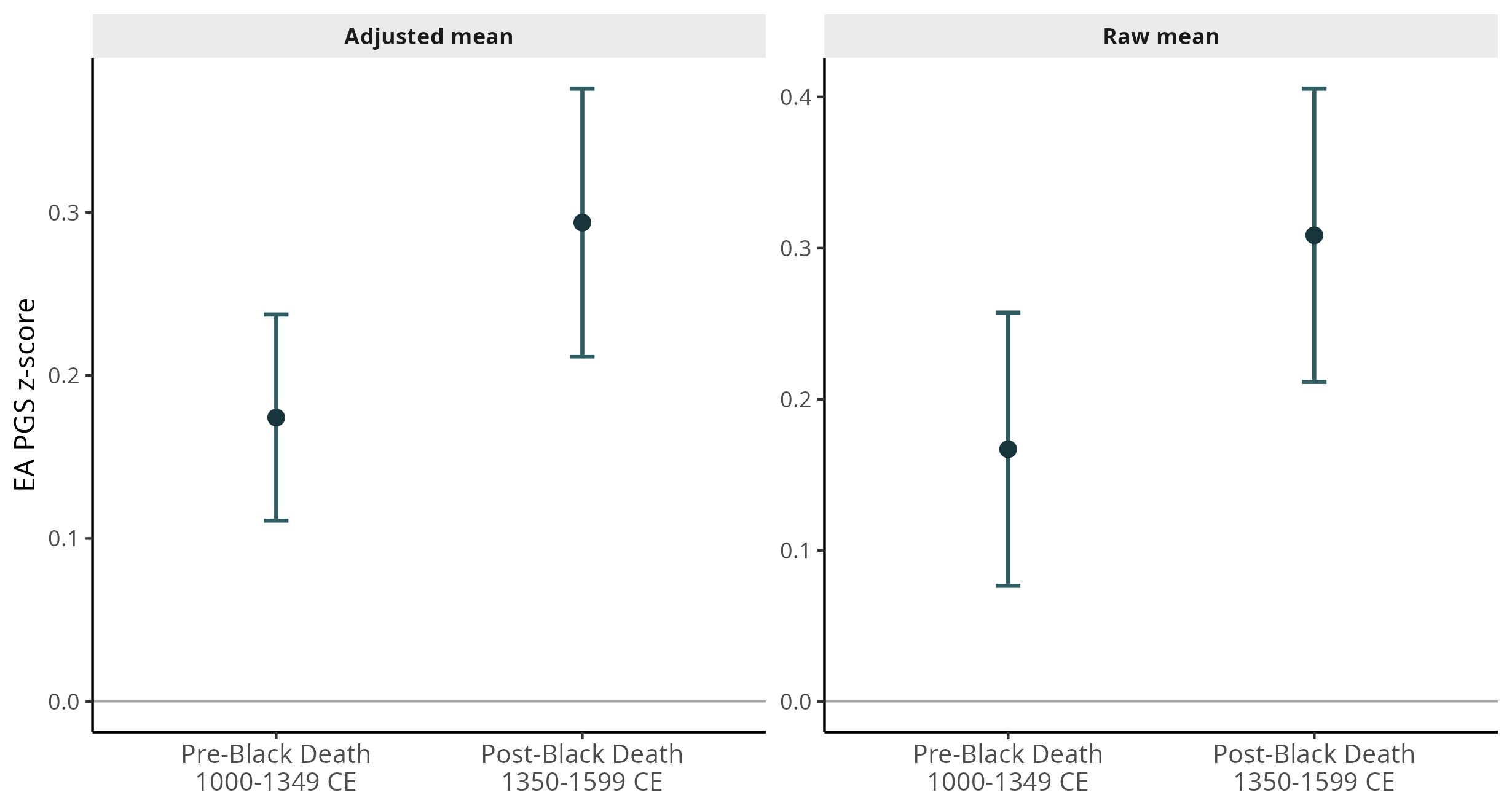
The adjusted pre/post regression estimates a post-1350 gap of 0.142 SD with cluster p=1.99e-04. Read literally, this says that individuals sampled after 1350 have higher EA PGS than individuals sampled before 1350, after adjusting for Dataset, broad region, coverage, PC1-PC5, and log imputation variance. The sign is therefore consistent with the hypothesis, but the design is still vulnerable to composition: if the post-1350 sample is concentrated in different places, cemeteries, social strata, or source studies than the pre-1350 sample, the coefficient can partly reflect those differences despite the covariates.
This regression coefficient is the inferential result, not just the difference between the two adjusted means in the plot. In the current data, the raw post-minus-pre mean difference is 0.142 SD; residualizing EA on the covariates and then comparing period means gives a slightly smaller descriptive gap of 0.120 SD. The full regression, EA_z ~ PostBD + covariates, estimates 0.142 SD because it adjusts the period indicator and the outcome jointly. In other words, the adjusted-means plot is a readable visualization, while the regression coefficient is the formal covariate-adjusted pre/post test.
That is why I treat the pre/post model as supportive rather than decisive. It is easy to interpret, but historically coarse. It answers the question, ‘Are the later medieval individuals higher than the earlier medieval individuals in this window?’ It does not by itself tell us whether 1350 is a real turning point in the longer series.
The Hinge Model: A Change in Trajectory
But a simple before/after comparison assumes that genetic change happens like a clean step-stool. What if the Black Death didn’t cause a sudden leap, but instead acted as a turning point, a “hinge” that accelerated an existing trend?
To test this, I fit a hinge model across 12,000 years of European history, setting a “knot” exactly at the year 1350 CE. This allows us to see if the slope of the trajectory changed after the pandemic.
When we analyze the slopes, a much more compelling story emerges.
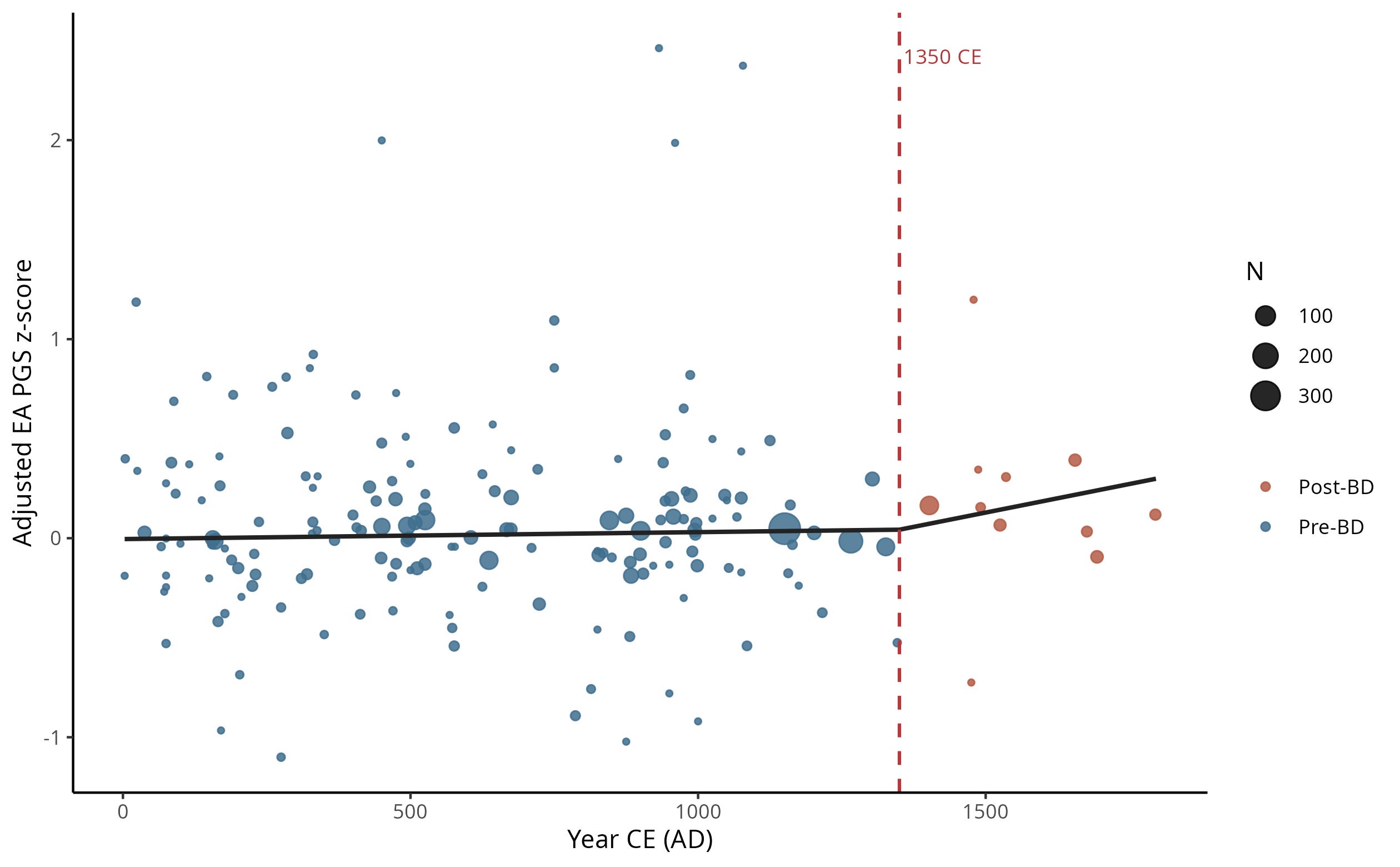
Table 1. Long-Run EA Hinge Model Coefficients
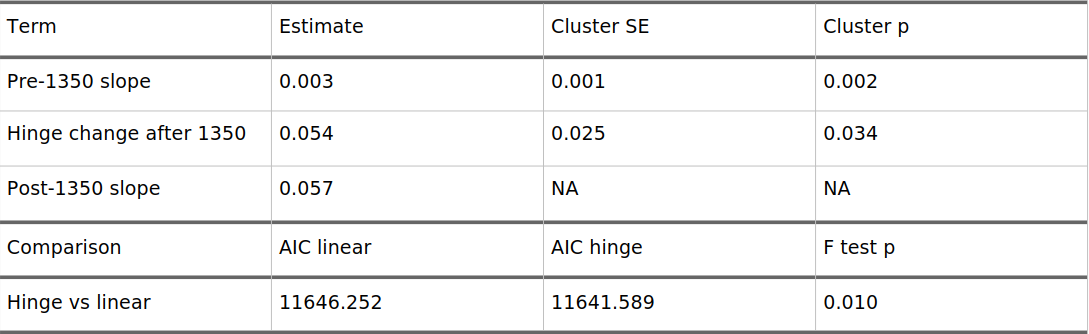
The results here are statistically robust. For the millennia leading up to the Black Death, the polygenic score for educational attainment was creeping upward at a very slow, steady pace (slope = 0.003, p = 0.005).
After 1350 CE, that trajectory dramatically steepened. The slope experienced a highly significant upward shift of +0.054 (p = 0.034), resulting in a post-plague slope of 0.057. Crucially, comparing the models shows that the hinge model is a statistically superior fit over a basic linear model (p = 0.01). The Black Death didn’t just push the numbers up; it accelerated the entire genetic timeline.
The long-run hinge model proves that Europe’s genetic landscape didn’t just experience a temporary bump—the entire trajectory accelerated after 1350 CE.
But this leaves us with a massive causal riddle: Was this dramatic acceleration actually driven by the pandemic, or are we just looking at a massive historical coincidence?
To prove a true evolutionary signature, we have to look for direct geographical alignment. If the Black Death caused this shift, we should see an undeniable pattern: the regions hit hardest by the plague must show a significantly steeper trajectory than the regions that escaped relatively unscathed.
When we map country-level mortality data directly to these ancient skeletons, the data reveals a striking, highly significant interaction.
Coming up in the premium section:
The Severity Models: The exact regression outputs and p-values proving how plague mortality alters the post-1350 hinge.
The Famine Control Test: I run the identical workflow on Height and BMI to see if this was just a general story of human bodies surviving starvation, or if something completely unique happened to educational attainment proxies.
The Boundary Lines: Why one specific scoring method completely changes the BMI results, and what that tells us about the limits of ancient DNA data.
Upgrade to a paying subscription to unlock the complete data tables, severity models, and the final conclusion.