
The Dating Study Everyone Is Sharing Is Being Misread

A large new study on romantic preferences has been circulating widely online, often with the same triumphant interpretation: the redpill was right.
The headline result seems to support that claim. When researchers compared what people say they want in a partner with the traits that actually predict their attraction to a specific person, the largest mismatch involved physical attractiveness. In particular, women appear to underestimate how much looks influence their attraction.
The results do show a gap between stated preferences and the traits that predict attraction. At the same time, the way the researchers measured those “revealed preferences” makes the interpretation less straightforward than many online summaries suggest.
To understand what the study really shows, it helps to look more closely at how the data were collected and what exactly was measured.
The largest global dataset on partner preferences
The study, recently published in the Journal of Personality and Social Psychology, analyzed data from more than 10,000 participants across 43 countries and 22 languages.
Participants first rated how desirable 35 traits were in an ideal romantic partner. These traits ranged from personality attributes such as kindness and humor to characteristics related to status, resources, and physical appearance.
Participants were then asked to think about a specific person they knew. For those already in relationships this was their current partner, while single participants were asked to think about the person they most wanted to date. They rated that person on the same set of traits and then reported their feelings toward that individual using the study’s main outcome measure, a self-reported romantic evaluation score. This score was constructed from several items assessing romantic interest, but it also included statements reflecting exclusivity and attachment, such as seeing the person as an ideal partner or turning to them first when something important happens. In other words, the dependent variable captures a broader form of romantic evaluation rather than immediate sexual or physical attraction alone.
This design allowed the researchers to compare two kinds of preference.
Stated preferences:
what people explicitly say they want in a partner.
Revealed preferences:
which perceived partner traits statistically predict romantic attraction.
Where the biggest mismatch appears
When the researchers compared these two measures, the discrepancies followed a clear pattern.
Some traits were overstated. Participants rated them as highly important, but they predicted attraction less strongly than those statements implied.
Other traits were understated. Participants rated them as relatively unimportant, yet they strongly predicted romantic attraction.
The strongest understatement involved physical traits. Attributes such as physical attractiveness, sexiness, having a nice body, smelling good, or being a good lover predicted romantic attraction more strongly than participants’ own reports indicated.
By contrast, several prosocial personality traits showed the opposite pattern. Traits such as being patient, emotionally stable, or a good listener were rated as highly desirable in surveys but predicted attraction less strongly in the statistical models.
In short, people misjudge the relative importance of different traits, and the largest downward bias concerns physical attractiveness.
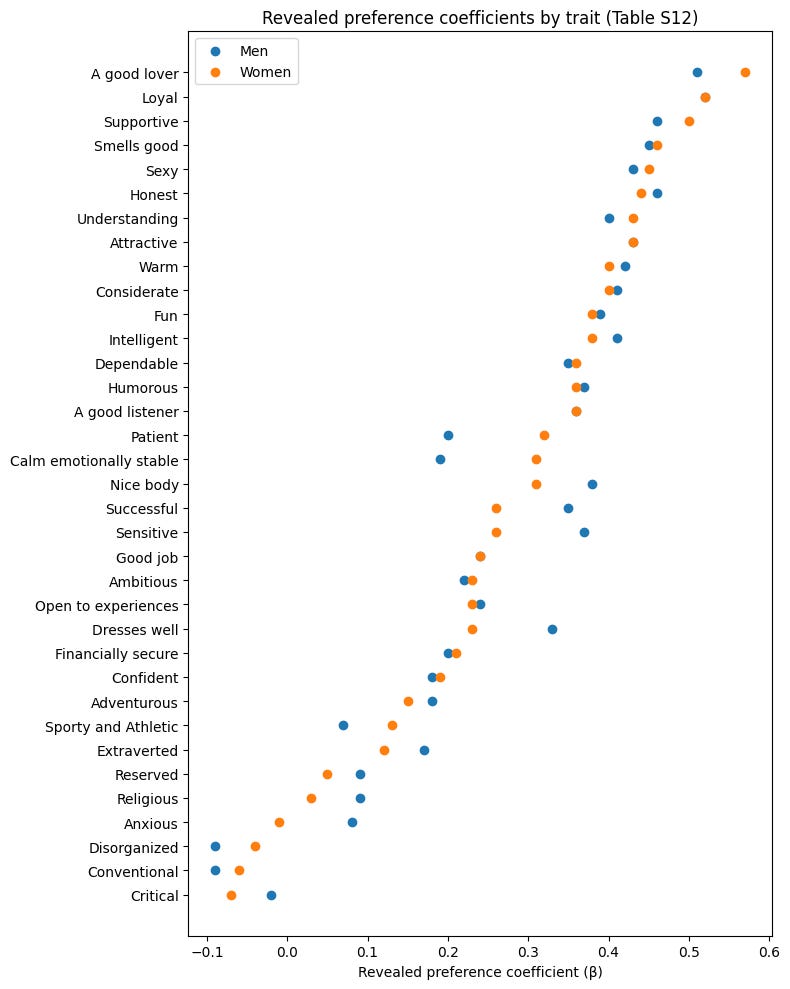
The gender difference
The pattern becomes clearer when men and women are analyzed separately.
Both sexes understated the importance of physical attractiveness when describing their ideal partners. However, the magnitude of the mismatch differs substantially.
For men, the gap between stated and revealed preferences for physical traits such as “attractive,” “nice body,” and “sexy” averaged about six ranking positions (out of 35 traits). In surveys, these traits ranked 9th, 18th, and 17th in importance, but their revealed importance based on the regression analysis placed them at 7th, 13th, and 6th.
Among women, the discrepancy was much larger. Women understated the importance of these same traits by roughly thirteen ranking positions on average. In their stated preferences, the traits ranked 18th, 28th, and 23rd, yet their revealed preference ranks were 8th, 17th, and 5th, almost identical to men’s revealed rankings.
In other words, when the statistical model examines which perceived traits actually predict romantic evaluation, men and women appear to respond to physical attractiveness in broadly similar ways. The difference lies primarily in how those preferences are reported.
Social norms may help explain this pattern. In many cultural settings, emphasizing physical attractiveness in partner choice is seen as superficial. Women often face stronger pressure to frame their preferences in terms of personality, kindness, or emotional compatibility rather than appearance.
Survey responses reflect those norms. But when attraction is analyzed statistically, physical traits appear to play a larger role than participants’ explicit reports suggest.
This looks like confirmation of a familiar argument: that people say one thing about their preferences but act differently in practice.
The problem is that the study does not actually measure partner choice.