

Long before rice paddies, samurai or the first Japanese state, the archipelago was home to hunter-gatherer-fishers now called the Jōmon. Their way of life endured for more than ten millennia, and they made some of the world’s earliest pottery. The Jōmon did not simply disappear when farming arrived: a portion of their ancestry survives in Japanese people today (Cooke et al., 2021; Yamamoto et al., 2024).
About 3,000 years ago, migrants with Northeast Asian ancestry brought wet-rice agriculture during the Yayoi transition. Centuries later, as political power consolidated during the Kofun period, another substantial influx introduced ancestry related to other East Asian populations. The groups mixed. Modern Japanese origins are therefore not a story of a timeless, isolated population—or of one population wholly replacing another.
For decades, the leading model was simpler: indigenous Jōmon plus continental farmers. Ancient DNA complicated it. Genomes spanning the Jōmon, Yayoi and Kofun periods support a tripartite origin for present-day Japanese: Jōmon ancestry, a Northeast Asian component associated with the spread of farming, and a later East Asian component associated with state formation (Cooke et al., 2021). A study involving more than 250,000 modern participants later showed that this Jōmon legacy still helps structure genomic variation across the archipelago (Yamamoto et al., 2024).
This turns a present-day Japanese genome into a historical mosaic. One stretch of chromosome can be more Jōmon-like; the next can be more mainland-like, because recombination has repeatedly cut and reshuffled ancestral chromosomes. Every Japanese chromosome is, in that sense, an archaeological site.
And that creates the real mystery. Did these ancestries merely mix, or did natural selection edit the mosaic after admixture—preserving Jōmon-derived segments in some regions while thinning them in others? The question has become especially timely after Watanabe and colleagues analysed 42 Jomon genomes and reported signals consistent with cold adaptation in pathways involving thermogenesis, lipid metabolism and cold sensation (Watanabe et al., 2026). Here I ask whether Jōmon ancestry is unusually enriched or depleted around variants used in three polygenic scores: educational attainment, height and skin colour.
A genome is a mosaic, not a smoothie
A whole-genome ancestry percentage compresses a great deal of history into one number. Local ancestry does the opposite: it moves along each chromosome and asks which reference source is more compatible with each segment. Because recombination breaks inherited chromosomes at every generation, admixed genomes become mosaics of ancestry tracts (Gravel, 2012). Here, a two-state hidden Markov model assigned a probability of Jōmon-like or mainland-like ancestry to phased chromosome segments in 104 Japanese-in-Tokyo participants from the 1000 Genomes Project (1000 Genomes Project Consortium, 2015).
Researchers sometimes use the phrase “local admixture,” but local ancestry is the more precise term: admixture is the historical mixing event, while local ancestry is the inferred source of one particular chromosome segment. Figure 1 follows the full logic. Ancient genomes define the reference endpoints; recombination creates alternating ancestry tracts; the hidden Markov model uses marker patterns and continuity along the chromosome to estimate a Jōmon-like probability; and the score loci are compared with the same locus pattern shifted to other positions on the chromosome.
Figure 1. How local ancestry works.
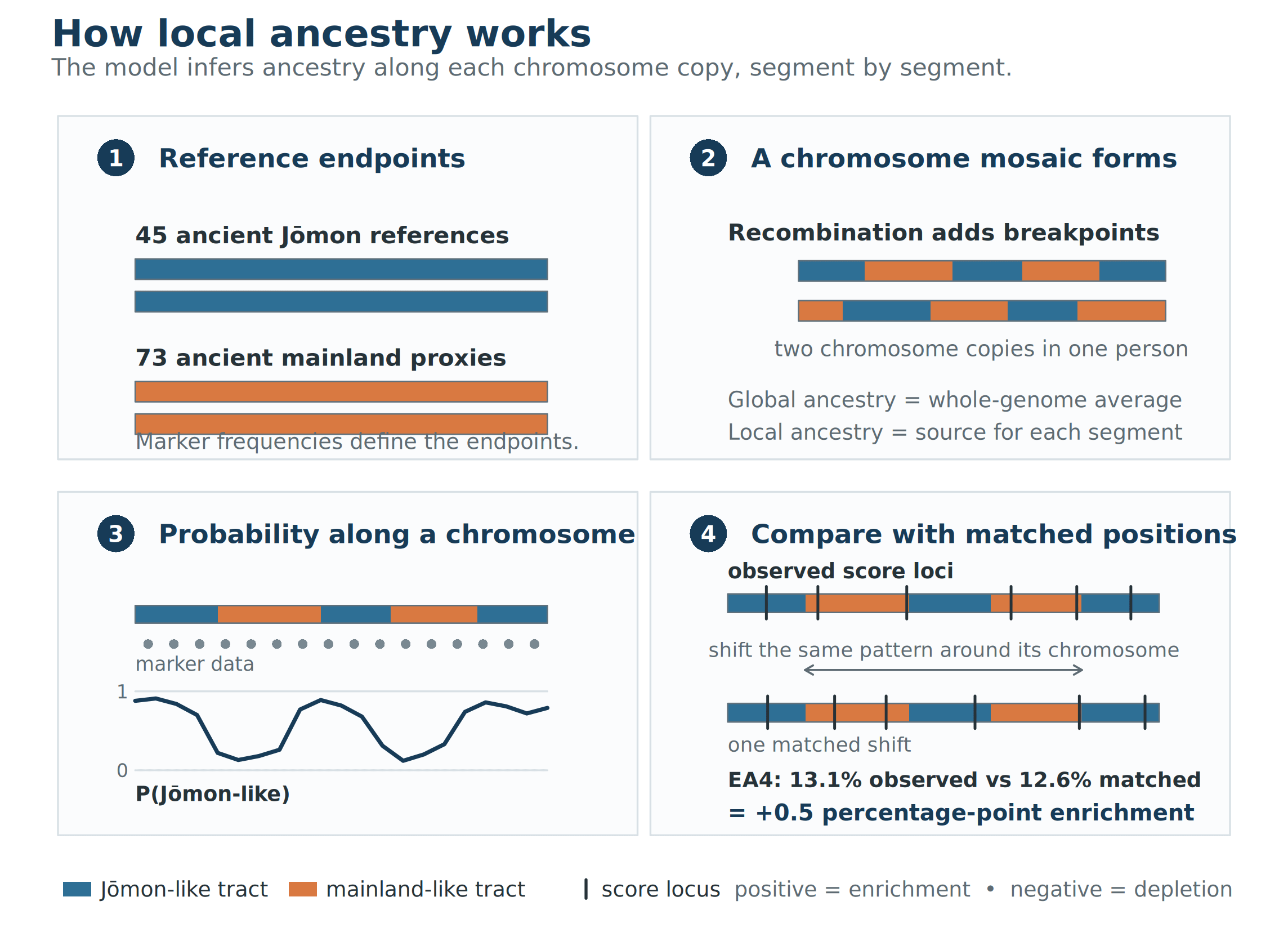
This schematic follows one chromosome from reference panels to the selection test. Blue and orange segments represent probabilistic Jōmon-like and mainland-like assignments, not cultural identities. The hidden Markov model (HMM) combines allele patterns at nearby markers with the expectation that ancestry usually continues along a tract. The lower-right panel uses the primary equal-weight EA4 result as a numerical example: 13.1% Jōmon ancestry at the score loci versus a 12.6% chromosome-matched null, a difference of about +0.5 percentage points. A positive difference is enrichment; a negative difference is depletion.
The words “Jōmon-like” and “mainland-like” matter. The model compares modern haplotypes with allele-frequency endpoints estimated from ancient reference panels. The primary Jōmon endpoint used 45 independently represented ancient individuals. The mainland endpoint pooled 65 ancient people from Shandong dated about 2,016–2,374 years before present—used as geographically and chronologically plausible Yayoi-related proxies—with eight Gaya-period Koreans dated about 1,525–1,550 years before present, used as Kofun-related proxies. Shandong-only and Gaya-only models tested how much the conclusion depended on this subjective proxy choice.
Three scores, two different questions
I examined three polygenic scores. The first comes from the fourth major genome-wide association study of educational attainment, commonly called EA4. It uses variants associated with years of schooling in a modern sample of about three million people, mostly of European genetic ancestry (Okbay et al., 2022). It is not an intelligence score, and the original study showed that family-level controls substantially reduce its association with education. The second score uses height-associated variants from a multi-ancestry GWAS of 5.4 million people (Yengo et al., 2022). The third uses skin-colour variants discovered in 48,433 East Asians by Kim and colleagues (2024); higher values are oriented toward lighter measured skin colour.
For each score, two questions must be kept separate:
Question 1: Do alleles on Jōmon-like and mainland-like tracts receive different PGS weights? This describes ancestry-associated differences in the score. It does not establish selection after admixture.
Question 2: Is Jōmon ancestry unusually common or rare around the score loci? This is the local-ancestry test relevant to post-admixture enrichment or depletion. Even here, demographic and reference-panel explanations must be excluded before calling selection.