
The People Who Replaced Ancient Europe

Ancient DNA has made some old historical words feel concrete again. Migration, replacement, invasion, mixture: these used to be arguments built from pots, graves, language trees, and guesses about who moved where. Now we can ask the same questions with genomes.
When early farmers moved into Europe from Anatolia and the Aegean world, they did not enter an empty continent. They met western hunter-gatherers whose ancestors had lived there for thousands of years. In most of Europe, this was not just the spread of a new subsistence package. Olalde et al. (2026) summarize the broader Neolithic transition as 70-100% ancestry turnover across much of Europe between 6500 and 4000 BCE, with northwest Europe as a striking exception where forager ancestry persisted much longer.
The later Steppe-related expansions were just as consequential in some places. Olalde et al. (2018) estimated that Beaker-associated ancestry replaced about 90% of Britain’s gene pool after about 2450 BCE, and Olalde et al. (2026) summarize the process as roughly 90-100% replacement of local Neolithic ancestry within a few hundred years. In other words, some of these prehistoric migrations were close to total population replacement at the genetic level, even when archaeology shows complicated mixtures of people, practices, and material culture.
But how genetically different were these incoming populations from the people they partly replaced?
One way to answer that question is to use Fst, a standard measure of genetic distance between populations. An Fst of zero means two groups are genetically indistinguishable at the measured markers. Larger values mean greater allele-frequency differentiation.
I compare the ancient results with distances among modern superpopulations. In genetic datasets, a superpopulation is a broad continental-scale grouping, such as Europe, Africa, East Asia, South Asia, West Asia, Oceania, or the Americas. It is not identical to the everyday word race, but it is one of the technical categories closest to it: a coarse grouping of populations that share relatively more ancestry with each other than with populations outside the group.
Methods note
I used the AADR v66 2M dataset. The ancient groups are broad source-like sets defined from the AADR metadata and K=7 ADMIXTURE components, then Hudson Fst was computed directly from the genotype data. The ADMIXTURE components were used to select samples, not as the final object of comparison.
For the modern benchmark, I used the pairwise Hudson Fst estimates in fst/modern_groups_v66, restricted to modern population pairs with at least five individuals in both groups. That gives 5,253 modern population-pair comparisons. Where useful, I also use the existing broad superpopulation labels: Africa, Europe, West Asia, South Asia, East Asia, Oceania, and the Americas.
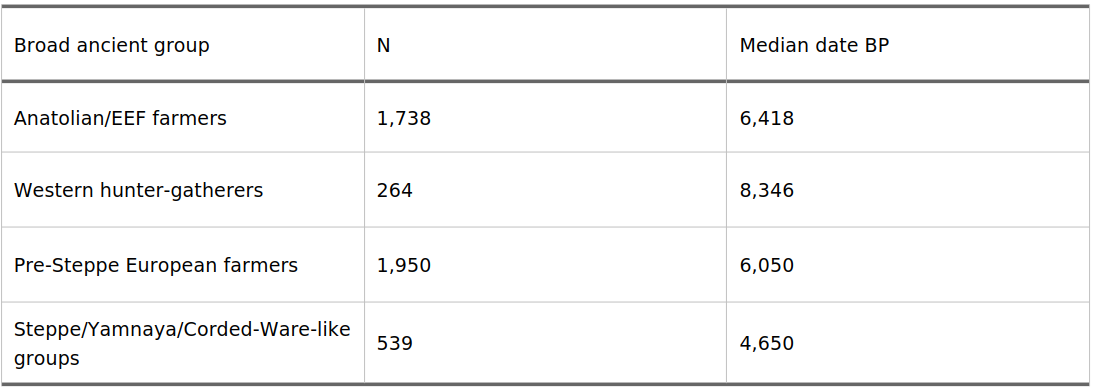
These labels are intentionally broad. They are not meant to imply that the Anatolian farmers or the Steppe people were one uniform tribe. They are source-like clusters built to estimate the size of two historical genetic gaps.
Two ancient replacement fronts
Before looking at the numbers, it helps to put the movements back on the map. The first arrow represents the spread of farmer-related ancestry from Anatolia and the Aegean into a Europe still partly occupied by western hunter-gatherers. The second represents the later movement of Steppe-related ancestry into farming Europe.
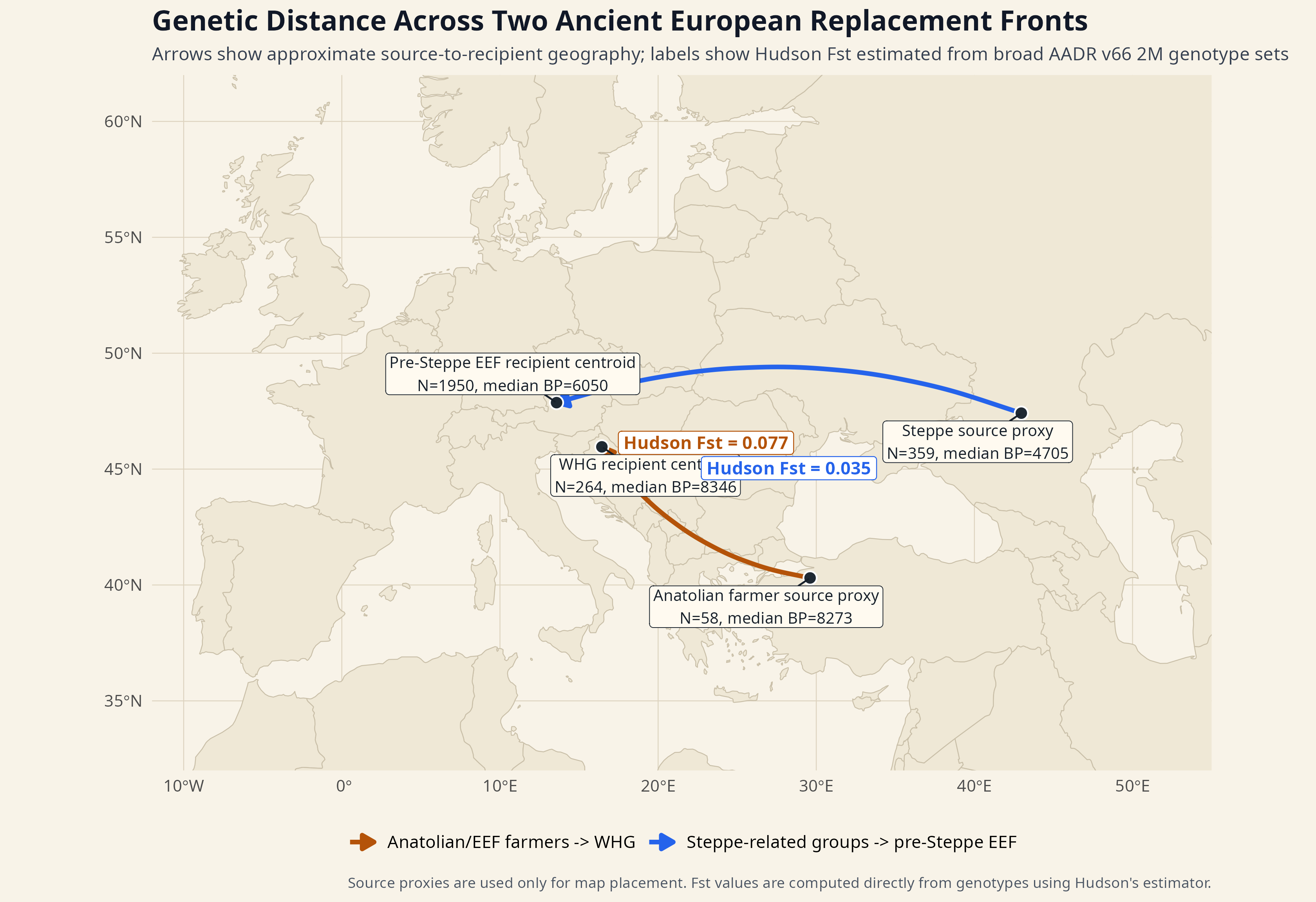
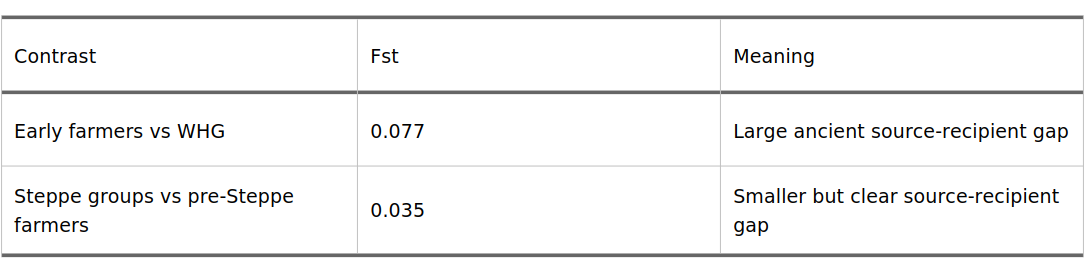
The first contrast is the larger one. The Fst between early farmers and western hunter-gatherers is 0.077. The later Steppe-vs-farmer contrast is 0.035.
That difference already says something historically plausible. Early farmers and western hunter-gatherers were separated by a deeper Near Eastern versus European hunter-gatherer ancestry divide. Steppe groups, by contrast, were not a completely alien source relative to Europe. They were themselves a mixture involving eastern hunter-gatherer-related and Near Eastern/Caucasus-related ancestry, and they entered a Europe whose farmer populations already had some hunter-gatherer ancestry.
The map shows where the two replacement fronts were. But the more interesting question is not just where these populations moved. It is how genetically far apart they were, and whether those distances were small by modern standards, large by modern standards, or somewhere in between.
Below the paywall I compare the ancient farmer-WHG and Steppe-farmer distances to thousands of modern population-pair Fst estimates. This is where the result becomes interpretable: one ancient migration looks closer to ordinary within-region variation, while the other sits much higher, approaching the lower range of modern continental-scale differences.
