

Barton et al. make a stronger claim about East Asian skin pigmentation than their evidence can really carry. In the abstract, they write that while West Eurasians depigmented in the last 10,000 years, “most skin lightening in East Asians arose prior to the Holocene.” Later they sharpen the point further. They say they “failed to observe strong selection at skin pigmentation in the East Eurasian cohort” and conclude that “genetic selection for skin lightening in East Asia preceded the Holocene.”
I do not think that conclusion follows from their analysis.
The disagreement is not over whether polygenic scores should be used. Barton et al. used them, and so did I. The real difference lies in how they were analyzed. In my 2025 Twin Research and Human Genetics paper, I also got null results with a European-based pigmentation score in East Asians. However, once an East Asian-based pigmentation score (Kim et al., 2024) is used, my direct regression approach detects a temporal increase toward the present, whereas Barton et al.’s framework still does not.
Consequently, their negative result is more plausibly read as a limitation of method than as proof that East Asian depigmentation was largely over before the Holocene.
Their method helps explain why. The core of their paper is a GLMM designed to detect consistent directional allele-frequency change over time. In their own description, it tests for “consistent trends in allele frequency change over time” that can be explained by directional selection. They also say quite openly that heterogeneous samples help when selection pushes in a consistent direction across space and time, but lose power when the pattern fluctuates. This gives us a hint to why pigmentation is a difficult trait for this framework in East Eurasia, where geography, ancestry, and latitude all structure the phenotype.
Barton et al. then extend the analysis to polygenic traits, but still within that same general logic: they ask whether pigmentation emerges as a strong, coherent signal in a very broad and heterogeneous ancient sample. For pigmentation, even after switching from mainly European GWAS weights to East Asian-based scores, they still report no significant result after multiple-testing correction. But that is not the same question I asked in my paper. I modeled the East Asian-based pigmentation score directly at the individual level, regressed it on date, and then added ancestry, geography, and coverage as covariates.
The temporal trend is not a fragile bivariate pattern either. It remains in the multivariable models after ancestry and geographic controls are added.
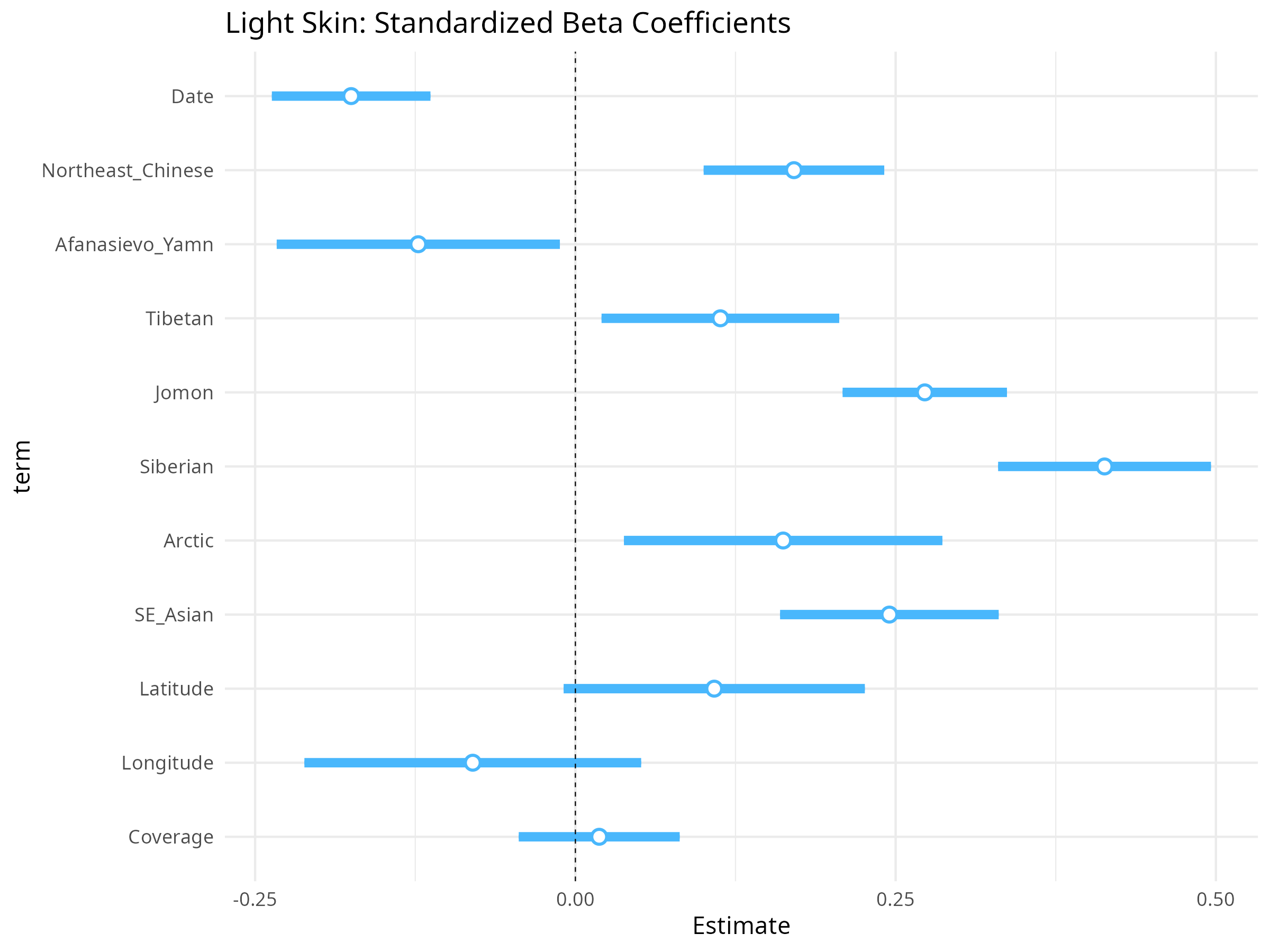
Two details are worth keeping in mind when reading this plot. First, Southern China is the reference group, so the ancestry coefficients are interpreted relative to it. Second, Date is measured in years BP, which means a negative coefficient for Date indicates lower light-skin PGS in older samples, i.e. darker predicted pigmentation deeper in the past.
Barton et al.’s GLMM is built to detect consistent allele-frequency change across a heterogeneous macro-regional sample, and they explicitly note that such samples gain power when selection pushes in the same direction over space and time but lose power when the pattern fluctuates. Their trait-level statistics, g and gsign, inherit the same logic: they ask whether many trait-associated variants move in a coordinated way strongly enough to produce a significant aggregate signal. My regression asks a different question. Using an East Asian-based pigmentation score, it tests whether the net individual-level pigmentation score rises toward the present after ancestry, geography, and coverage are controlled. That makes it better suited to a trait whose history is spatially structured and ancestry-dependent rather than continent-wide and uniform.
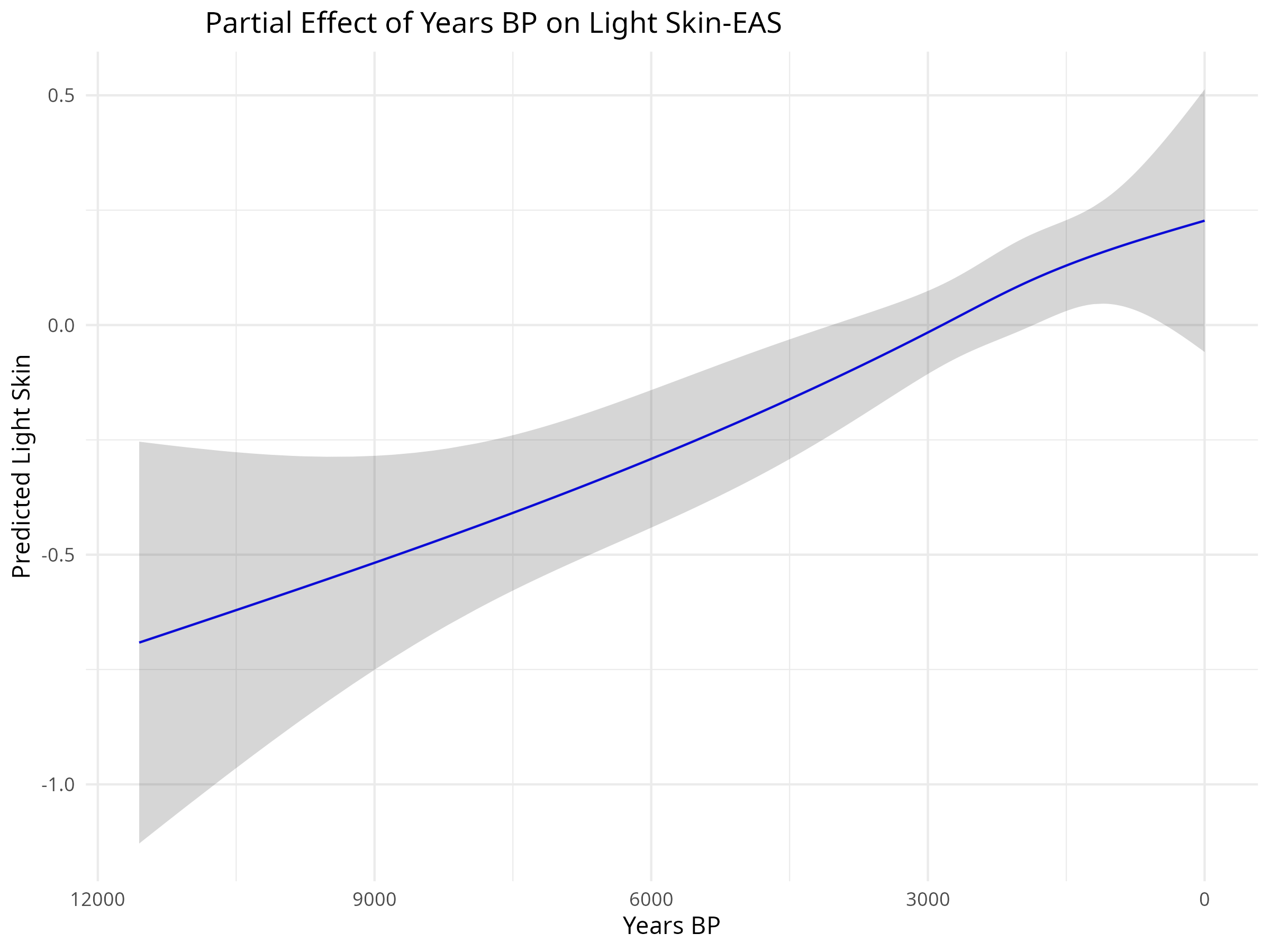
The divergence becomes obvious when you look directly at the fitted temporal trend from the East Asian-based pigmentation score.
Unlock the analysis of why the historical signal reappears.
