
The World Used to Be Bigger

A thousand kilometers is not the same thing in every century.
In one world, it can mean a chain of neighboring communities, regular marriage contacts, shared routes, seasonal movement, trade, and overlapping political horizons. In another, it can mean a hard break: different worlds separated by mountains, forests, water, language, subsistence, and time.
Ancient DNA gives us a way to ask whether that intuition leaves a genetic trace. At the same physical distance, were older ancient populations more genetically differentiated than more recent ones?
After controlling for geographic distance and broad region-pair, older group pairs have higher Hudson FST. Put plainly: the same number of kilometers corresponded to more genetic distance in older periods.
First, distance matters today
Before asking whether distance mattered more in the past, we need a baseline.
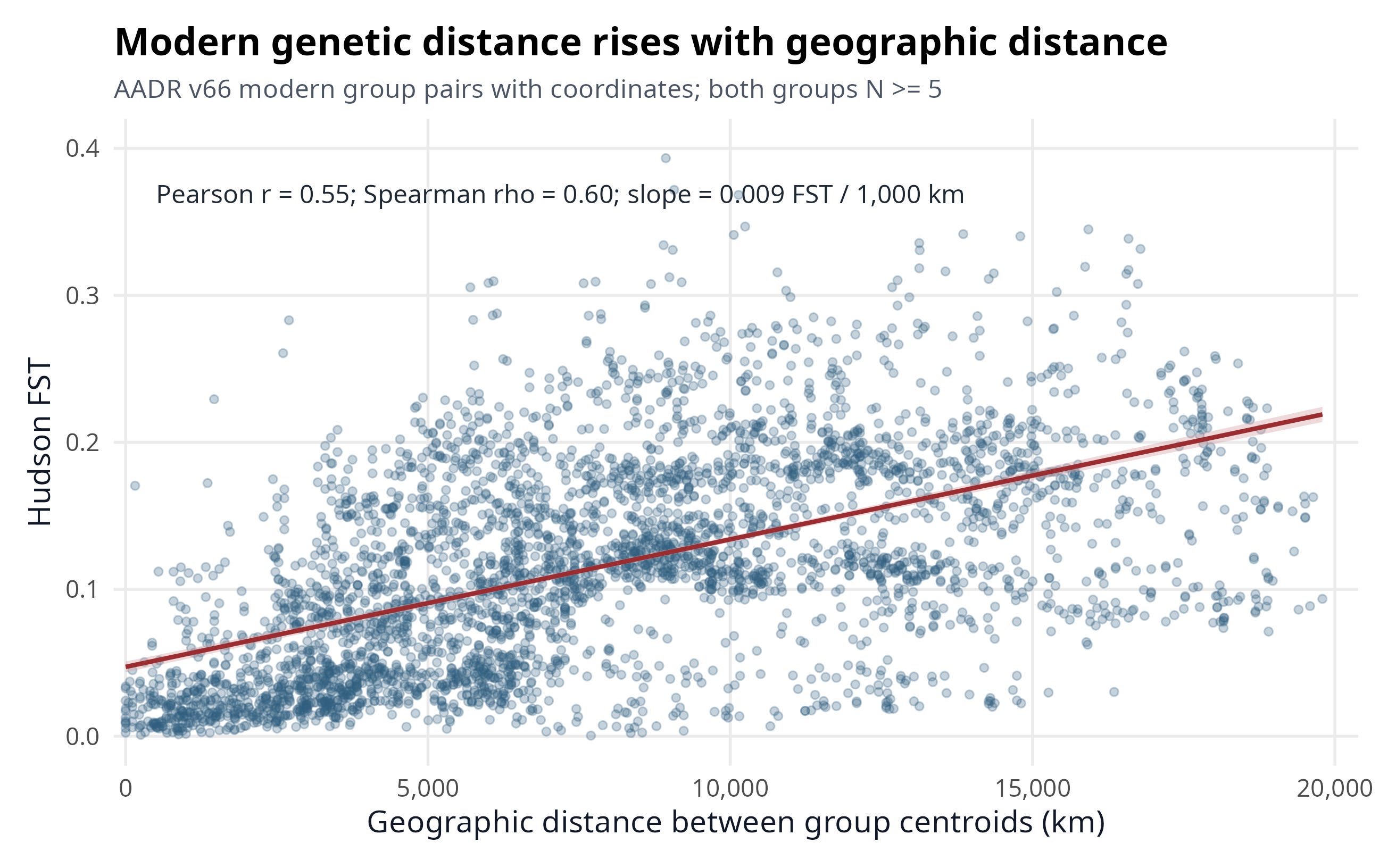
Among present-day populations in the AADR dataset, populations that live farther apart tend to be more genetically different. This is hardly surprising, but it is important to establish before moving on to the ancient data.
To show this, I matched the modern AADR Hudson FST table to the geographic coordinates of each population and calculated the distance between population centers. I restricted the analysis to groups with at least five individuals and known coordinates.
The relationship is far from perfect, but it is clear: greater geographic distance generally corresponds to greater genetic distance.
Figure 1. Modern FST by geographic distance
The real question is whether a given distance meant the same thing throughout history. Did 1,000 kilometers separate populations more strongly 8,000 years ago than it did 2,000 years ago? Ancient DNA allows us to test exactly that.
The continuous trend
Even after accounting for how far apart two populations were and which broad regions they belonged to, older population pairs were consistently more genetically different from one another.
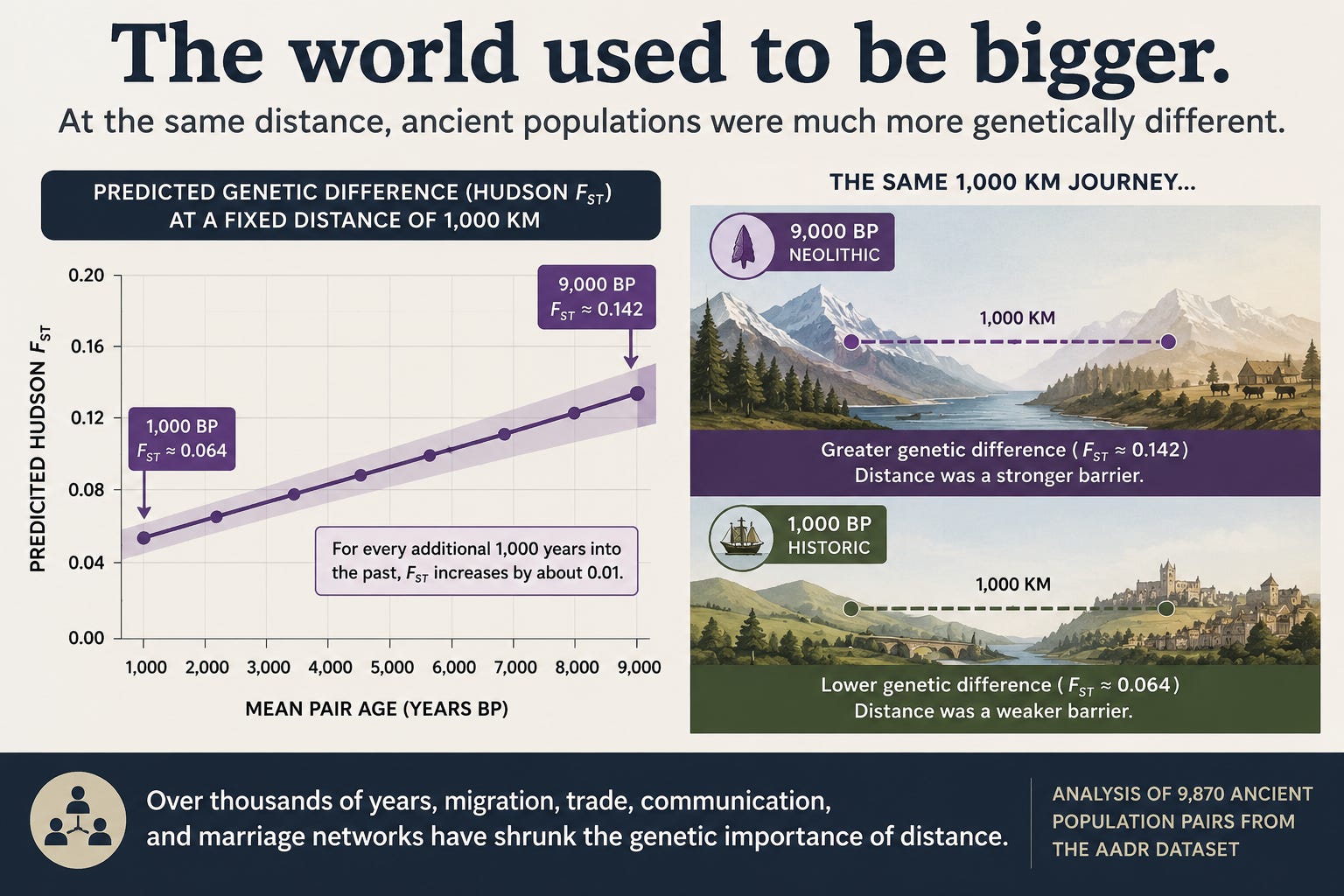
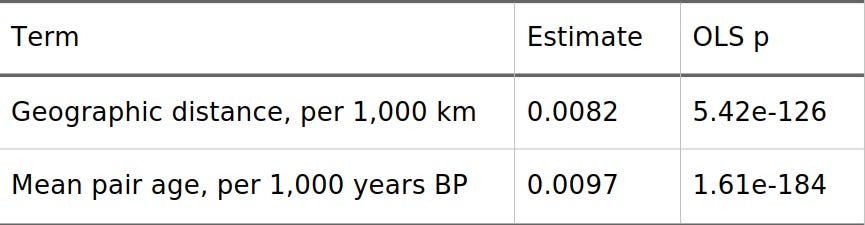
The effect is large enough to matter. For every additional 1,000 years into the past, Hudson FST increases by about 0.01.
In practical terms, this means that a journey of 1,000 kilometers connected people much less effectively in the distant past than it does in more recent periods. Populations separated by the same physical distance were genetically more distinct, suggesting that migration, trade, communication, and marriage networks became progressively better at bridging geographic space over time.
Table 1. Core model coefficients
One way to read the result is to fix the distance. At 1,000 km, the predicted FST rises steadily as pair age gets older.
Table 2. Predicted FST at 1,000 km by mean pair age
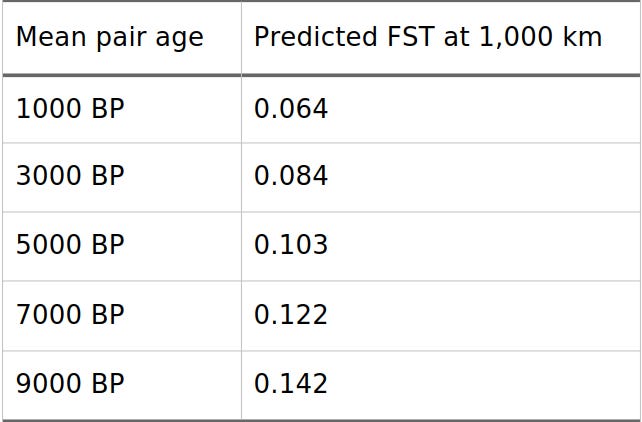
Because this is a linear model, the smooth spacing between rows is the fitted time slope. It should be read as a compact model summary, not as a claim that genetic distance changed mechanically by the same amount every millennium.
Figure 1. Predicted FST by age at fixed geographic distances
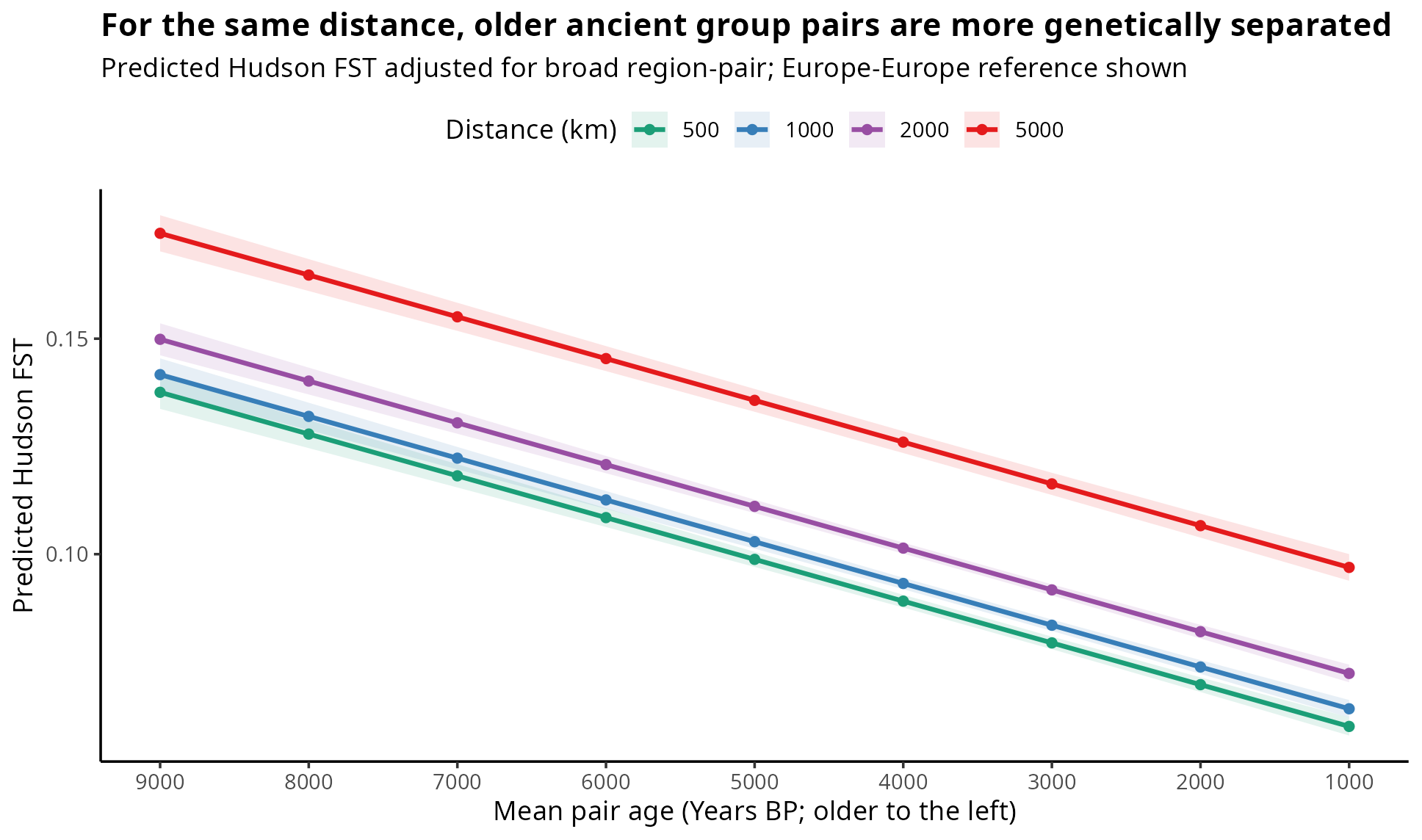
Figure 2 isolates the 1,000 km case. This is the most direct visualization of the question: hold distance fixed and move through time.
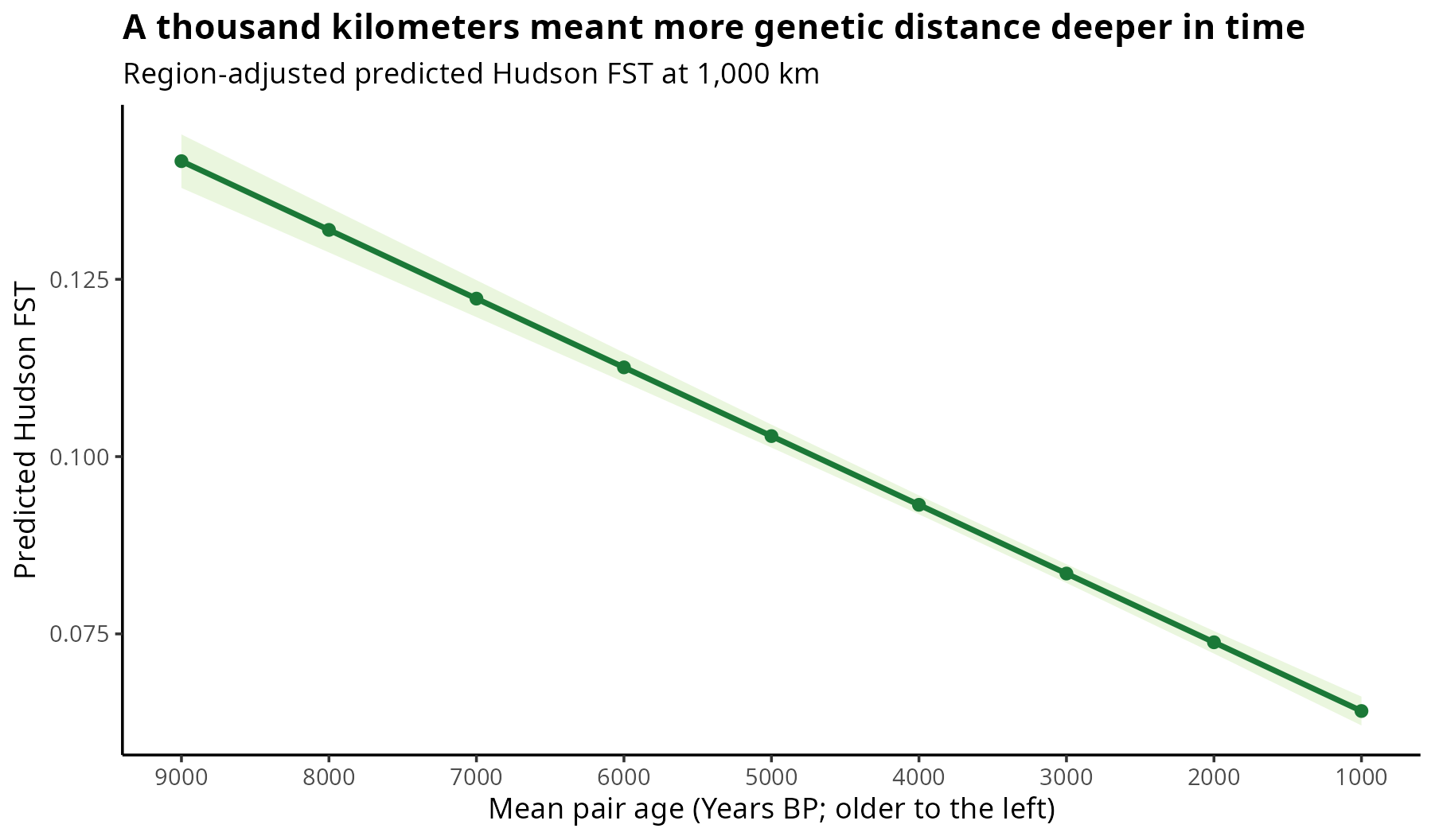
In this model, 1,000 km around 1,000 BP corresponds to predicted FST of about 0.064. The same 1,000 km around 9,000 BP corresponds to about 0.142. The exact numbers depend on the model and the AADR groups that survive the sample-size filter, but the direction is robust.
Some concrete same-country-sized examples
The abstract version of the result is easy to miss. A more intuitive way to read it is to ask what distances inside modern countries would have implied in the Neolithic.
Modern countries did not exist in the Neolithic, of course. London and Edinburgh were not endpoints in a British population system, and Rome and Milan were not Italian cities. The point is only to give the distance scale a familiar shape. These are present-day city pairs separated by roughly 500-660 km.
Table 3. Model-predicted FST for same-country-sized European distances
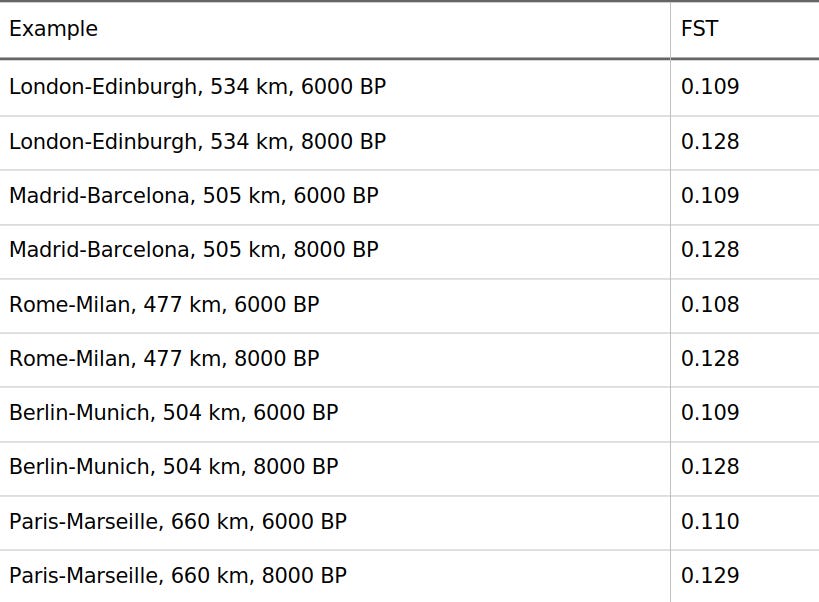
Those values are large compared with modern within-country or near-within-country population proxies in the same AADR-derived modern FST benchmark.
Table 4. Modern within-country or regional proxy FST values
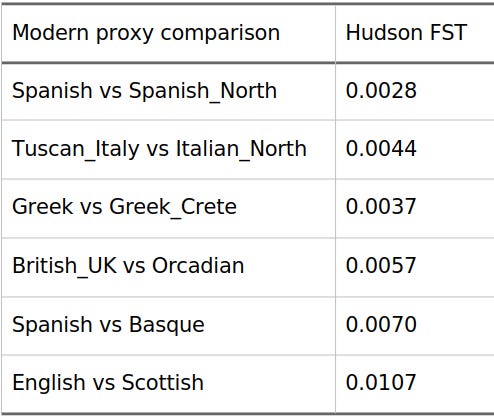
A 500 km separation inside present-day Europe often corresponds to tiny modern FST values, on the order of a few thousandths in these proxies. In the ancient model, a similar geographic separation around 6000-8000 BP corresponds to predicted FST around 0.11-0.13, similar to the distance between East Asians and Europeans. That is not a small difference in scale.
What this means historically
Older ancient populations were more genetically patchy over space. The same physical distance separated more differentiated populations in the deeper past than in later periods.
That does not require a single mechanism. Several processes can produce the pattern. Small effective population sizes can make local drift stronger. Sparse contact networks can allow neighboring regions to diverge. Later expansions and mixtures can smooth older discontinuities. Farming, pastoralism, metallurgy, trade, ships, horses, roads, empires, and marriage networks can all make distance less absolute, but FST does not tell us which one is responsible in any particular case.
Methods
I use FST as the genetic-distance measure. An FST of zero would mean two groups are genetically indistinguishable at the measured markers; higher values mean greater allele-frequency differentiation. Geographic distance is the great-circle distance between group centroids.
The unit of analysis is AADR Group ID pairs, not individual pairs. I first KING-pruned individuals, retained ancient groups with at least 25 post-pruning individuals, computed Hudson FST between retained groups, and then modeled group-pair FST as a function of geography and time.
The retained dataset contains 141 ancient groups, 7,494 individuals, and 9,870 group-pair comparisons. For the region-controlled continuous model, pairs with unclassified broad-region labels were dropped, leaving 9,045 group pairs.
The core model is simple:
Hudson FST ~ geographic distance + mean pair age + broad region-pair
Mean pair age is the mean of the two groups’ median Years BP. Broad region-pair is a dummy for combinations such as Europe-Europe, Europe-West Asia, West Asia-West Asia, and so on.
References
Bhatia, G., Patterson, N., Sankararaman, S. & Price, A.L. (2013). Estimating and interpreting FST: The impact of rare variants. *Genome Research*, 23(9), 1514-1521. https://doi.org/10.1101/gr.154831.113
Chang, C.C., Chow, C.C., Tellier, L.C.A.M., Vattikuti, S., Purcell, S.M. & Lee, J.J. (2015). Second-generation PLINK: rising to the challenge of larger and richer datasets. *GigaScience*, 4, 7. https://doi.org/10.1186/s13742-015-0047-8
PifferPilfer is a reader-supported publication. To receive new posts and support my work, consider becoming a free or paid subscriber.Mallick, S., Micco, A., Mah, M., Ringbauer, H., Lazaridis, I., Olalde, I., Patterson, N. & Reich, D. (2024). The Allen Ancient DNA Resource (AADR) a curated compendium of ancient human genomes. *Scientific Data*, 11, 182. https://doi.org/10.1038/s41597-024-03031-7
Manichaikul, A., Mychaleckyj, J.C., Rich, S.S., Daly, K., Sale, M. & Chen, W.-M. (2010). Robust relationship inference in genome-wide association studies. *Bioinformatics*, 26(22), 2867-2873. https://doi.org/10.1093/bioinformatics/btq559
Not unexpected, but still useful.
Presumably, if before domestic animals the average travel speed was about the same throughout paleolithic and early neolithic, the effect can be purely due to population growth. Even at the same migration speeds larger population should produce more homogenization across same distances
Interesting analysis, but intuitive.