

This is not a rigid law of intellectual history or a statistical certainty. It is a softer, yet undeniable pattern: the builder standing beside the cathedral, watching the pilgrims arrive, and quietly insisting they have completely misunderstood what was built.
Again and again, a field advances due to an unusually talented individual. Years later, when that creation becomes famous, commercialized, or weaponized, that same pioneer transforms into its dissident—not necessarily an enemy, but a disappointed parent or a heretic trying to recover the revolution’s original meaning.
Call it the Yann LeCun Effect.
Artificial Intelligence: The Contemporary Frontier
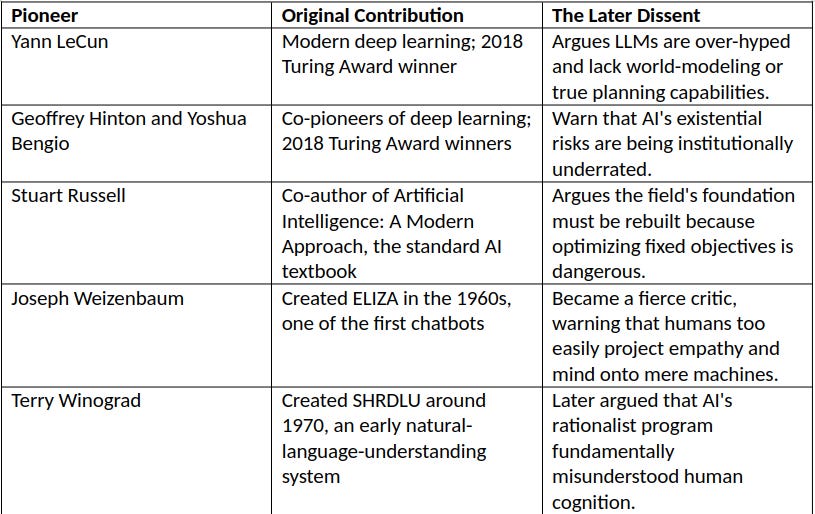
As a central figure in modern deep learning and a 2018 Turing Award winner, Yann LeCun helped construct the intellectual world that made today’s AI boom possible. Yet, in today’s discourse, he often sounds like a dissenter:
The Paradigm Critique: He argues that Large Language Models (LLMs) are an impressive engineering feat, but they are not a true theory of mind or the path to human-level intelligence.
The Reality Check: He maintains that current systems lack even animal-level intelligence and that existential risk rhetoric is wildly overblown.
LeCun’s skepticism, however, faces a massive empirical challenge. Critics argue that his rigid boundaries are increasingly disproven by the sheer capability of modern AI.
First, there is the staggering velocity of the technology: the sheer volume of advanced, multi-step tasks that AI can execute at blinding speed goes far beyond simple text prediction. Second, and more profoundly, AI has broken into the realm of elite human intellect by solving open, notoriously difficult mathematical puzzles such as Erdős problems.
When a machine achieves heuristic breakthroughs in pure mathematics that baffled humans for generations, it suggests that the line between “spectacular engineering” and genuine higher-order problem solving is blurring much faster than the pioneers care to admit.
LeCun is not alone. AI is uniquely fertile ground for this effect because the line between engineering and metaphysics is constantly blurred:
Physics & The Great Metaphysical Disputes
This phenomenon is not new. The classic historical example is Albert Einstein and quantum mechanics.
Popular memory labels Einstein as the old physicist who couldn’t accept the future. In reality, his 1905 paper on light quanta helped birth quantum physics. His famous objection—“God does not play dice”—was not a denial that the equations worked, but a dispute over meaning. He believed the field had mistaken predictive power for actual understanding.
The Moral Shock: Weapons & Biotechnology
Sometimes the pioneer’s turn is driven by a profound moral realization rather than philosophy. The technology escapes the lab, and the creator is left grappling with its political destination.
The Nuclear Architects: Leo Szilard conceived the nuclear chain reaction and initiated the Manhattan Project, only to later aggressively lobby for international weapons control. J. Robert Oppenheimer and Andrei Sakharov followed similar trajectories, their later warnings carrying immense weight precisely because of their insider complicity.
The Genetic Gatekeepers: Paul Berg (recombinant DNA pioneer) led the call for a voluntary moratorium on risky gene experiments in the 1970s. Decades later, Jennifer Doudna (CRISPR co-inventor) became a leading voice calling for strict global governance after the premature birth of gene-edited babies in China.
The Industrial Legacy: Alfred Nobel amassed a fortune inventing dynamite for construction and mining. Witnessing its devastating use in warfare, he repurposed his wealth into the Nobel Prizes to rewrite his legacy toward peace and human advancement.
The Disappointed Internet Fathers
In the digital age, pioneers frequently find themselves loving the original research vision while loathing the implemented civilization.
Tim Berners-Lee invented the World Wide Web as an open, decentralized information-sharing system. He spends his later years criticizing what it became: an ecosystem of corporate surveillance, addictive algorithms, and commercial enclosure.
The Architects: Jaron Lanier (VR pioneer) and Ted Nelson (hypertext creator) both became sharp critics of Web 2.0, arguing that ad-driven platforms and crude implementations eroded true human personhood and literary potential.
The Feature Designers: On a product scale, Ethan Zuckerman (the pop-up ad), Aza Raskin (infinite scroll), and Justin Rosenstein (the Facebook Like button) have all expressed regret over how their local, clever mechanisms were weaponized by the attention economy.
The Ambiguous Cases: When Authority Meets Infallibility
The “pioneer turned critic” possesses massive rhetorical force because an insider cannot be easily dismissed as ignorant. However, this is precisely where the Yann LeCun effect becomes dangerous: insider status does not equal infallibility, and a pioneer is not automatically right.
Two specific cases illustrate the deep ambiguity and danger of abusing this trope.
The Case of Kary Mullis
Kary Mullis won the 1993 Nobel Prize in Chemistry for inventing PCR, which became a foundational technique of modern molecular biology. Later in life, however, he became a prominent dissenter from the scientific consensus on HIV and AIDS, famously arguing that HIV had never been proven to cause AIDS. Mullis also fiercely objected to certain applications of his own technology in that debate, specifically criticizing the idea that PCR could straightforwardly quantify viral load without making major interpretive assumptions.
While this makes him a powerful example of the pioneer-turned-critic trope, a crucial caveat is required: Mullis’s status as the brilliant inventor of PCR did not make his medical views on HIV correct. The scientific consensus that HIV causes AIDS remains overwhelming. Furthermore, public misquotations have often weaponized his legacy, exaggerating his actual position into the entirely false claim that PCR cannot detect viruses or infectious diseases at all.
There is also a less flattering possibility at play here: envy, or status displacement. A pioneer may create a tool or idea, only to watch later figures build larger careers, institutions, fortunes, or moral authority on top of it. The founder then becomes not merely a critic of misuse, but a resentful critic of successors.
Mullis is the delicate, textbook example of this social dynamic. PCR became central to molecular medicine, including HIV detection and viral-load monitoring, while Mullis became hostile to the HIV/AIDS consensus and to public health figures such as Robert Gallo, Luc Montagnier, and Anthony Fauci. While it is impossible to prove envy from the outside (and Mullis always gave intellectual reasons for his dissent) the social situation is recognizable: the inventor of a powerful method watches other people become authorities through applications of that method, and subsequently attacks the authority structure that grew around it.
The Case of Robert Malone
Robert Malone represents a more delicate and highly visible modern example. In the late 1980s, Malone made landmark early contributions to RNA delivery and vaccine-related mRNA technology. Decades later, during the COVID-19 pandemic, he emerged as one of the most prominent critics of mRNA vaccines and public vaccine mandates.
This case demands careful handling because it perfectly exposes the limits of the pioneer myth:
In public discourse, Malone is frequently labeled as “the sole inventor of mRNA vaccines.” This claim is historically inaccurate.
mRNA vaccines were actually the culmination of decades of collaborative work by a vast web of researchers, including Katalin Karikó, Drew Weissman, lipid nanoparticle experts, immunologists, and major industry teams.
Malone belongs in the history books as an important early contributor, not as a lone creator. He serves as a vital warning for this essay: the “pioneer turns critic” narrative is so rhetorically seductive that it tempts people to overstate a single person’s historical role, or to treat past insider status as a blank check for modern scientific correctness.
Why This Happens
There are several structural reasons why pioneers so regularly become dissenters:
They remember the contingency: While the public sees a finished product as inevitable destiny, the pioneer remembers the duct tape, the toy assumptions, and the arbitrary choices that built it.
They separate the idea from the implementation: It is entirely logical to love the concept of an open web or genetic editing while despising platform monopolies or reckless embryo manipulation.
They are immune to category errors: The pioneer knows the machine too well to buy into the myth. Weizenbaum knew ELIZA didn’t care; LeCun knows prediction is not the same as embodied intelligence.
Status Displacement and Resentment: When a quiet research field mutates into a multi-billion-dollar industry driven by capital, marketers, and politicians, the pioneer loses sovereignty over their life’s work. Dissent then becomes a complex psychological mix: partly intellectual, partly moral, and sometimes a deeply human reaction to watching new successors build massive fortunes, institutional authority, and global fame on top of their original foundations.
Conclusion
Einstein was not infallible about quantum mechanics; his intuition failed him on the metaphysics of reality. Weizenbaum was not entirely correct about the absolute limits of AI.
Similarly, LeCun’s skepticism does not automatically settle the future of LLMs. While he dismisses current architectures as limited engineering paradigms, the empirical evidence of AI executing advanced tasks at superhuman speed and solving open Erdős problems proves that the machine is already outgrowing the imagination of its creators.
The takeaway of the Yann LeCun effect is not to blindly trust the apostate founder, but to listen carefully when they choose to become an apostate. They are valuable because they interrupt the smooth, corporate myth at the exact moment it is becoming socially convenient.
Pink Floyd and Albert Einstein:
I have a Pink Floyd bootleg LP, "nocturnal submission: robot love" https://www.floydboots.com/pages/n10.php which includes what is presumably a backstage comment from one of the band https://youtu.be/KzqwOLhsRDs?si=0vdBEiQuz4vZRDDI&t=2161 ". . . so bloody thousands and thousands upon thousands of them have stood and pretended to enjoy something they didn't even understand!".
I think the best quality of Pink Floyd's music is its abstract, other-worldy, untethered to anything nature which acts as a catalyst for thoughts and feelings. Does "understand" mean having an accurate perception of the musician's emotions and deliberate thoughts? I don't think it necessary - and to have this might in some ways restricts flights and fancy.
In a 1951-12-12 letter to long-time friend Micheal Besso, Albert Einstein wrote that neither he nor anyone else knew what the quanta was. The "quanta" is the "photon" - the conception that electromagnetic radiation (EMR, radio waves, infra-red, visible light, UV, X-rays and gamma rays) consists not of classical waves, but of discrete packets of energy, where the energy is proportional to the frequency and where stronger sources of EMR consist of more packets. To this day, this is still widely accepted as a crucial foundation of physics, despite numerous problems.
Quantum mechanics is a highly mathematical field which is widely believed to be the best representation of profoundly perplexing aspects of matter and EMR at the smallest scale. This started with Albert Einstein's 1905 "photoelectric" article https://en.wikipedia.org/wiki/Annus_mirabilis_papers, written as a 26 year old patent examiner, for which he won the 1921 Nobel Prize in Physics. Starting with the assumption of quantized energy levels in EMR - so packets AKA quanta and later photons - he proceeded with a chain of mathematical transformations which resulted in the formula for Planck's black body radiation spectrum, which to this day has no other widely accepted explanation. (I regard the transformations as mathematical hi-jinks with no physical continuity - if someone can point me to an argument to the contrary, I would appreciate it.)
The photon/quanta theory was rejected for valid reasons, such as the interference between individual sources of EMR. However, ca. 1920 some experiments with X-ray diffraction in crystals were widely (probably mis-, I think) interpreted as solid proof of the existence of quanta.
Michael Besso was an engineer Albert Einstein met at the patent office ca. 46 years earlier. Using both Google and Perplexity AI I was unable to find the original German text. Then I found an image of the letter at https://onlineonly.christies.com/s/einstein-letters-friend-part-ii/what-are-light-quanta-57/50658. I Photoshopped it and used Perplexity AI to OCR it. I guess this is a good rendition of the passage:
"Die ganzen 50 Jahre bewußten Grübelns haben mich der Antwort der Frage "Was sind Lichtquanten" nicht näher gebracht. Heute glaubt zwar jeder Lump, er wisse es, aber er täuscht sich."
Google Translate translates this to:
"All these 50 years of deliberate pondering have brought me no closer to answering the question "What are light quanta?" Today, every scoundrel thinks he knows, but he's wrong."
(I am working on deriving the black body spectrum from antenna effects and some other things I am not yet on top of. The photo-electric effect can probably be explained by "rogue wave" peak concentrations of classical waves, for a moment converging on a single electron and so ejecting it from the metal's surface. Disproving the quantum theory of light is a step towards disproving the Big Bang Theory. All that would take is showing how light and similar EMR, not necessarily every wavelength from low radio waves to gamma rays, at least to the same degree, is transformed by subtle interactions with the lone electrons and bare nuclei of the intergalactic medium, probably one proton and one electron per cubic metre, so that its wavelength is stretched, and some energy is lost - heating the plasma to its hundreds of millions of degrees K - at a rate which approximates the very slight red-shifting of the light from distant galaxies. Cosmologists cannot imagine such a process because they are locked into thinking of EMR as photons, rather than classical waves. This is relevant to the heating of the solar corona, one of the best recognised unsolved problems in physics. Cosmologists are mistaken in regarding the Big Bang Theory as a fact when they can't explain the heating and acceleration of the solar corona, which is happening right under our noses. https://astroneu.com.)
Robert Malone is entirely correct to regard modified MRNA injections, falsely portrayed as "vaccines", as a horror. They program our cells (Which cells? Anywhere in the body. Which types of cells? All.) to produce a facsimile of a viral protein, such as the toxic SARS-CoV-2 spike protein, which is generally attached to the outside of the cell's plasma membrane, for the purpose of giving the immune system target practice. The modified mRNA itself - and, in many cases, DNA fragments from the gene edited e-Coli production vats - is transported directly into our cell's cytosol. This reckless and destructive in numerous respects.
The COVID-19 pandemic, with tens of millions of people killed, was entirely man-made. U.S. and Chinese government funded research led to the creation of the virus and the corrupted, groupthunk, fascist, pandemic response did the rest. No government has taken a real interest in either the origins or the pandemic response, but U.S. Republicans have done excellent work on both. https://vitamindstopscovid.info/00-evi/ and https://vitamindstopscovid.info/07-origins/,
Excellent article on a fascinating subject.
The case of unintended consequences. Humans have an uncanny ability to turn good into evil.