

Ancient DNA has made the human past directly observable in a way population geneticists could only approximate a generation ago. In The History and Geography of Human Genes, Cavalli-Sforza and his coauthors had to reconstruct history indirectly from the spatial distribution of living populations. Ancient DNA changes that. It lets us track populations through time instead of inferring the past from geography alone.
That opens the door to a harder question than who came from where. We can now ask how much ancient populations differed from us, in what direction they differed, and whether those differences stayed within the range of ordinary regional variation or climbed into something larger.
That question matters even more now that ancient genomics has moved beyond ancestry in the narrow sense. The first explicit test of directional selection on cognitive ability using ancient DNA was published in 2017 by Michael Woodley and myself (Woodley et al., 2017). My later work (Piffer and Kirkegaard, 2024; Piffer, 2025) extended that approach and reported directional selection across multiple polygenic traits over the last twelve thousand years. Akbari et al. (2026) then replicated and greatly expanded that general result at much larger scale in West Eurasia.
Once you accept that ancient populations were being reshaped by migration, drift, replacement, and selection, another question becomes hard to avoid. Were ancient Europeans merely earlier versions of modern Europeans, or were some of them separated from us at a scale closer to what ordinary people would recognize as a major human division?
Geneticists usually avoid the word race and use broader labels such as superpopulation instead. In practice, superpopulations are the large continental-scale clusters used in modern population-genetic work: Europe, West Asia, East Asia, South Asia, Africa, the Americas, and Oceania. That makes them the closest technical counterpart to what people usually mean when they ask whether one population is as different as another race.
The obvious problem is confounding. Small ancient groups can look artificially extreme, and mixed-region comparisons can produce misleading nearest-population matches. So the analysis here uses a stricter benchmark: ancient groups are restricted to Europe, the modern side keeps all present-day superpopulations for comparison, and the main analysis keeps only ancient groups with at least twenty-five individuals.
Set the word itself aside for a moment. If you compare ancient Europeans to modern Europeans, do they stay within the range of ordinary modern European variation, or do they climb into the range now seen between present-day superpopulations?
To answer that, I use Hudson’s Fst, a standard population-genetic measure of genetic distance. Very loosely, higher Fst means two populations are more genetically differentiated from one another.
It is worth pausing to note that this kind of analysis depends on an enormous collective effort. Ancient DNA became historically informative not just because of new methods, but because laboratories, archaeologists, and database builders created datasets large enough to make temporal comparisons credible. The Harvard ancient-DNA lab and its many collaborators around the world have been central to that process, as have data infrastructures such as the Allen Ancient DNA Resource and the National Genomics Data Center in China, which make ancient genomes available in forms researchers can actually use.
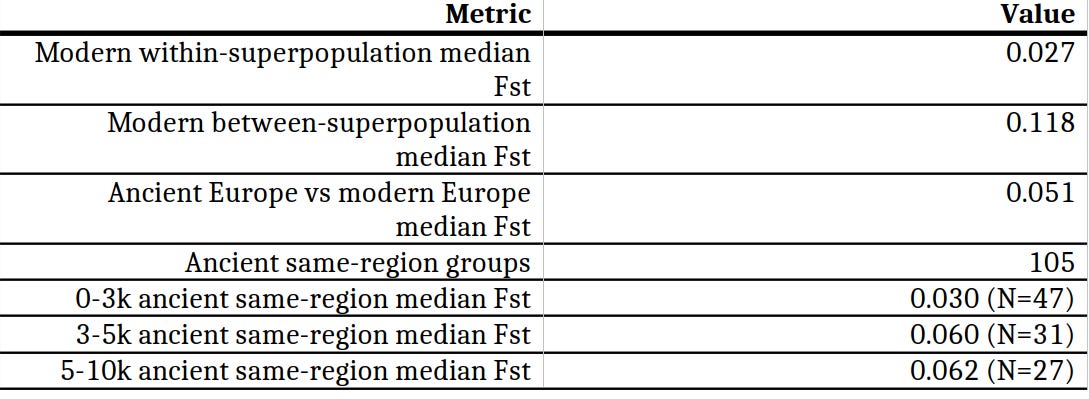
Methods note. The benchmark uses Hudson’s Fst from the AADR v66 2M panel (Mallick et al., 2024). The main working set is the Europe-only ancient benchmark with ancient groups restricted to N >= 25. That leaves 105 ancient European groups for the same-region comparison: 47 in 0-3k BP, 31 in 3-5k BP, and 27 in 5-10k BP.
Results
Start with the raw Europe-only benchmark, because that is what makes the whole question interesting in the first place. Before any size filter is applied, the median ancient Europe versus modern Europe Fst is 0.129. That is not just above ordinary within-Europe variation. It is slightly above the median distance between present-day superpopulations. If you stopped there, the result would look stark: ancient Europeans would seem to be separated from modern Europeans by distances roughly on the scale of present-day superpopulation differences.
But that raw version is not the one to trust. Small ancient groups inflate the upper tail, and once they are removed the picture changes. In the main N >= 25 analysis, the median ancient Europe versus modern Europe Fst falls to 0.051, while the median modern within-superpopulation Fst is 0.027 and the median modern between-superpopulation Fst is 0.118 . So the cleaned result still places the typical ancient-modern comparison well above routine within-superpopulation variation, but no longer at the level of the typical gap between present-day superpopulations.
Figure 1. Cleaned Benchmark Distributions
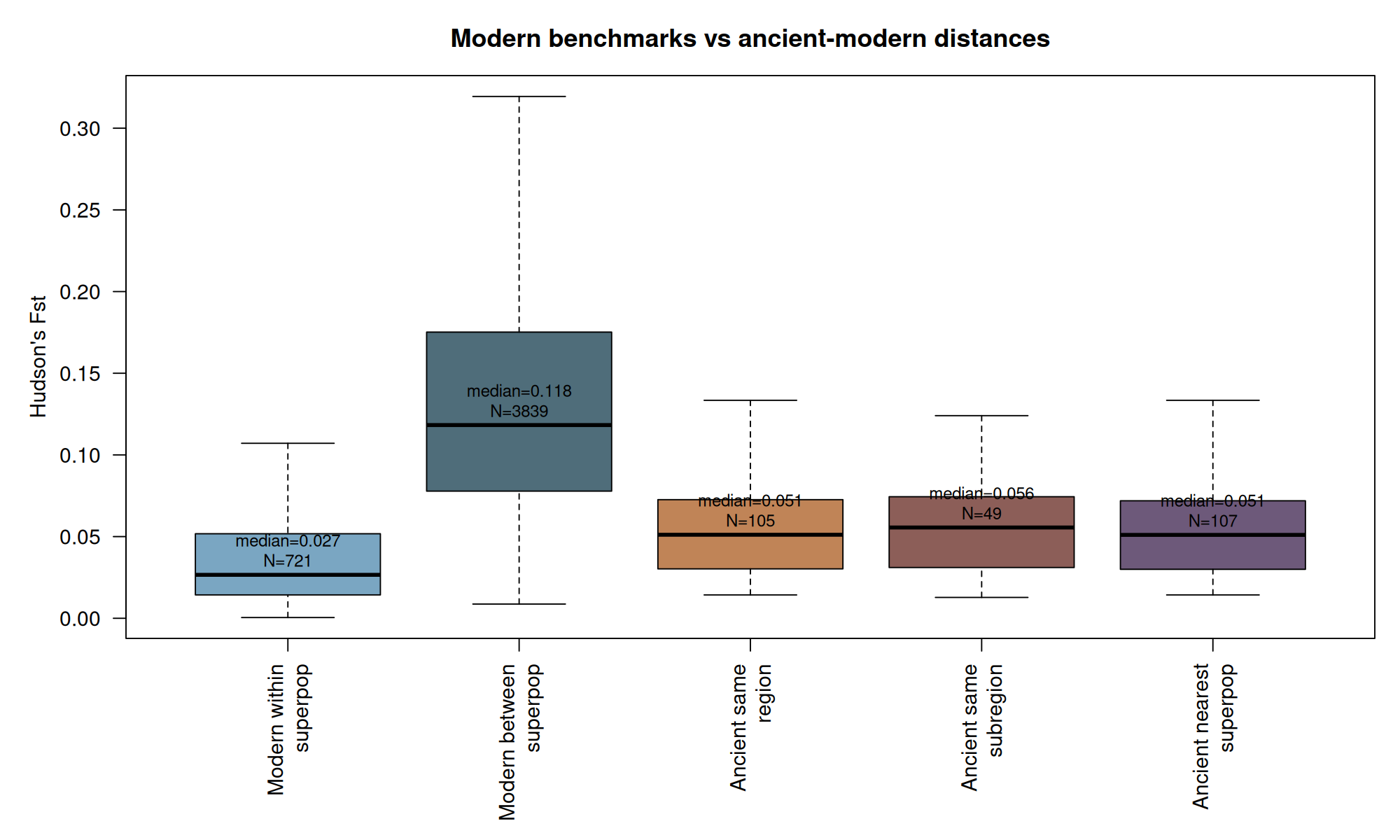
Table 1. Headline benchmark numbers for the cleaned Europe-only N >= 25 analysis.
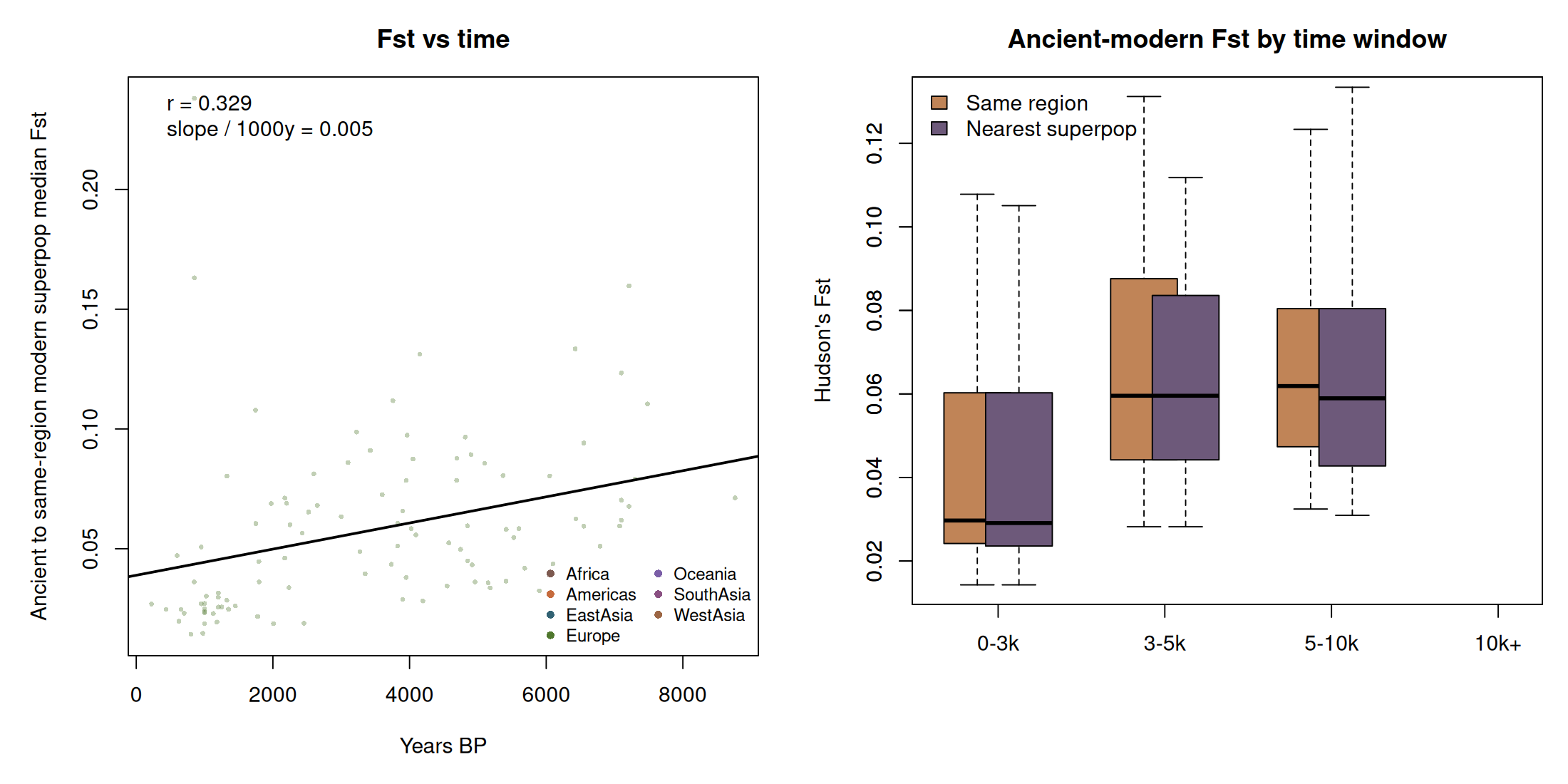
Space is the obvious source of genetic distance. Populations that live far apart usually differ more than populations that live close together. The more interesting question is what time does on top of that. Once the ancient side is restricted to Europe and the small groups are cleaned out, the answer is no longer muddled: older Europeans are systematically farther from the present than more recent Europeans are. The median same-region Fst is 0.030 for 0-3k BP, rises to 0.060 for 3-5k BP, and to 0.062 for 5-10k BP. In other words, the genetic distance between ancient and modern Europeans does not just reflect geography. It grows as you move backward in time.
Figure 2. Ancient-Modern Fst Through Time
What matters now is not just the median, but the overlap: how often ancient-modern distances are actually larger than the genetic distances separating present-day human populations, and which ancient groups still sit in that upper tail.
