

There is a beautiful myth about what drives Italian life. Ask a romantic outsider, and they will tell you Italians are moved by the opera, football, the local village square, the grandmother’s Sunday ragù, or the precise, unhurried geometry of a perfect cappuccino.
And emotionally? Maybe they are.
But when Italians actually pack their bags, when they change their legal residence and enter the dry, unromantic ledger of municipal registers, the data points to a reality that is far more decisive: work.

Not work in the abstract, mind you. What actually moves Italians is a very practical, localized promise: that a specific province can turn their education into a salary, their youth into stable employment, and their household into something sustainable. A province doesn’t need to be postcard-beautiful to attract people; it just needs to make the next step of adult life look structurally possible.
I wanted to dig past the sentimental cultural clichés, so I looked at the hardest evidence available: ISTAT records of where people actually registered their residence in 2024. I combined these internal migration tables with ISTAT’s 2025 Bes dei territori indicators—a massive dataset that measures provincial quality of life across indicators like jobs, innovation, civic participation, and safety. To ensure massive cities like Rome and Milan didn’t skew the reality simply by being huge, I converted every flow into rates per 1,000 residents.
Then I ran a regression model to ask a simple question: What actually predicts where people move?
The results don’t look like a tourism brochure. In fact, they break the usual North-South clichés entirely.
1. The Real Migration Scoreboard
If you look at net migration (arrivals minus departures per 1,000 residents), you find an unexpected leaderboard.
In 2024, the biggest net winners weren’t glamour destinations like Florence or Milan proper. They were places like Pavia, Alessandria, Vercelli, Imperia, Ferrara, Piacenza, Genova, and Cremona. On the flip side, the steepest net losses were in Caltanissetta, Napoli, Enna, Nuoro, Agrigento, Barletta-Andria-Trani, Reggio di Calabria, and Palermo.
Figure 1. Net migration per 1,000 residents by province, 2024.
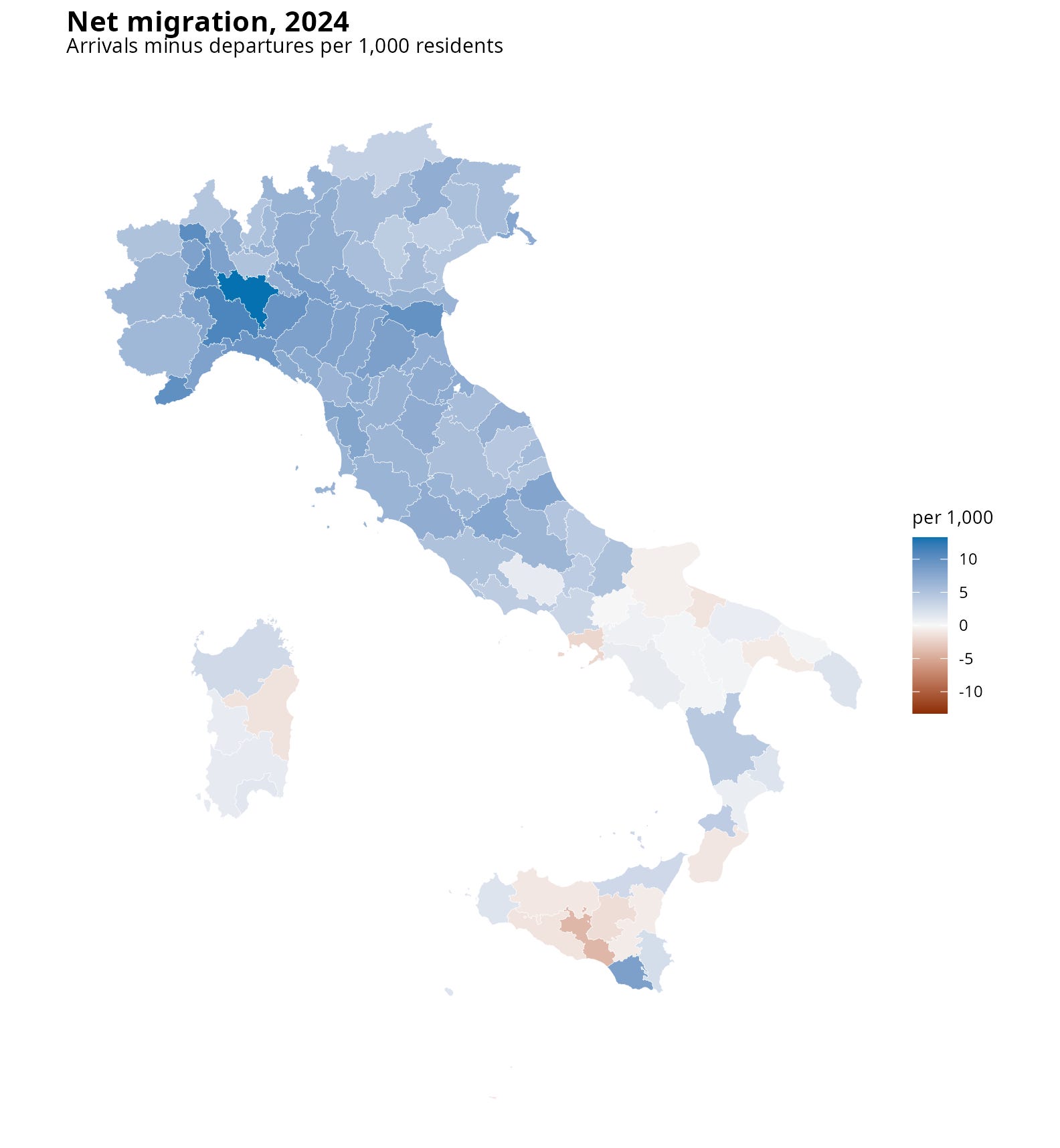
As you can clearly see on the map in Figure 1, this isn’t just a basic Milan or Rome growth story. Take Pavia: it wins heavily because it is tightly plugged into the Milanese labour and university ecosystem without forcing residents to pay Milanese rents.
Piacenza and Cremona thrive because they sit in the hyper-productive geographical belly of the Po Valley. Alessandria and Vercelli aren’t industrial chic or major tourist hubs, but they sit within a northern industrial belt where job-hopping and economic mobility are seamlessly legible.
Crucially, none of these high-performing provinces boast the majestic, snow-capped scenery of the Alps, or the iconic beach coastlines of Liguria, Amalfi, or Sardinia. Yet, they pull people in anyway. A province doesn’t need an alpine view or a beach resort to be a demographic magnet; it just needs a functioning local economy.
Meanwhile, the losing side of Figure 1 is brutal. Interior Sicily, Calabria, and parts of Puglia aren’t just graying due to a low birth rate—they are actively losing the competition for working-age adults.
2. High-Mobility vs. Being “Stuck”
A common trap in migration analysis is treating arrivals as the ultimate sign of attraction. But that’s only half the equation. To understand what’s really happening, we have to look at how people arrive and how they leave across the country.
Figure 2. Total arrivals per 1,000 residents by province, 2024.
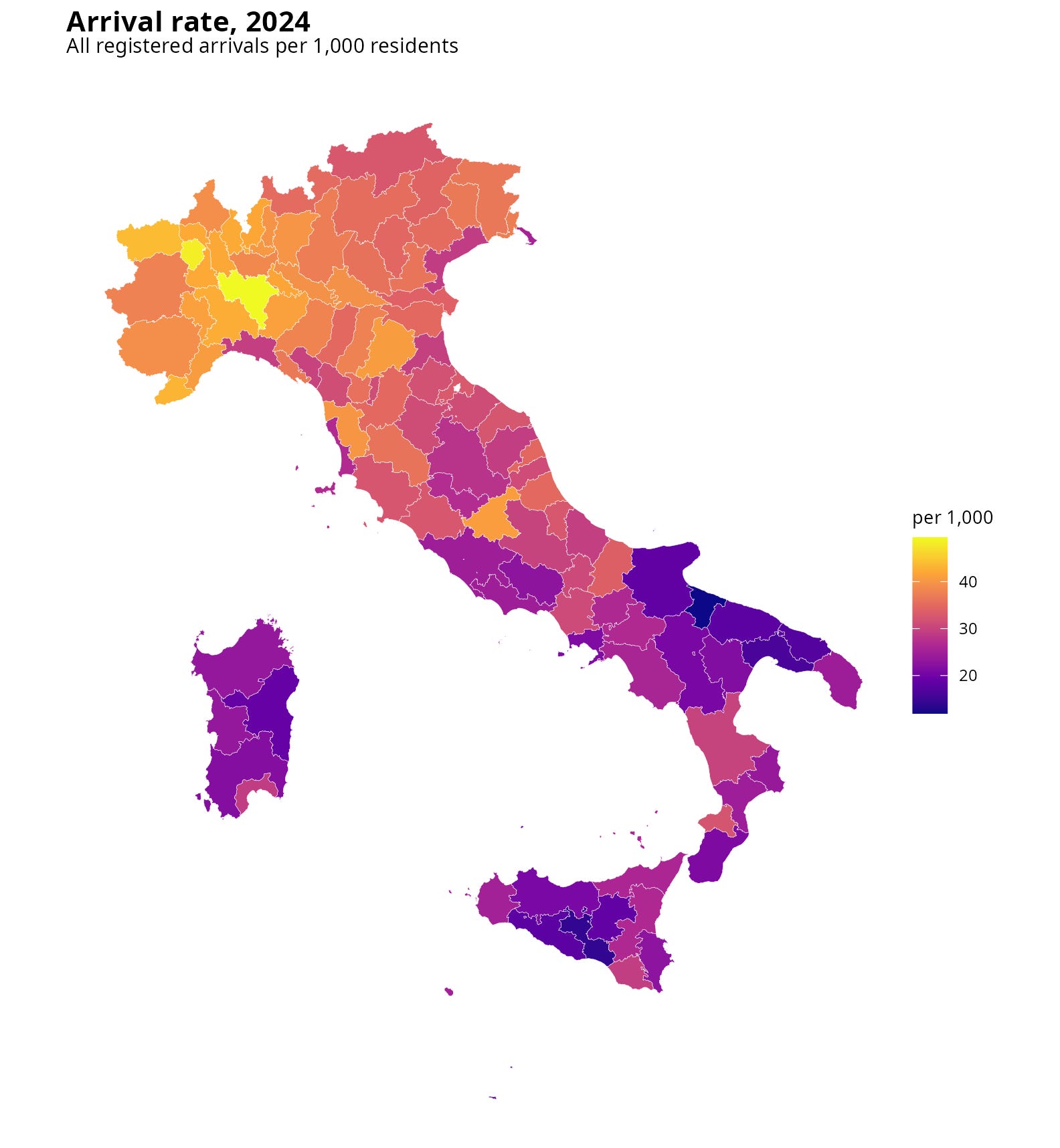
Figure 3. Total departures per 1,000 residents by province, 2024.
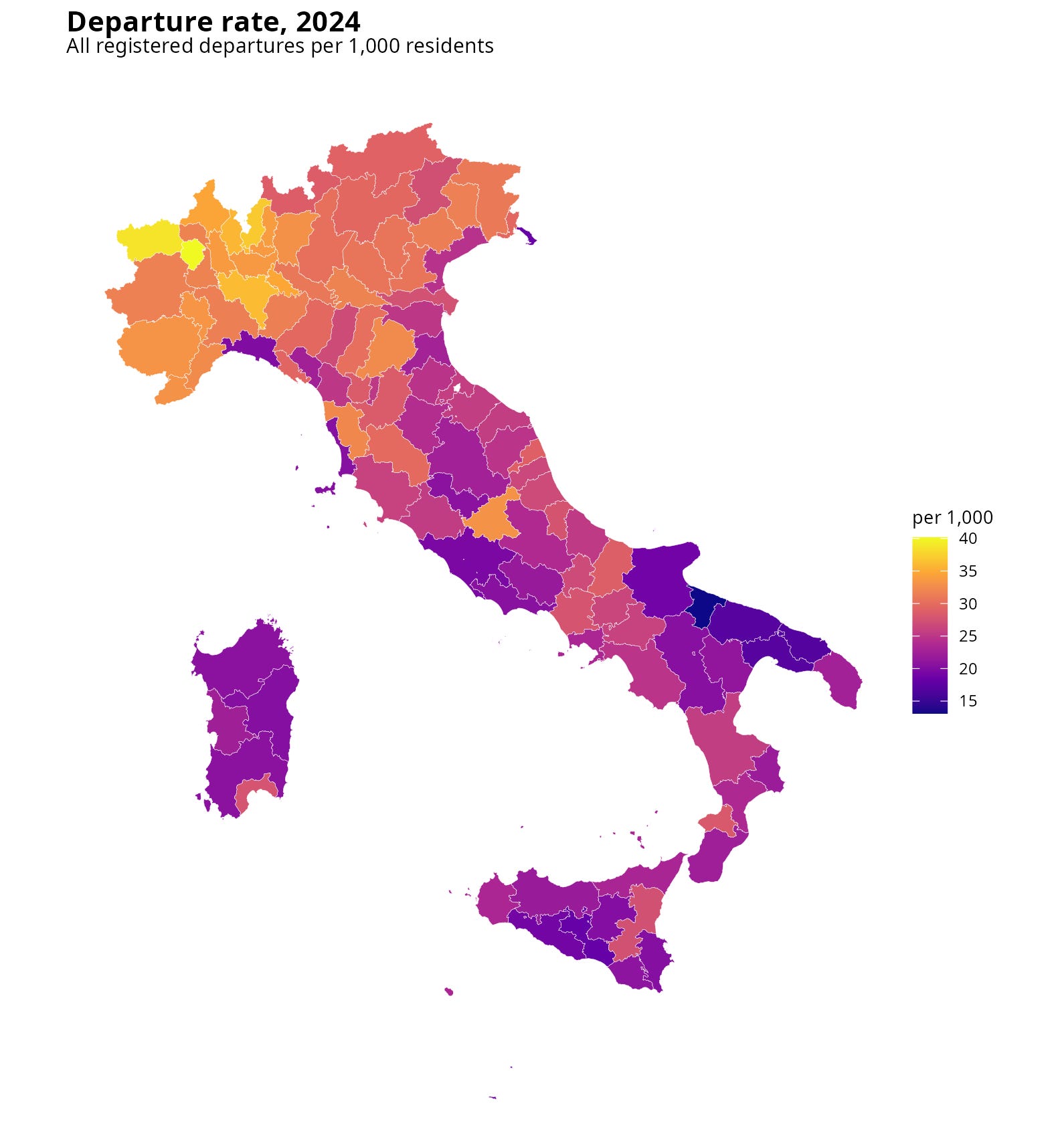
If you compare the arrival rates in Figure 2 with the departure rates in Figure 3, you notice something fascinating about Northern Italy: it operates on intense economic churn. The provinces with the highest raw arrival rates in 2024 were places like Pavia, Biella, Valle d’Aosta, and Imperia, but many of these exact same regions also suffered very high departure rates.
People move in, people move out, and they constantly trade one province for another as jobs, rents, relationships, and childcare needs evolve. This churn is actually a sign of economic health. A high-mobility province is a functioning labor market where people feel secure enough to relocate for a job, knowing they can also easily leave if a better alternative pops up nearby.
The opposite of mobility isn’t cozy regional stability; it’s being stuck.
When you look at what drives these patterns, the data is crystalline: provinces with higher overall employment, vibrant youth job markets, robust patenting (innovation), and high voter turnout see people flood in. Conversely, areas heavily defined by economic fragility and low-income pensioners keep outsiders from ever showing up.
3. The Graduate Filter or The Internal Brain Drain
The cleanest, most telling statistical signal comes from internal migration between Italian provinces.
Figure 4. Internal net migration per 1,000 residents by province, 2024.
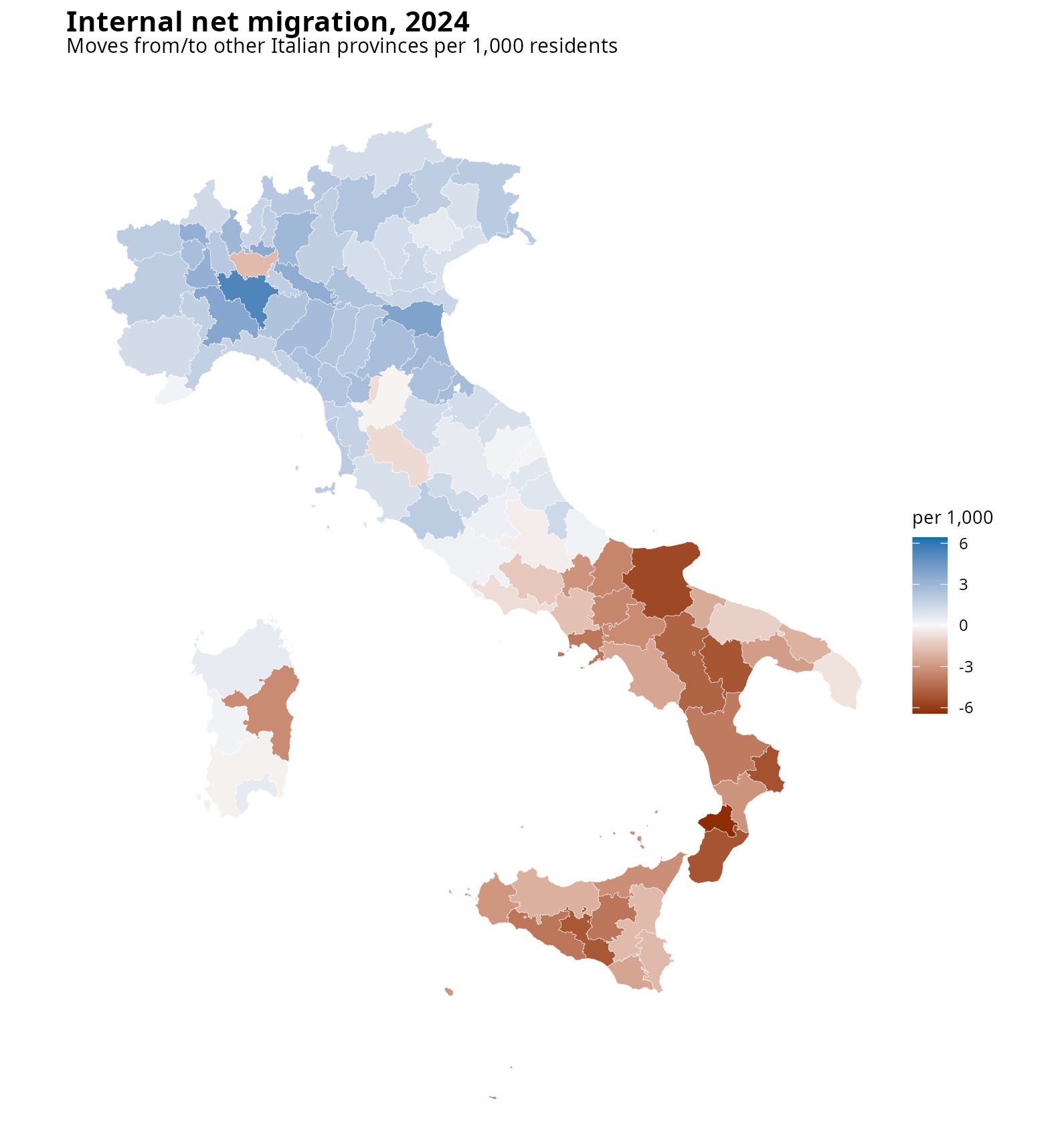
Figure 5. ISTAT’s graduate-mobility indicator, meaning whether a province gains or loses Italian graduates aged 25-39, and internal net migration.
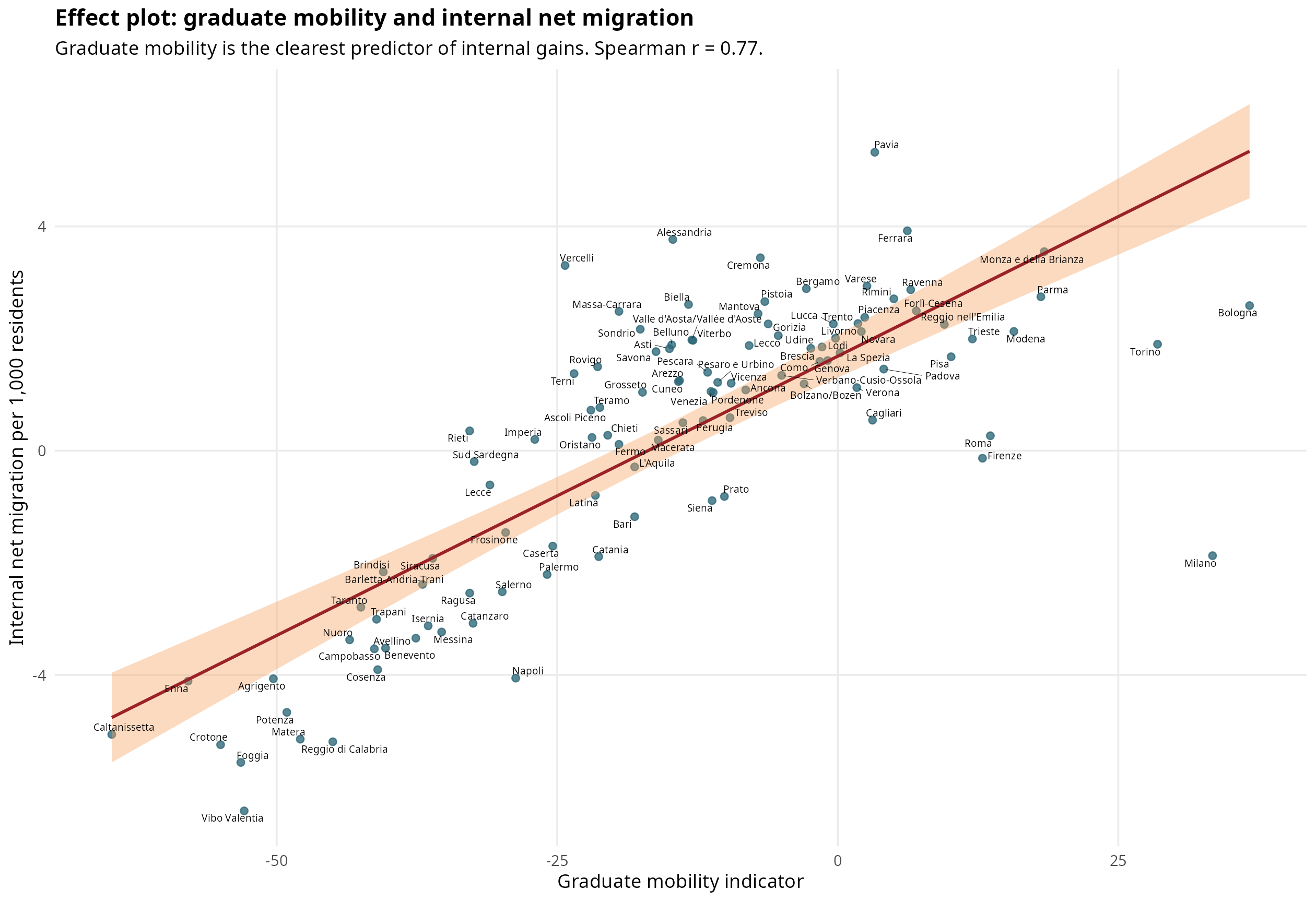
As shown in the internal migration map (Figure 4), the flight from the South to the North becomes even starker when you isolate domestic moves. And if you look at the regression plot in Figure 5, the single strongest predictor of whether an Italian province will grow internally is what ISTAT calls the “mobility of Italian graduates aged 25-39”.
This tracks whether a region is gaining or losing young adults with university degrees. This is the exact demographic for whom moving matters most: they are young enough to change paths, educated enough to rigorously compare opportunities, and old enough that their choice dictates where they will lay down long-term family roots.
Provinces that can attract or hold onto young educated adults win the broader migration game across the board. It is the ultimate statistical translation of the everyday phrase “there is work there”.
Conversely, areas plagued by low pension incomes, weak labor market participation, and poor school competencies suffer devastating population drains. This tells us that people aren’t just moving for a paycheck today; they are reacting to the local stock of human capital and mapping out the perceived future of the place.
This leads to a harsh truth: The South isn’t just being abandoned. It is facing a highly selective demographic and brain drain filter.
Migration doesn’t hit every group equally; it actively sorts the population. The filter allows those with the highest resources, university degrees, and economic runway to exit toward northern labor markets. Meanwhile, it effectively traps those who lack the liquid capital to relocate or who are bound by local family obligations.
Over time, this brain drain filter creates a compounding downward spiral. It hollows out the origin provinces by removing the very human capital—young, educated professionals and tax-payers—needed to revitalize the local economy. This leaves the remaining community older, poorer, and more reliant on low-income pensions, performing even worse on the exact indicators that attract future investment. Migration isn’t just an after-effect of geographic inequality; it is the exact mechanism by which geographic inequality reproduces itself.
4. Foreign Inflows Follow a Different Logic
When we shift the lens from internal moves to foreign net migration (international arrivals minus international departures), the map transforms completely.
Figure 6. Foreign net migration per 1,000 residents by province, 2024.
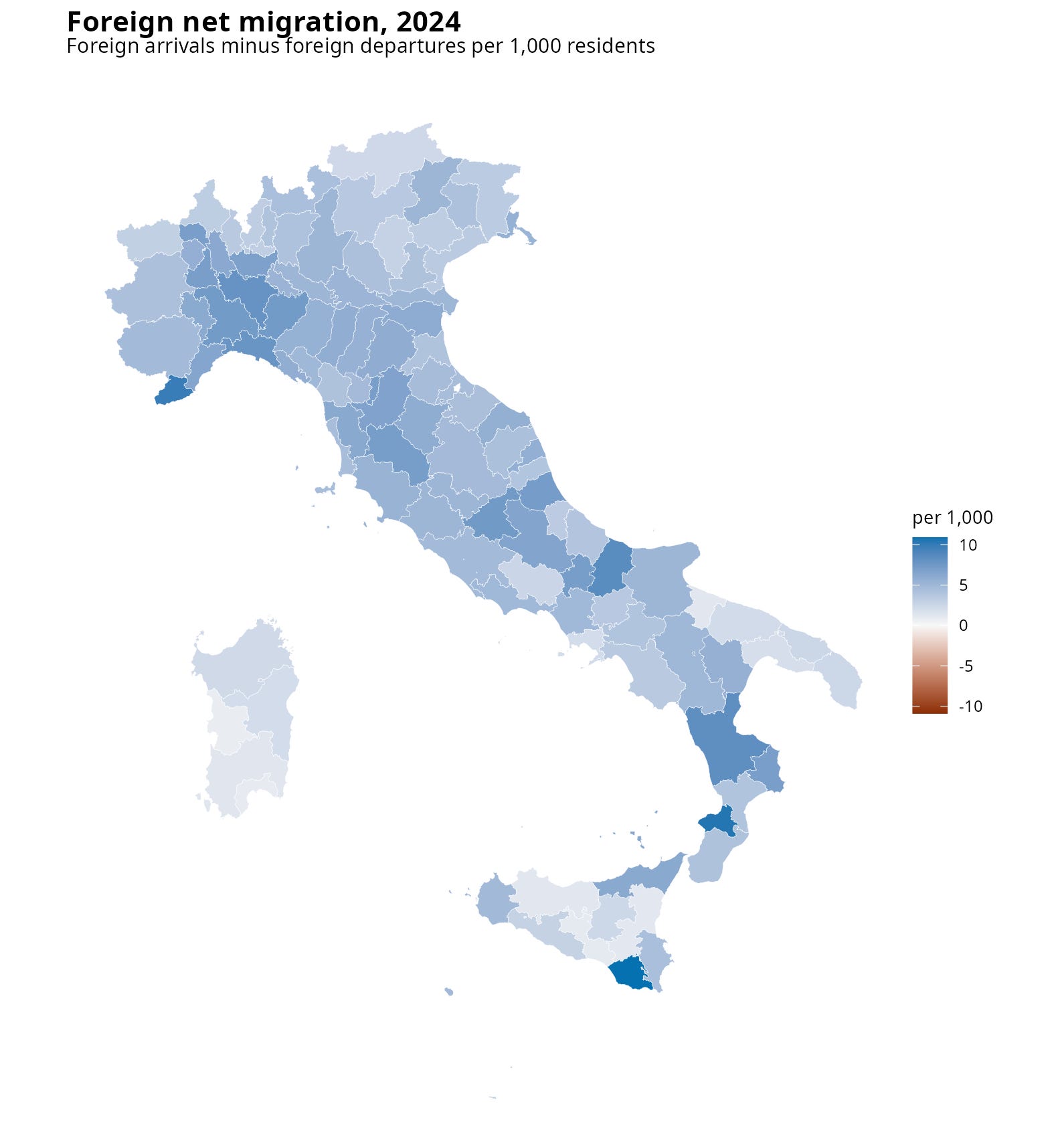
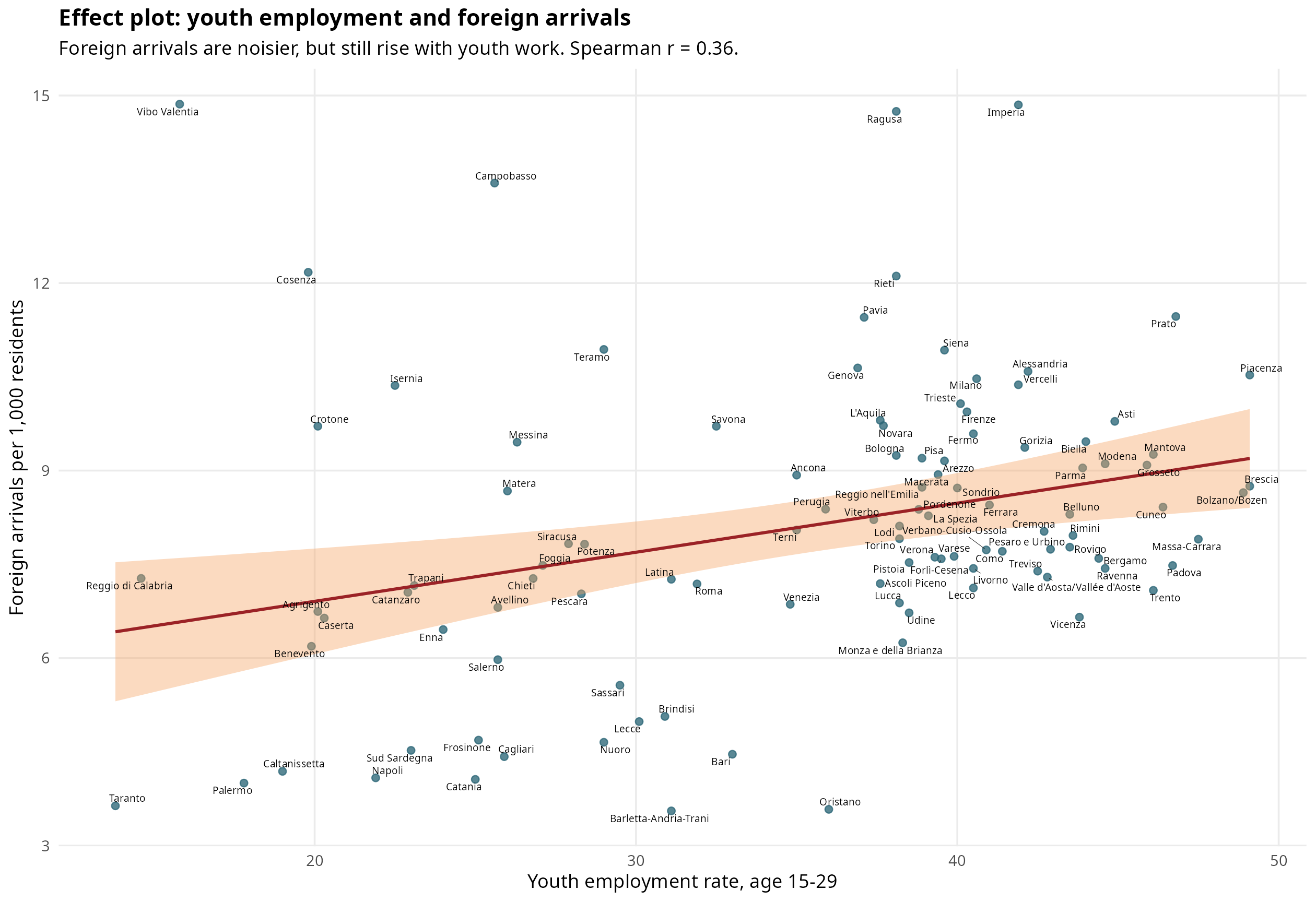
Figure 7. Youth employment and foreign arrivals.
Suddenly, as displayed in Figure 6, positive inflows light up in regions that are completely bypassed by Italian graduates. In 2024, provinces like Ragusa, Vibo Valentia, Imperia, Campobasso, Cosenza, Pavia, Genova, and Rieti saw major foreign net gains per resident.
Why the divergence? Statistically, the standard quality-of-life indicators explain very little here. While the scatter plot in Figure 7 shows that higher youth employment offers a moderate pull, international migration is dictated by entirely different forces: agricultural labor networks, local care economies, the hospitality industry, existing migrant communities, and transnational family ties.
A province can look structurally weak or unattractive to a young Italian professional, yet remain a vital landing pad for foreign workers responding to highly specific local labor shortages. When it comes to foreign departures, the statistical models find virtually no robust signal at all. Leaving Italy as an international resident has less to do with a province’s baseline economy and far more to do with transnational routes, family networks, and the specific passports individuals hold.
5. Leaving Italy Altogether
What about the over 103,000 young adults (aged 18-39) who left Italy entirely in 2024? (Crucially, 85% of them were Italian citizens ).
Figure 8. Young adult emigration abroad and youth labour-market distress. Province-level emigration is age 18-39; labour-market distress is the BES youth non-participation rate.
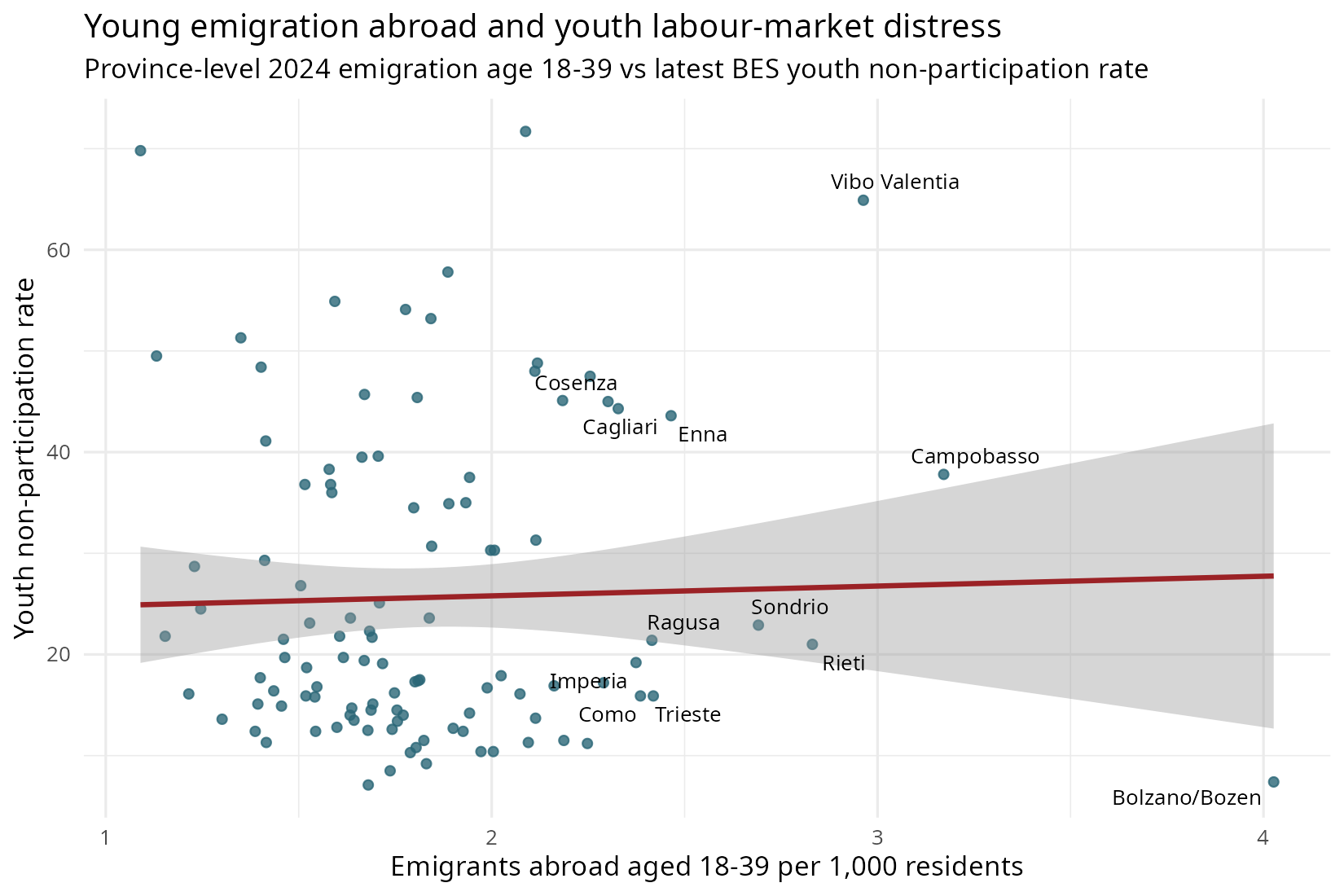
If you look at absolute numbers, they pour out of giant reservoirs like Milan, Rome, Turin, and Naples. But if you look at the rates per 1,000 residents featured in Figure 8, the highest young adult emigration is found in an incredibly diverse mix of provinces: Bolzano, Campobasso, Vibo Valentia, Rieti, and Sondrio.
This tells us that leaving Italy isn’t a single phenomenon. It’s a mix of three completely different dynamics:
Rich-border mobility: Highly productive alpine regions (like Bolzano) where popping over the border for work is a normal, integrated economic choice.
Southern exit: Young people fleeing structurally weak labor markets.
Metropolitan professional mobility: Corporate and academic high-flyers chasing global hubs.
Is leaving the country acting as a “safety valve” that at least lowers local youth unemployment? The scatter plot in Figure 8 gives an absolute answer: No.
The correlation between young adult emigration abroad and youth labor market distress is practically zero. As the data points show, rich Bolzano has massive youth emigration and a booming youth labor market; struggling Vibo Valentia and Enna have massive youth emigration alongside completely stalled youth labor markets.
The complete data breakdown, regression plots, and supplementary indicator maps (Employment Rate, Graduate Mobility, and Low Pension Income by province) are available below for paid subscribers. Upgrade your subscription to unlock the full model and support deep-dive, independent data journalism.
