

Why do so many of the world’s strongest men seem to come from the far north?
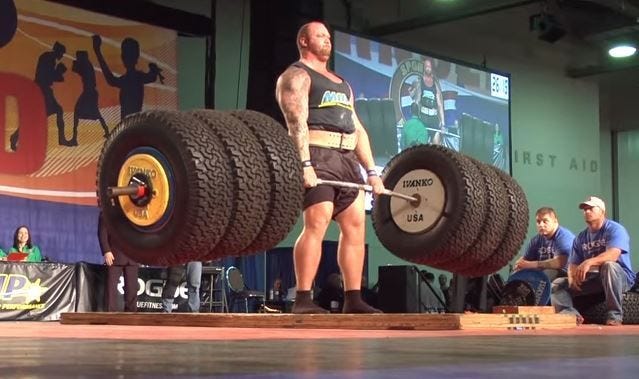
Iceland has a population smaller than many cities, yet it has produced a remarkable number of strongmen, and the Nordic region more broadly has a long record of overperforming in sports where raw strength matters. Hafþór Júlíus Björnsson is the most famous modern example.
Let’s start with the sport where the northern pattern is hardest to dismiss.
I combined four men’s strongman title sets: World’s Strongest Man, the Arnold Strongman Classic, the IFSA World Championship, and Europe’s Strongest Man. For each country, I summed historical gold, silver, and bronze finishes across those competitions, scored them 3, 2, and 1, and then divided by 2024 population to get per-capita rates. One caveat is obvious: because Europe’s Strongest Man is a continental event, this table is a little more favorable to European countries than a pure world-only measure would be.
Combined major strongman performance per capita
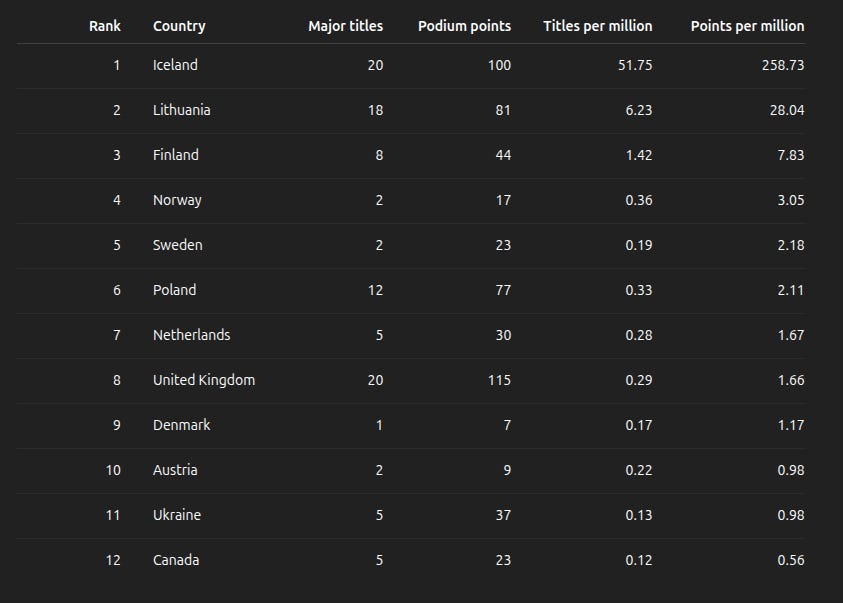
Iceland comes first by a huge margin. Lithuania is second. Then comes a Nordic cluster: Finland third, Norway fourth, Sweden fifth, and Denmark ninth.
Strongman is also the sport in which a muscle-related advantage should show up most clearly. There are no weight classes, and success depends heavily on absolute strength and body mass. At the same time, the Nordic countries have a strong cultural investment in this kind of competition, so genes are unlikely to be the whole explanation. Culture and training almost certainly play a role too.
The strongman numbers are strong enough that they demand an explanation. Culture is part of it. But culture is probably not all of it. A recent genetics study adds a new piece to the puzzle.
