

The air-conditioning culture war is funny until your bedroom is still an oven at midnight. Ancient data raises a darker question: what happens when a society is built for a cooler climate?
Every summer now feels as if someone has put the planet in a frying pan. Pavements radiate heat after sunset. Bedrooms stay hot long after midnight. The fan spends eight hours moving the same warm air from one side of the room to the other. By morning, the first question is not whether climate change is real. It is whether anybody managed to sleep.
Open social media during a European heatwave and the discomfort quickly becomes a culture war. Americans ask how a supposedly rich continent can still live without universal air conditioning. Europeans answer with shutters, thick walls, insulation, energy prices, environmental costs, and complaints about Americans refrigerating every room. Then come the “Europoor” memes: an argument about adaptation recast as a contest over which civilization is more competent.
During the record-breaking heat of June 2026, the joke became a real political dispute. Roughly one European household in five had air conditioning, compared with nine in ten in the United States. Commentators held up that gap as evidence that Europe was poor, overregulated, or simply too stubborn to adapt. The argument became loud enough that the European Commission was pressed to take a position on household AC—and declined (Liboreiro, 2026; Niranjan, 2026).
Beneath the insults is a serious question. What happens when the climate changes faster than buildings, infrastructure, habits, and institutions? Air conditioning is only the most visible symbol. The deeper issue is whether a society can reorganize quickly enough when the environmental assumptions on which it was built stop being true.
Ancient societies could not reach for a thermostat, import electricity across a continental grid, or redesign millions of homes with modern materials. Their responses to climate shifts came through migration, changing crops and settlement, political reorganization, conflict, or collapse. That makes the ancient record an imperfect but provocative place to ask whether sustained warming has accompanied movement toward simpler forms of social organization before.
The newest results from this ancient-DNA analysis make that question uncomfortable. Across three measures of temperature, and in two differently constructed samples, stronger warming over the previous millennium is associated with earlier archaeological categories. Every one of the six warming coefficients is negative and statistically significant.
So will global warming push modern civilization backward?
What was actually measured
The outcome is an ordered archaeological stage: Paleolithic, Mesolithic, Early or Middle Neolithic, Late Neolithic or Chalcolithic, Bronze Age, and Iron Age. These are broad period labels. They summarize packages of technology and archaeology, often differently across regions. They are not a universal scale of human worth, institutional quality, intelligence, or happiness.
The statistical model is ordered probit. A positive coefficient shifts the modeled distribution toward later categories; a negative coefficient shifts it toward earlier categories. The coefficient belongs to a latent statistical index. It is not a numeric civilization score. A coefficient of -0.40 does not mean that a society lost four-tenths of an age, and it does not translate into one common probability change for every stage.
Temperature change is defined just as carefully:
warming = current reconstructed temperature - temperature at the same place about 1,000 years earlier
EA PGS combines polygenic scores from two large genome-wide association studies of educational attainment (Lee et al., 2018; Okbay et al., 2022).
The split model assigns a positive warming magnitude to samples whose locations warmed and estimates that slope separately from cooling. It also controls for current temperature, sample date, DNA coverage, PC1-PC10, and EA PGS. The result therefore concerns the relationship between recent climate history and stage, not merely the difference between cold northern places and warm southern ones.
Two ways of counting the past
I tested the pattern in two complementary ways: first among 1,500 individuals whose periods could be linked directly to study supplements, and then across the full dataset after giving each of 2,500 archaeological groups one equal vote.
The first analysis offers better individual-level historical detail; the second prevents a handful of heavily sampled sites from dominating the result.
The result that invites the dramatic headline
Table 1 reports the coefficient for one additional degree Celsius of warming. Negative values point toward earlier archaeological categories on the ordered-probit index.
Table 1. Warming over the previous millennium and ordered archaeological stage
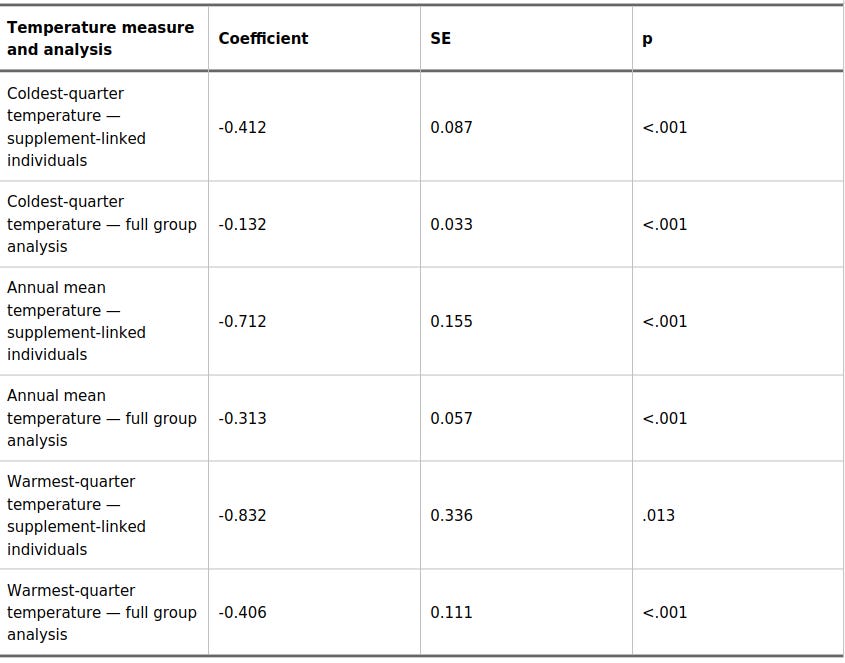
The pattern is remarkably consistent in sign. In the supplement-linked analysis, the warming coefficients range from -0.412 to -0.832. In the full group analysis, they are smaller, ranging from -0.132 to -0.406, but remain negative and statistically significant.
Figure 1. Ordered-probit warming coefficients with 95% intervals.
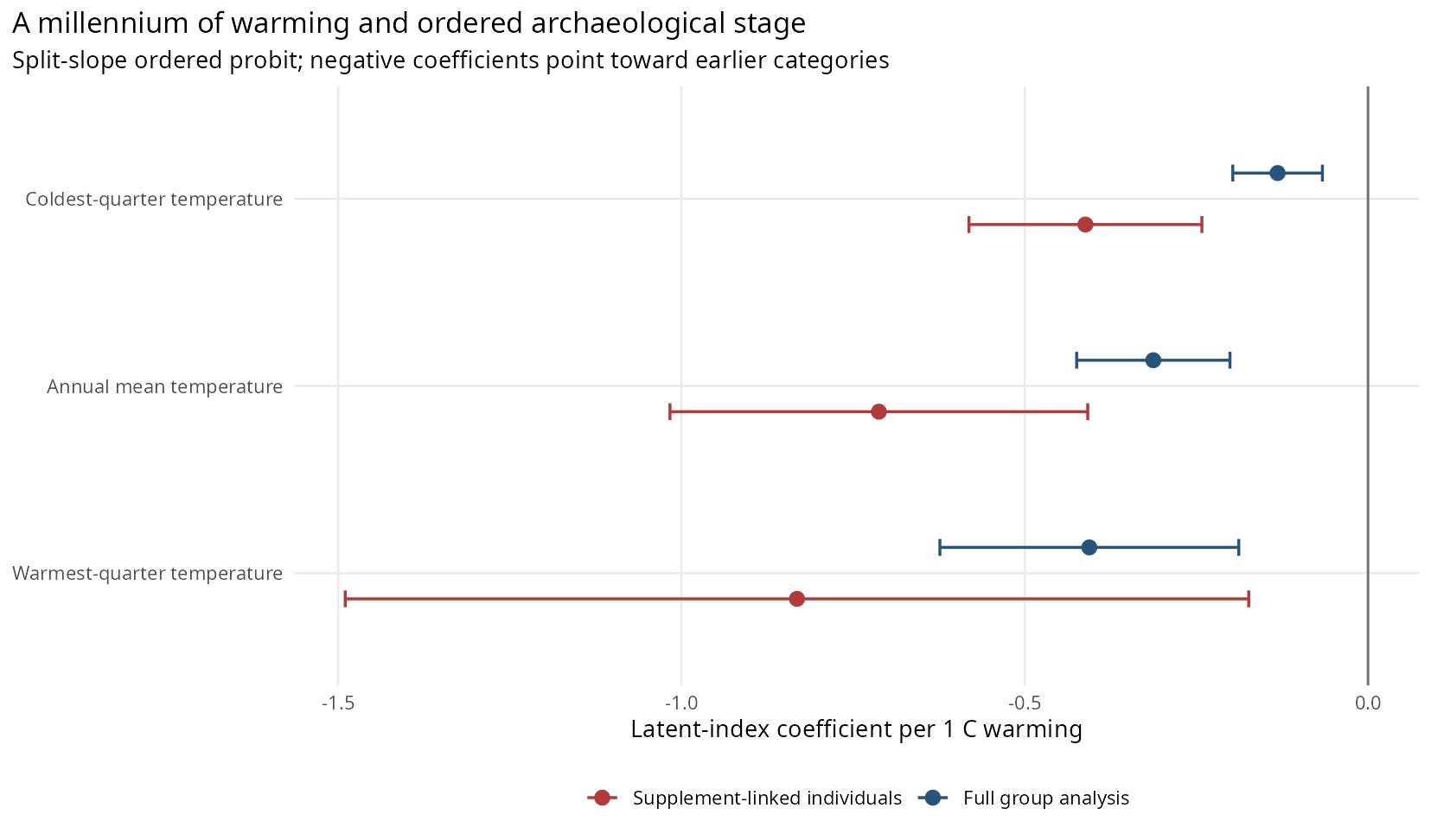
This replication across units matters. It means the warming association is not simply an artifact of counting 100 people from one archaeological group as 100 independent examples of civilization. Collapsing the data to one row per group weakens the coefficient, but it does not erase the pattern.
The mirror-image trap
In a previous post I had fitted one straight line through both warming and cooling. That model made cooling appear to predict later stages: the implied cooling coefficients were positive for every temperature measure in both samples. It was tempting to say that cooling favored civilization.
In the supplement-linked sample those implied cooling coefficients were 0.308, 0.526, and 0.398. In the full group analysis they were 0.088, 0.182, and 0.129.
But one line forces cooling and warming to be exact opposites. If warming lies on the earlier-stage side, the fitted line automatically places cooling on the later-stage side. Once the model estimates cooling and warming separately, no cooling coefficient is positive. The claim that cooling itself advanced civilization disappears. What survives is the negative warming association.
That is a useful lesson far beyond this dataset. Symmetry assumptions can turn evidence about one side of a relationship into an apparently strong claim about the other. Here the dramatic cooling story was less robust than it looked.
Does warming predict lower EA PGS?
To test whether climate change was associated with the EA PGS, the regression used EA PGS as the outcome and separate 1,000-year cooling and warming measures as the main predictors in 10,945 deduplicated individuals.
It adjusted for current temperature, sample age, DNA coverage, PC1-PC5, latitude, longitude, and persistent differences between locations; uncertainty was clustered by one-degree location.
The headline result is asymmetric: cooling is associated with higher EA PGS, whereas warming does not predict lower EA PGS.
Table 2. Cooling and warming over the previous millennium as predictors of EA PGS
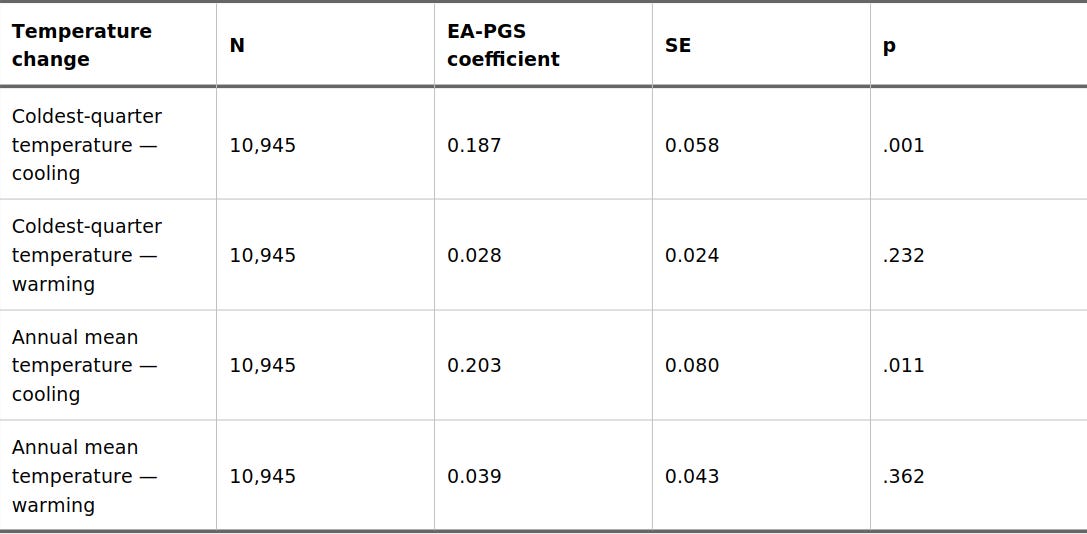
The coding matters. Cooling is entered as a positive magnitude, so a positive cooling coefficient means that one additional degree of cooling is associated with higher standardized EA PGS. A positive warming coefficient would mean that greater warming is associated with higher EA PGS.
For coldest-quarter temperature, one additional degree of cooling is associated with a 0.187-standard-deviation higher EA PGS (SE 0.058, p=.001). The warming coefficient is only 0.028 (SE 0.024, p=.232). For annual mean temperature, the cooling coefficient is 0.203 (SE 0.080, p=.011), while the warming coefficient is 0.039 (SE 0.043, p=.362).
Figure 2. Within-location split-slope coefficients with 95% intervals.
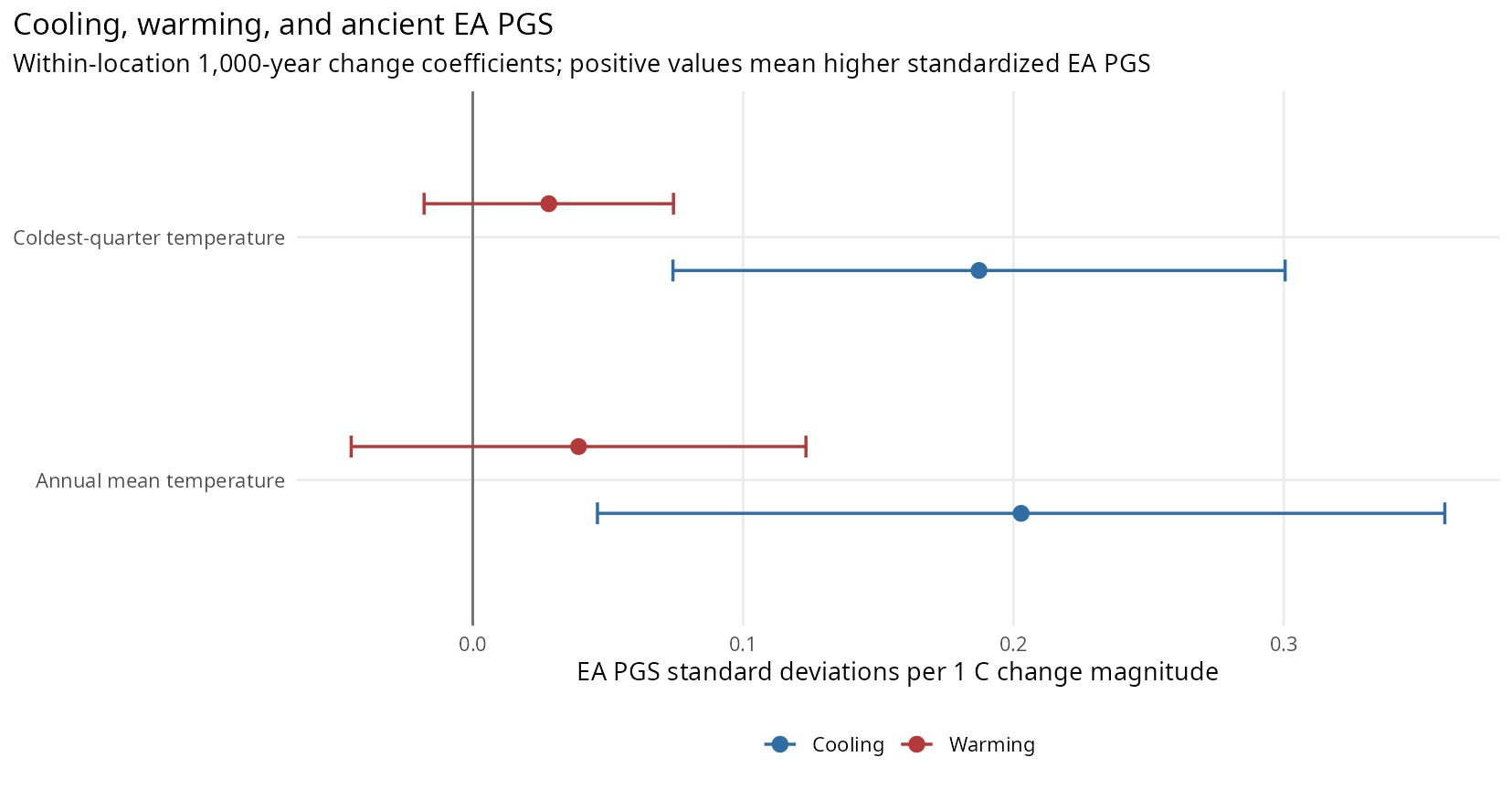
A single straight-line climate-change model misses this asymmetry: its within-location coefficients are -0.009 for coldest-quarter temperature (p=.587) and -0.017 for annual mean temperature (p=.553). Both are near zero. Once cooling and warming are allowed separate slopes, the association sits on the cooling side.
The result therefore does not show that warming lowered EA PGS. Both warming estimates are small, positive, and statistically non-significant. It does show that cooling intervals are associated with higher EA PGS in these split models. That could reflect selection, migration, population replacement, residual ancestry structure, or uneven sampling; it is not proof that cooling genetically improved a population.
This distinction matters for the civilization result. Warming predicts earlier archaeological stage in the ordered-probit models, but the separate climate-to-PGS models do not show warming predicting lower EA PGS. The proposed chain—warming lowers EA PGS, which then lowers civilization stage—is therefore not supported by these results.
What might the warming association represent?
One possibility is material stress. Long-run warming can alter water availability, growing seasons, crop suitability, pasture, disease ecology, wildfire, and the reliability of food storage. A community living near an ecological threshold may respond very differently from one with irrigation, trade access, or political institutions capable of redistributing risk.
Migration is another possibility. The people sampled after a warming interval need not descend from the people sampled before it. Climate can push populations out, pull others in, change trade routes, and reorganize settlement. Ancient DNA records population turnover as readily as it records local continuity.
PCs reduce ancestry confounding but cannot guarantee that every relevant historical process has been isolated.
Ancient vulnerability is not a modern forecast
Modern societies are not enlarged Bronze Age villages. Fossil energy, global trade, irrigation, crop breeding, refrigeration, medicine, insurance, air conditioning, and state capacity profoundly alter how temperature affects daily life. They also create new dependencies and systemic risks that have no direct ancient equivalent.
The ancient association therefore cannot be inserted into a climate model to predict when a modern country will regress.
What it does provide is a historical warning against complacency. Climate shifts can coincide with changes in settlement, population composition, subsistence, and archaeological organization. Complex societies are not automatically insulated from environmental stress.
So, will warming push civilization backward?
The ancient data answer a smaller question. In this sample, places that had warmed more over the previous millennium were associated with earlier archaeological categories, and that result survives both an individual-level provenance check and a one-row-per-group analysis.
That is interesting evidence. It is not a prophecy. It does not demonstrate that warming caused regression, that cooling created progress, or that warming lowered EA PGS. It tells us that warming and archaeological stage moved together in a repeated historical pattern—and that the next task is to discover whether the connection runs through ecology, migration, conflict, institutions, sampling, or some combination of them.
Methods
The reported climate models are PC1-PC10-adjusted ordered probits. The supplement-linked branch uses HC1 standard errors clustered by Group ID, while the broad branch gives each exact Group ID one unweighted observation. Current temperature, Years BP, coverage, and standardized EA PGS are included. ADMIXTURE results are not reported while replacement components are pending.
Sample-construction details
The analysis begins with a deduplicated AADR resource containing 17,525 biological individuals—one retained Genetic ID per exact Individual ID, selecting PASS-like records first and then the record with the highest Coverage_2M_hits.
The supplement-linked analysis uses 1,500 people from 514 AADR groups whose archaeological periods were matched by Genetic ID to downloaded study supplements. Individuals are the observations, with uncertainty clustered by Group ID.
The broad analysis starts from 10,946 eligible retained individuals and collapses them into 2,500 exact AADR Group IDs, with one equal vote per group. In the 76 groups whose fallback labels straddle stages, the assigned stage is the label nearest the group’s median date, with Genetic ID breaking an exact tie.
The separate climate-to-EA-PGS analysis uses OLS on 10,945 unique Genetic-ID observations. The outcome is standardized EA PGS. Temperature change equals current-window temperature minus reconstructed temperature 1,000 years earlier; warming is the positive part of that difference and cooling is the magnitude of its negative part. Current temperature and climate-change terms are decomposed into within-location and between-location components. Models adjust Years BP, coverage, PC1-PC5, latitude, and longitude, with HC1 standard errors clustered by rounded 1-degree location bin. No civilization-stage or ADMIXTURE variable enters this model.
References
Liboreiro, J. (2026, June 29). Neither pro nor con: EU declines to take stand on AC debate amid brutal heatwave. Euronews. https://www.euronews.com/my-europe/2026/06/29/neither-pro-nor-con-eu-declines-to-take-stand-on-ac-debate-amid-brutal-heatwave
Niranjan, A. (2026, July 5). From ‘heat panic’ to ‘sacrificed at the altar’: Europe’s air conditioning culture wars heat up. The Guardian. https://www.theguardian.com/environment/2026/jul/05/europe-air-conditioning-culture-wars-heat-up
Mallick, S., Micco, A., Mah, M., Ringbauer, H., Lazaridis, I., Olalde, I., Patterson, N. & Reich, D. (2024). The Allen Ancient DNA Resource (AADR) a curated compendium of ancient human genomes. Scientific Data, 11, 182. https://doi.org/10.1038/s41597-024-03031-7
Karger, D.N., Nobis, M.P., Normand, S., Graham, C.H. & Zimmermann, N.E. (2023). CHELSA-TraCE21k - high-resolution (1 km) downscaled transient temperature and precipitation data since the Last Glacial Maximum. Climate of the Past, 19, 439-456. https://doi.org/10.5194/cp-19-439-2023
Lee, J.J., Wedow, R., Okbay, A. et al. (2018). Gene discovery and polygenic prediction from a genome-wide association study of educational attainment in 1.1 million individuals. Nature Genetics, 50, 1112-1121. https://doi.org/10.1038/s41588-018-0147-3
Okbay, A., Wu, Y., Wang, N. et al. (2022). Polygenic prediction of educational attainment within and between families from genome-wide association analyses in 3 million individuals. Nature Genetics, 54, 437-449. https://doi.org/10.1038/s41588-022-01016-z
Great analysis, thanks.
As an aside: "By morning, the first question is not whether climate change is real."
Climate change is real and has been for millions of years. The unanswered question is what the cause(s) are.