
Are Northern Italians Really More Germanic? A Second Look

In my previous deep dive into whether Northern Italy can truly be called “Germanic,” I began with a persistent internet trope: the side-by-side comparison of the fair, Alpine Northerner and the olive-complexioned Southerner. While these memes are often historically crude and reductive, they linger because they touch on an intuitive truth.
Even commercial DNA services like NexoGENO lean into this, framing the North as a blend of Continental, Celtic, and Germanic influences, while the South is defined by Greek, Near Eastern, and Mediterranean roots, like in the picture below.
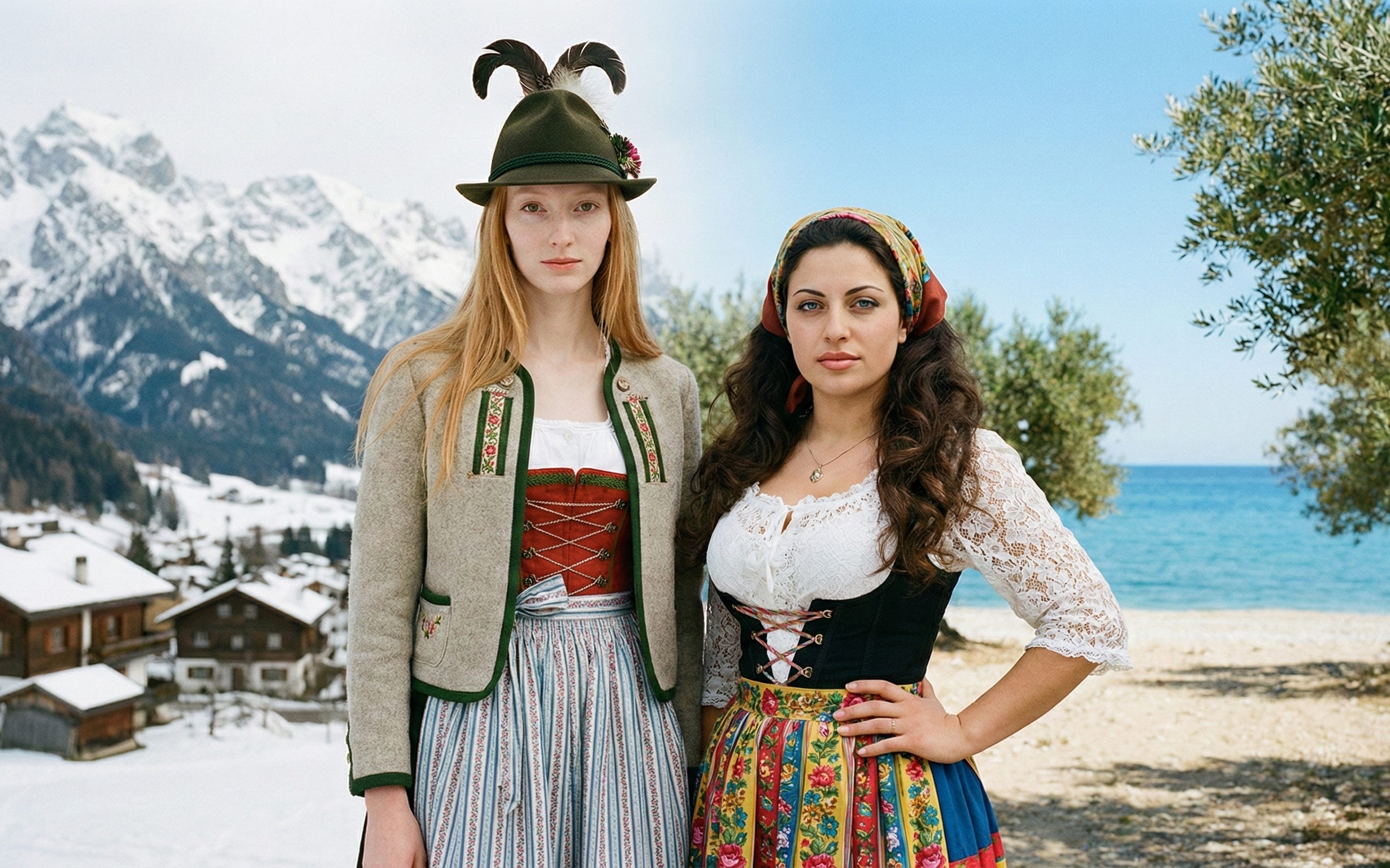
This is the same intuition in a more commercial form. Italy is presented as two visible types, one northern and one southern. The question is whether that visual shorthand corresponds to anything measurable in the genome, once we stop staring at faces and actually test allele sharing.
The Genetic Question
Once we move past the “Barbarian Invasion” myths—the Goths, Lombards, and Franks—we have to ask:
Did the North actually absorb measurable ancestry from these northern migrants?
Is that migration what creates the North-South divide, or is the “pull” of the Eastern Mediterranean on the South the more significant factor?
Moving Beyond Fragile Models
Previously, I used Genoplot and G25 models to test these theories. While they confirmed a general North-South shift, these models are notoriously prone to “overfitting.” By swapping a Danish Iron Age proxy for a Hungarian Lombard one, you can make the percentages jump around until they fit a specific narrative.
To get a more robust answer, I’ve shifted my methodology for this follow-up. Using AADR Human Origins data and formal statistics, I’ve moved away from arguing over whether a population is “12% or 25% Germanic” and started asking a more precise question:
Do Northern Italians share more genetic drift with Migration Period northern Europeans than Southerners do? Conversely, do Southern Italians share more drift with Greek, Levantine, and Anatolian populations?
The Reality
The short answer is yes.
The long answer? The direction of the shift is undeniable, but the actual genetic distance is relatively small. When you strip away the percentage models and look at the raw data (the PCA plots and the f4-statistics) the pattern remains. The North pulls toward the Vikings, Saxons, and Lombards; the South pulls toward Cyprus, Anatolia, and the Levant.
The history is messier than a meme, but the genetic gradient is very real.
