
Did Climate Cooling Select for Cognitive Abilities?
In my previous posts, I found that ancient climate cooling predicted higher height polygenic scores and more introverted, less neurotic personality profiles.
Educational attainment (EA) was the next obvious trait to examine.
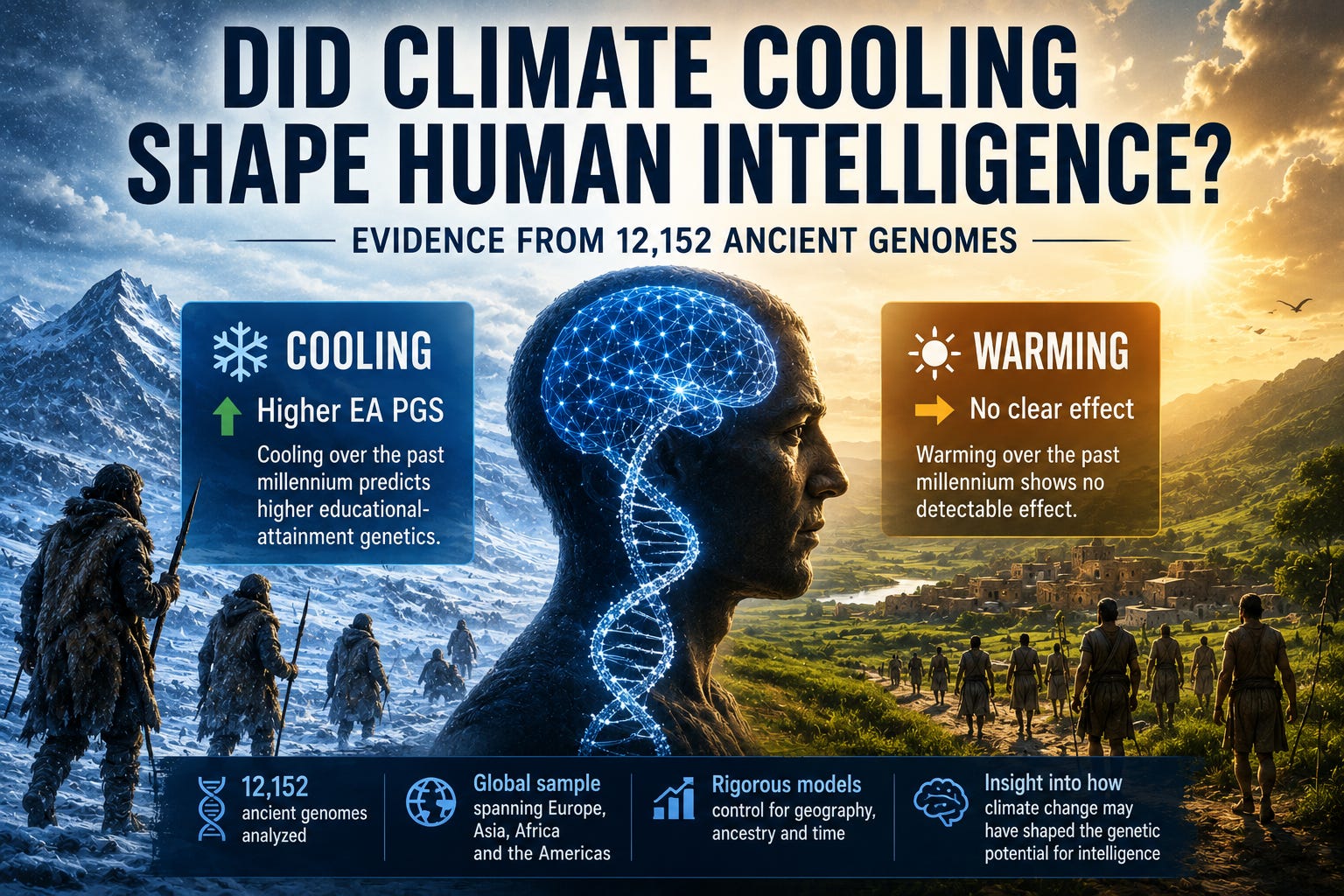
Ancient people did not attend universities, take standardized tests, or spend years in formal schooling. Yet the modern educational attainment polygenic score captures much more than education itself. It reflects thousands of genetic variants associated with cognition, persistence, long-term planning, and the ability to navigate complex social systems.
That raises an intriguing question:
When a region became colder than it had been a millennium earlier, did the genetic profile associated with educational attainment also change?
The answer depends on how the question is asked.
Using my primary climate-history model, the effect is essentially zero. But when cooling and warming are allowed to operate differently, a more interesting pattern appears: cooling predicts higher EA polygenic scores, while warming shows little evidence of producing the reverse effect.
Unlike height, where the signal is straightforward, EA turns out to be a more complicated and perhaps more revealing case.
I will not repeat the full methodological details here because they are identical to those used in the previous height and personality analyses. This post uses the same AADR sample, climate reconstructions, Mundlak within/between-location framework, ancestry controls, and robustness procedures described earlier.
The only thing that changes is the outcome variable: educational attainment polygenic score (EA PGS).
The first question is simple: if a location became colder or warmer than it had been a millennium earlier, did its EA polygenic scores change as well?
To test that, I added 1,000-year temperature change to the baseline model and asked whether it improved prediction.
Table 1. Linear 1,000-Year Temperature Change and EA PGS
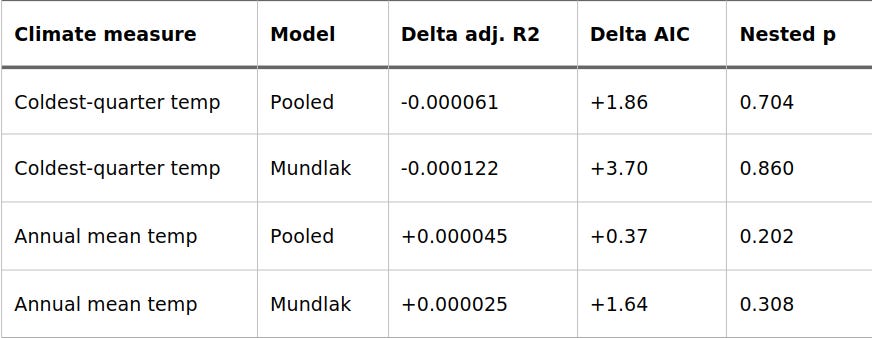
The result is straightforward: there is no detectable linear relationship.
Adding 1,000-year temperature change does not improve prediction of EA polygenic scores in either the pooled or Mundlak specifications.
If this were the only model examined, the conclusion would be simple:
There is no evidence that millennium-scale climate change influenced ancient EA polygenic scores.
Goodbye cold-winters theory!
The Split-Slope Diagnostic Changes the Picture
The problem with the linear model is that it assumes cooling and warming are mirror images of one another.
Nature does not necessarily behave that way.
To test this possibility, I replaced the single temperature-change term with separate cooling and warming variables:
Cooling = max(−Δ1000, 0)
Warming = max(Δ1000, 0)
This allows cooling and warming to have independent effects.