

Introduction
Here is a familiar refrain in ancient DNA discussions: “Polygenic scores from ancient genomes are too noisy to tell us anything about past phenotypes, especially when the GWAS they rely on are themselves noisy.”
I have become increasingly frustrated with this objection, not because the concern about noise is wrong in principle, but because it misses the real question.
The goal is not to predict an individual’s phenotype with clinical precision. The goal is to test whether polygenic scores, when applied to ancient genomes, recover robust, well-known population-level patterns. If they do, then the noise, in both the GWAS and the ancient data, clearly does not swamp the signal.
North–south clines are the ideal test case. In modern Europeans, skin pigmentation shows a strong and undisputed gradient: lighter in the north and darker in the south. This pattern appears consistently in anthropology, genetics, and even historical descriptions. If polygenic scores are meaningful when applied to ancient genomes, they should recover the same latitudinal gradient, even though ancient samples differ in ancestry composition, sequencing coverage, and preservation.
In
Part II: The Four Races of Europe

In Part I, I outlined the four deep ancestral lineages that formed the genetic foundation of modern Europeans:
I showed exactly this for height. Ancient height polygenic scores follow the expected north–south pattern, matching modern statistical averages, ecological principles such as Bergmann’s rule, and even long-standing stereotypes. That result already provided a compelling validation of ancient DNA polygenic scores for complex traits.
Here, I extend the approach to skin pigmentation. If pigmentation scores in ancient individuals also reproduce the north–south gradient, and then reveal a distinct acceleration toward lighter skin beginning in the Iron Age, this adds a second, independent line of evidence that ancient polygenic scores are capturing real evolutionary dynamics rather than random noise.
In other words, if polygenic scores can recover the traits where the answer is already known, we can trust them more when they illuminate traits where the answer is not yet known, including cognitive-ability proxies such as Educational Attainment and the long-term rise of complex traits across the Holocene.
Modern Populations as a Baseline for the Pigmentation PGS
Before turning to ancient genomes, it is essential to establish a clear baseline: does the Skin Pigmentation PGS behave sensibly in present-day populations where the true ranking is already known?
Before interpreting any of the results, it is important to explain how the polygenic score for skin pigmentation was built. The goal was to use a GWAS that is large, well powered, and explicitly multi-ancestry, so that the SNP weights are not biased toward a single continental group.
For this reason, I used the Pan-UK Biobank Skin Colour GWAS, which reports effect sizes for several ancestry groups as well as a meta-analysis effect size that combines them. This meta effect size is designed to capture signals shared across populations, which makes it a better choice for constructing a score that will be applied to both modern and ancient genomes from diverse backgrounds.
The plot below shows pigmentation scores for 86 modern populations across Europe, the Middle East, South Asia, East Asia, Oceania, and Africa. Each box represents the distribution of scores within a population, with individual genomes shown as black points.
Figure 1. Skin pigmentation polygenic scores across 86 modern populations.
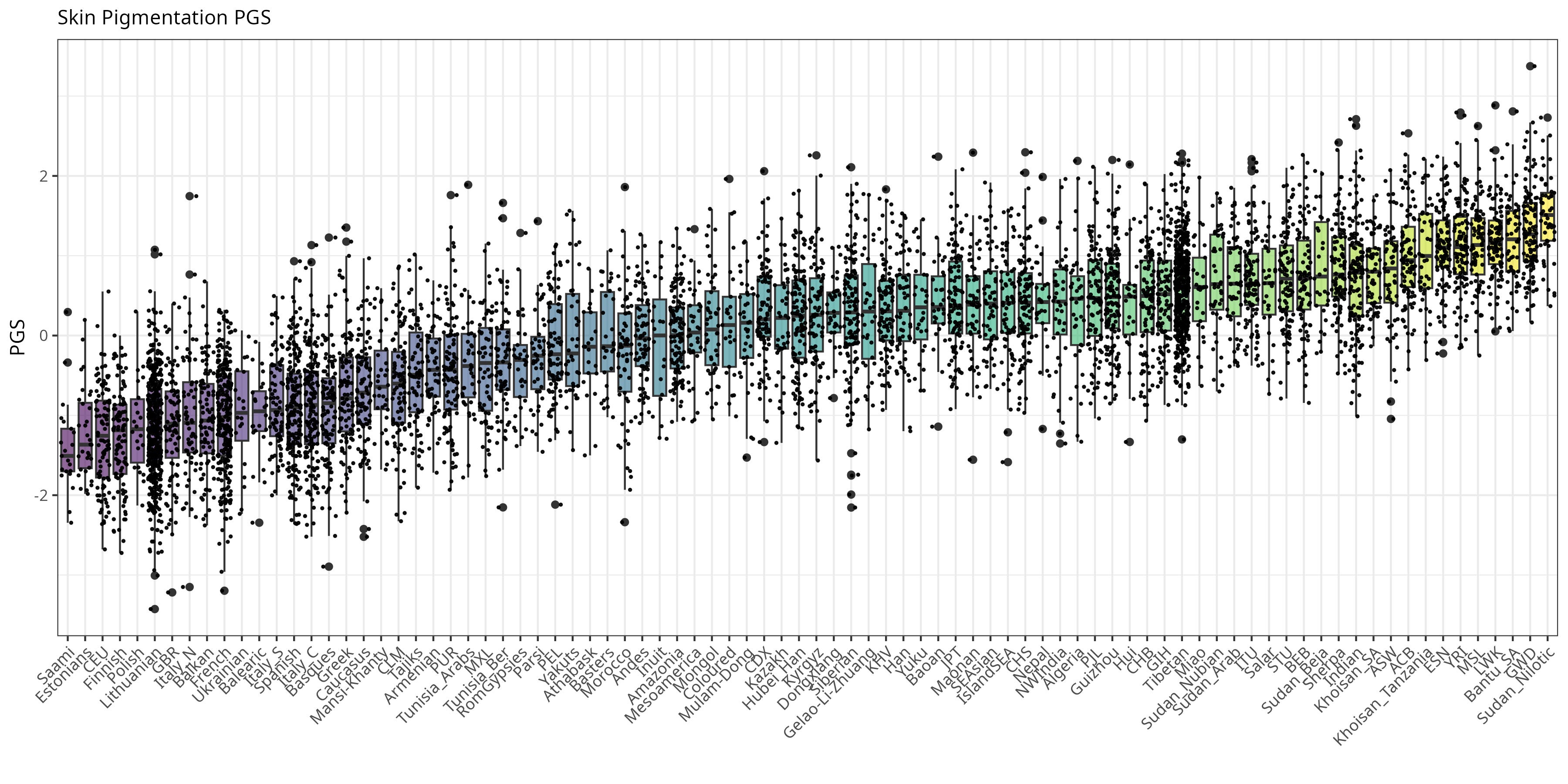
Northern Europeans such as Saami, Estonians, CEU (Utah Whites, US), Finnish, Polish, cluster at the very bottom of the distribution, with the lowest pigment scores.
Southern Europeans follow them, visibly darker on average but still well separated from non-European groups. Note how Northern Italians are visibly lighter than Central and Southern Italians (althogh the rank order of these two is oddly swapped).
Middle Eastern and North African populations fall in an intermediate range, higher than southern Europeans but lower than sub-Saharan Africans.
South Asians span a broad middle band, reflecting their well-known internal diversity in pigmentation.
East Asians1 sit lower than South Asians but well above Europeans, matching the biology: their lighter skin evolved largely through different genetic pathways from Europeans.
Sub-Saharan Africans, as expected, occupy the highest end of the score distribution.
In short, the PGS recovers the correct global ordering, including fine-grained distinctions such as the north–south European gradient. This provides a crucial validation step. If the score can reproduce widely accepted patterns in living populations, then it becomes meaningful to apply the same score to ancient genomes and interpret their trajectories over time.
This modern benchmark is the foundation on which the ancient analyses rest. Once we know the score behaves sensibly today even across groups that are genetically very distant, we can investigate how these pigmentation-associated alleles rose, fell, and accelerated through the major demographic transitions of European prehistory.
Next, I follow skin pigmentation scores from Mesolithic hunter-gatherers to Medieval towns, quantify the Iron Age surge in selection for lighter skin, and fit ancestry-adjusted models that tease apart farmer, hunter-gatherer, Steppe and latitude effects. Were Vikings truly “modern Nordic” in their pigmentation? Where do Celts, Etruscans and Romans sit on the scale between Levantine farmers and present-day Europeans? Become a paid subscriber to see the full time series, culture-level plots, and regression results.
