Ancient Italy through time
Source identity update. This explorer retains the earlier projected records. Five additional aliases have since been joined; the phase analysis and adjusted trends use the reconciled people.
How to read these values — Probabilities measure model support for four ancient reference classes. They are not ancestry percentages. The Italian comparator pools central Italian Etruscan, Picene and Latial Iron Age or Republican people. The Baltic comparator is not a Slavic reference.
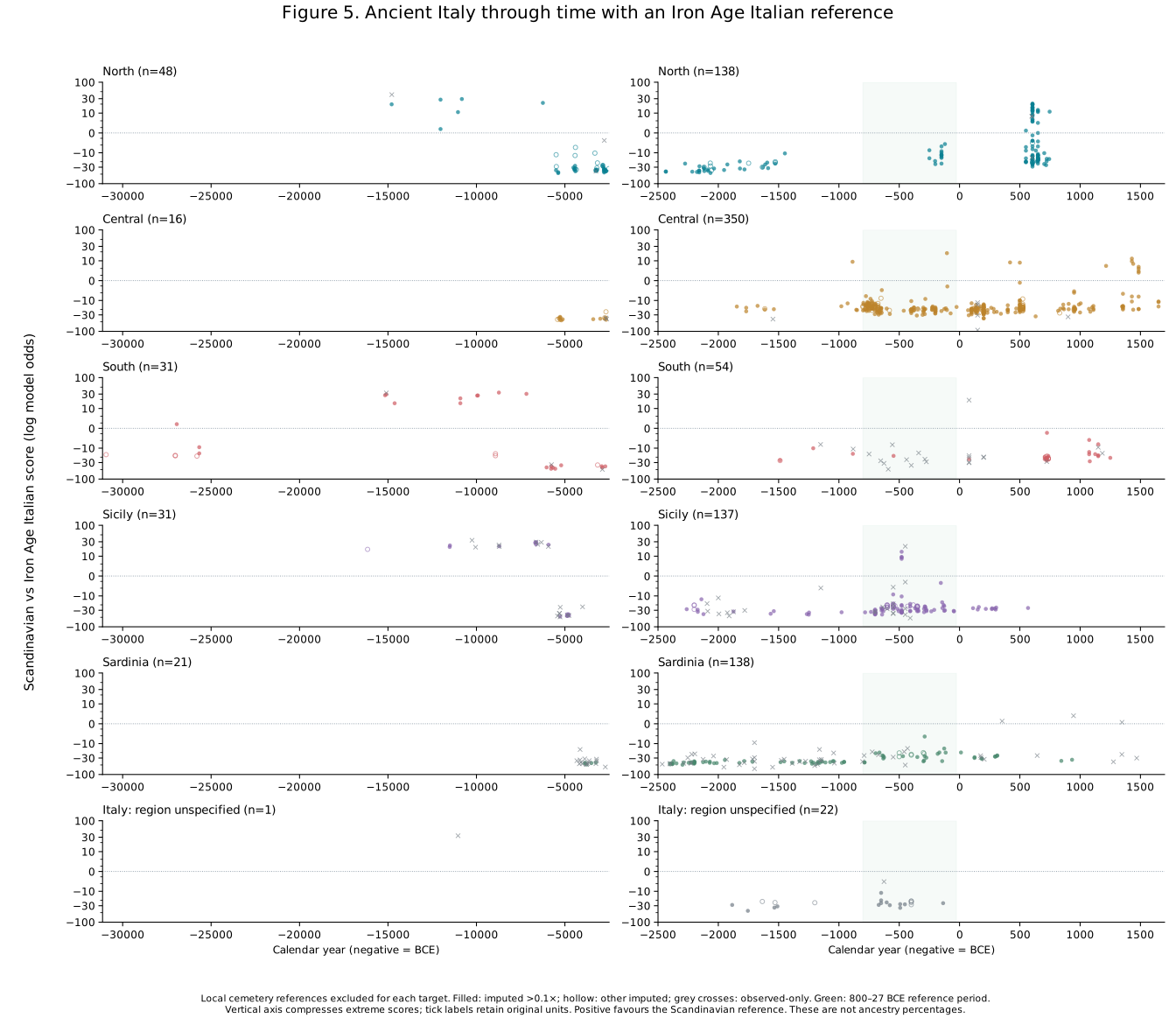
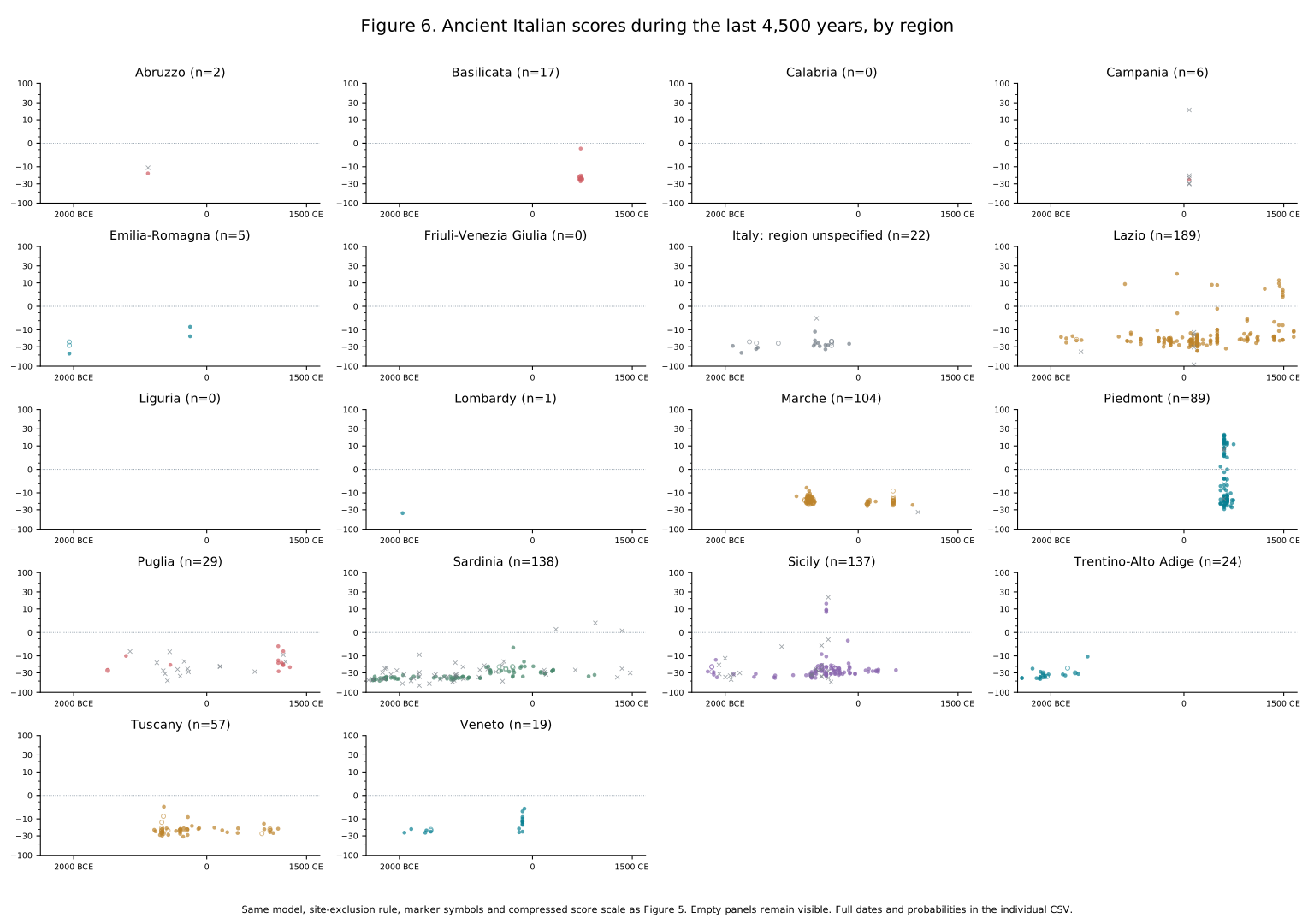
The revised four-reference model adds an Etruscan-, Picene- and Latial-associated Iron Age Italian background. Figure 5 shows individual scores through time; Figure 6 provides the regional SVG overview. Table 5 counts reference probabilities above 0.5 in the selected samples.
1005 people are scored; 987 have dates and 18 remain in the individual CSV without a time-axis position. Two author-confirmed Picene duplicates are counted once. Two previously undated Roca Vecchia genomes now use the published archaeological-context interval, not direct dates measured on those people.
Marker quality: filled circles are imputed genomes with documented coverage above 0.1×; hollow circles are other imputed genomes; crosses are observed-only records. Hover for coverage, usable markers, source, all four probabilities and the number of local reference genomes excluded for that site. Every Italian training individual is scored without its own local site contributing to the reference.
Table 5. Reference-class probabilities above 0.5, by period
Table 5 uses the current filters and local-reference specification. Counts describe sampled individuals, not population ancestry fractions. Some people have no class probability above 0.5.
| Period | N | Scandinavian >0.5 | Western/central >0.5 | Italian >0.5 | Baltic >0.5 |
|---|
Methods, source corrections and undated records
The first ten PCs and the original PCA axes are preserved. The four-class model uses equal priors and shrinkage linear discriminant analysis. The Italian background pools 72 Etruscan-associated, 68 Picene-associated and 9 Latial genomes. Local cemetery/spatial blocks are removed before scoring each ancient target, including in every site/study refit. Ranges show reference sensitivity, not confidence intervals. The score CSV also provides the full-fit probabilities as an explicit diagnostic.
The earlier target-marker validation tested the original three-class classifier. The new Italian contrasts have native-marker reference holdouts rather than exhaustive probability calibration on every ancient target's marker set. Sparse observed data and low-coverage imputation can produce extreme projections. Chronological variation is descriptive: different periods contain different sites and relatives. Prehistoric scores cannot establish the presence of Germanic, Celtic or Italic languages. The northern Roman-period sampling gap remains.
Roca Vecchia's contextual interval is 3545–3331 cal BP (95% interval), represented by its midpoint 3438 BP. No direct human date is claimed. Fifteen Lavazza/Bardonecchia records use the source's archaeological-century intervals (5th–7th and 6th–8th centuries CE), with midpoints plotted. Alpine sources explicitly report no calibrated date or insufficient collagen for seven remaining records; ten Broion/La Sassa records lack an exact author-linked direct date, and one Vado all'Arancio burial has unresolved chronology. All retain scores in the CSV.
Data: individual scores and probabilities · Table 5 and conditional site-bootstrap summaries · undated-source audit · Figure 5 SVG · Figure 6 SVG